
Crawl Space Insulation — Complete Guide
Crawl space insulation sounds simple until you live in Charleston, where year-round coastal humidity punishes the wrong material choices. This guide walks you through the main insulation options for Lowcountry crawl spaces, including closed cell spray foam and foam board, and explains which ones actually hold up under a raised pier-and-beam home near the water. You will also learn why so many DIY attempts fail within a few seasons, and what separates a job that lasts from one that sags, molds, and falls to the dirt. If your floors feel cold in winter, clammy in summer, or you can smell your crawl space from the living room, start here before you buy a single roll or board.
What You'll Find in This Guide
Prefer to have a pro handle it? Crawl space insulation is one call away.
Why Crawl Space Insulation Fails Differently in Charleston
Most insulation advice online comes from colder, drier climates where the main job is holding heat in. Here in the Lowcountry, the bigger enemy is moisture, which changes everything about what works under your home.
According to JSE Labs, about 15% of American homes sit on a crawl space foundation. In Charleston, this share runs much higher, especially among older peninsula homes built on piers with vented crawl spaces. These vents were meant to dry the space but instead pull in humid outside air year-round. That air hits cooler surfaces under your floor, condenses, and soaks whatever insulation you installed.
This is why traditional fiberglass batts—the default choice nationwide—have a poor track record here. Fiberglass absorbs moisture like a sponge and loses most of its insulating value when wet. It grows heavy, pulls away from the subfloor, and often hangs down or lies in the dirt under older Charleston homes. Worse, damp fiberglass pressed against wood framing traps moisture where mold and rot do the most damage.
More than 60% of U.S. homes have experienced water or moisture problems in their basement or crawl space, according to the American Society of Home Inspectors. Charleston's conditions push that risk higher. NOAA Tides and Currents recorded 17 high-tide flood days in Charleston during the 2023-24 meteorological year—a record for the area. On flood-zone and tidal lots, ground moisture can stay elevated for weeks after a storm.
The first question is not "which insulation is cheapest" but "which insulation can survive this environment." Material choice, placement, and moisture control must work together. For unfamiliar terminology, the plain-English crawl space insulation glossary covers every term you're likely to encounter.
Comparing Your Options: Spray Foam, Foam Board, and Fiberglass
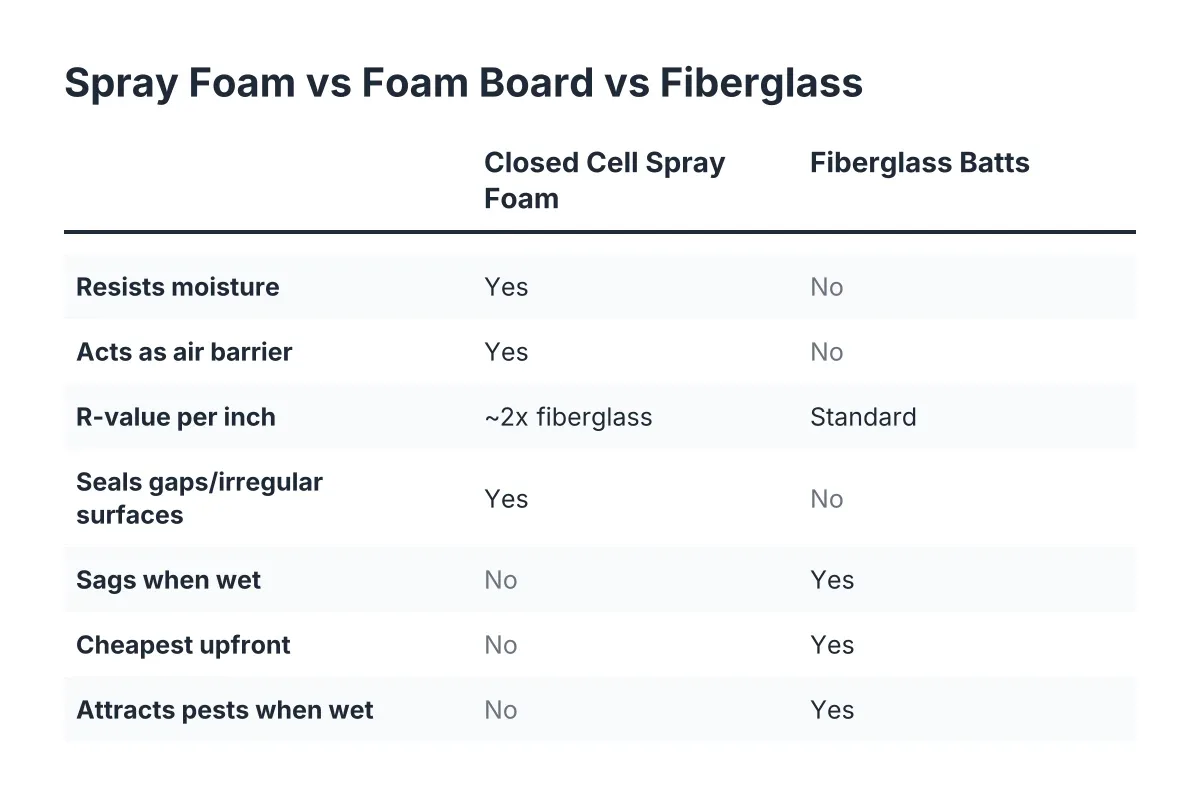
Three materials dominate the conversation around crawl space insulation: closed cell spray foam, rigid foam board, and fiberglass batts. Each behaves very differently once the humidity rises.
Closed Cell Spray Foam
Closed cell spray foam is the material most Lowcountry specialists reach for, and the reasons are practical rather than trendy. It resists water instead of absorbing it. It adheres directly to the surface it covers, so it cannot sag or fall out of place over time. Additionally, it acts as its own air barrier and vapor retarder, sealing the small gaps and penetrations that let humid air leak into your home. Applied to crawl space walls as part of an encapsulation approach, it turns the crawl space into a conditioned buffer zone instead of a swamp under your floor. The tradeoff is that it requires professional equipment and trained application. It is not a weekend project.
Rigid Foam Board
Foam board occupies the middle ground. It resists moisture far better than fiberglass, and homeowners can cut and install it themselves. However, performance depends entirely on the installation. Every seam, edge, and penetration must be sealed, because any gap lets humid air slip behind the board and condense against the wall. On the irregular brick piers and uneven masonry common in older Charleston homes, achieving a continuous air seal with flat boards is genuinely difficult. That gap between "installed" and "sealed" is where most foam board projects quietly fail.
Fiberglass Batts
Fiberglass remains the cheapest option on the shelf, and that is roughly where its advantages end in this climate. Between floor joists in a vented, humid crawl space, batts absorb moisture, sag, and feed mold growth. For reference, the U.S. Department of Energy's guidance on insulation explains how R-value measures resistance to heat flow, but R-value on the package only matters if the material stays dry. A soaked R-19 batt performs nowhere near its rating.
To put it simply, the ranking for Charleston conditions runs spray foam first, carefully sealed foam board second, and fiberglass a distant third.
DIY Crawl Space Insulation: What Works, What Backfires
Plenty of homeowners search for DIY crawl space insulation or even "how to insulate a crawl space for free" before calling anyone. That instinct makes sense. The space is accessible, the materials are at every home improvement store, and the job looks straightforward from the hatch. Before you crawl under there, though, it helps to know where DIY efforts tend to succeed and where they consistently go wrong.
What You Can Reasonably Do Yourself
Some preparation work is well within reach. You can clear debris, check that vents and the access door close properly, and seal obvious air leaks around pipe and wire penetrations with canned foam. Beyond that, air sealing the rim joist area with small cut pieces of foam board and sealant is a manageable project for a patient homeowner. These steps cost little and reduce the humid air flowing into the space, which helps whatever insulation comes later.
As for insulating "for free," the honest answer is that free materials rarely exist, but low-cost air sealing delivers much of the comfort improvement people are actually chasing. Cold floors in winter often trace back to air leaks, not just missing insulation.
Where DIY Projects Go Wrong
The failures follow a pattern. First, homeowners insulate without addressing moisture, so the new material becomes a mold host within a year or two. Second, foam board gets installed with unsealed seams, which lets humid air condense behind it against the foundation wall. Third, people insulate the floor of a vented crawl space when the walls of a sealed crawl space would serve a coastal home far better. Each mistake stems from applying cold-climate instructions to a hot, humid, high-water-table environment.
That said, the biggest risk is not wasted money on materials. It is covering up a moisture or structural problem. Insulation installed over damp framing hides early rot and makes it harder to spot a sagging beam or failing pier. For example, a Sagging-Floor Worrier who batts over a compromised joist has postponed the real repair and made it more expensive. Before any insulation project, DIY or professional, the space needs a clear-eyed look at moisture, drainage, and structure. The crawl space insulation glossary can help you understand what an inspector or installer means when they flag those issues.
What Actually Drives the Cost of a Professional Job
Nobody can quote your crawl space from a web page, and you should be skeptical of anyone who tries. However, you can understand what moves the number up or down, which makes every quote you receive easier to evaluate.
The Condition of the Space Comes First
The biggest cost driver is rarely the insulation itself. It is what has to happen before insulation makes sense. A dry, clean, structurally sound crawl space needs far less preparation than one with standing water, hanging debris, mold growth on the framing, or a torn vapor barrier. Consequently, two identical houses on the same street can receive very different quotes based on what is happening under the floor. Moisture remediation, mold treatment, drainage work, and structural repairs all precede insulation in a properly sequenced project, and each adds scope.
Size, Access, and Material Choice
Beyond condition, three factors shape the price. Square footage and wall height determine how much material the job requires. Access matters too, because a crawl space with eighteen inches of clearance takes longer to work in than one with three feet. Finally, the material and approach you choose set the baseline. Closed cell spray foam costs more per square foot than foam board, but it combines insulation, air sealing, and vapor control in one application. Foam board may look cheaper on paper while requiring more labor to seal correctly, especially around the irregular piers and uneven foundations typical of historic Charleston homes.
Questions Worth Asking Any Installer
When you compare quotes, ask each contractor the same things. Ask whether they are licensed and insured, and get any warranty terms in writing. Ask how they will address existing moisture before insulating, because insulation over a wet crawl space fails regardless of the material. Additionally, ask whether the quote covers wall insulation with encapsulation or floor insulation in a vented space, since those are different strategies with different outcomes in this climate. A quote that itemizes preparation, moisture control, and insulation separately tells you far more than a single lump figure.
Ready to Get Started?
Low Country Crawl Space Repair handles crawl space insulation, encapsulation, moisture control, and related repairs for homeowners in Charleston and its surrounding communities. If your floors feel cold, your crawl space smells musty, or old fiberglass is hanging from the joists, we can inspect the space and walk you through options that fit a Lowcountry home. Call or send a request to set up a crawl space inspection.