Crawl Space Dehumidifier Sizing: Pints, CFM, and Runtime for Charleston Homes
If you just found standing water under your house after a storm, the first thing to know is this: a crawl space dehumidifier is a humidity tool, not a water removal tool. It cannot pump out a flooded crawl space, and it cannot stop water from coming back after the next heavy rain. What it can do, once the water problem is handled, is hold the air under your house at a safe humidity level so mold and musty smells do not take hold.
That distinction matters because dehumidifiers are often sold as the fix when they are only part of the fix. This guide walks through how sizing actually works, in pints per day, airflow (CFM), and runtime, so you can tell whether one unit is enough, whether you need drainage first, and how to avoid paying for equipment your crawl space does not need. Charleston homes deal with more moisture than most; the city set a record of 17 high-tide flood days during the 2023-24 meteorological year, according to NOAA Tides and Currents. Sizing for our climate is not the same as sizing for a dry inland market.
1. How to Size a Crawl Space Dehumidifier: Square Footage and Humidity
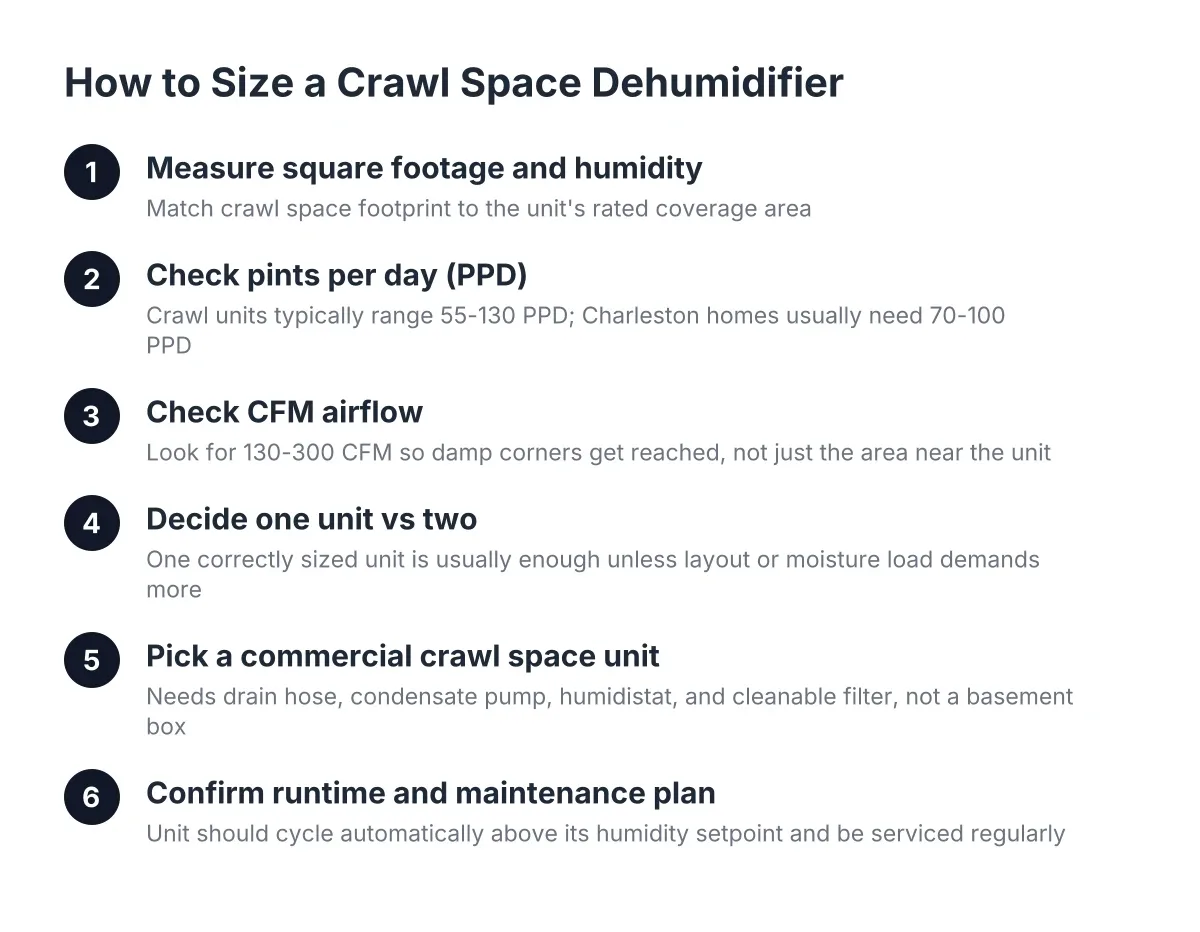
Sizing a crawl space dehumidifier starts with the footprint of the space, measured in square feet, matched against the unit's rated coverage area. Most units on the market list a coverage range, often 1,500 to 3,000 square feet, alongside a pints-per-day removal rating.
However, those coverage numbers assume moderate conditions. A vented crawl space two blocks from a tidal creek in Charleston is not a moderate condition. Coastal humidity, a high water table, and hurricane-season moisture cycles all push the real load higher than the label suggests. As a practical rule, treat the manufacturer's coverage number as a ceiling, not a target, and size to the lower half of the unit's rated range when the home sits in a flood-prone or low-lying lot.
2. Understand what pints per day actually measures
Pints per day (PPD) is the volume of water a dehumidifier can pull from the air in 24 hours under test conditions. For crawl spaces, units commonly range from about 55 to 130 PPD. A typical Charleston crawl space of 1,200 to 2,000 square feet usually lands in the 70 to 100 PPD range once you account for our humidity.
Be careful with the fine print, though. Manufacturers rate PPD at different test temperatures and humidity levels, so two units with the same number are not always equal. A rating taken at saturation conditions looks bigger than one taken at the newer standard test conditions. When comparing dehumidifier reviews or spec sheets for crawl spaces, check that you are comparing ratings taken under the same test standard.
3. Do not ignore CFM, the number most homeowners skip
CFM, or cubic feet per minute, measures how much air the unit moves through itself. Pints per day tells you how much water the machine can remove; CFM tells you whether it can reach the damp air in the far corners of the crawl space at all. A high-PPD unit with weak airflow dries a circle around itself and leaves the perimeter damp.
For most crawl spaces, look for a unit in the 130 to 300 CFM range, sized to the length and layout of the space. Long, narrow crawl spaces under older Charleston pier-and-beam homes often benefit more from better airflow and placement than from a bigger compressor. In some layouts, a single well-placed unit paired with a small circulation fan covers the space better than two dehumidifiers would, and at a lower purchase and energy cost.
4. One unit is usually enough, and here is when it is not
A single, correctly sized unit handles most homes. The idea that a larger crawl space automatically needs two units is a common oversell; controlled airflow can carry dry air to the far end of the space for a fraction of the cost of a second machine. If a quote includes multiple dehumidifiers, ask specifically why airflow alone will not do the job.
That said, two units are justified in specific cases: an unusually large footprint, a crawl space chopped into separate sections by foundation walls the air cannot cross, or a severe moisture load from a high water table that one unit cannot keep up with. The honest answer depends on layout and severity, not just square footage.
5. Choose a commercial crawl space unit, not a basement box from the store shelf
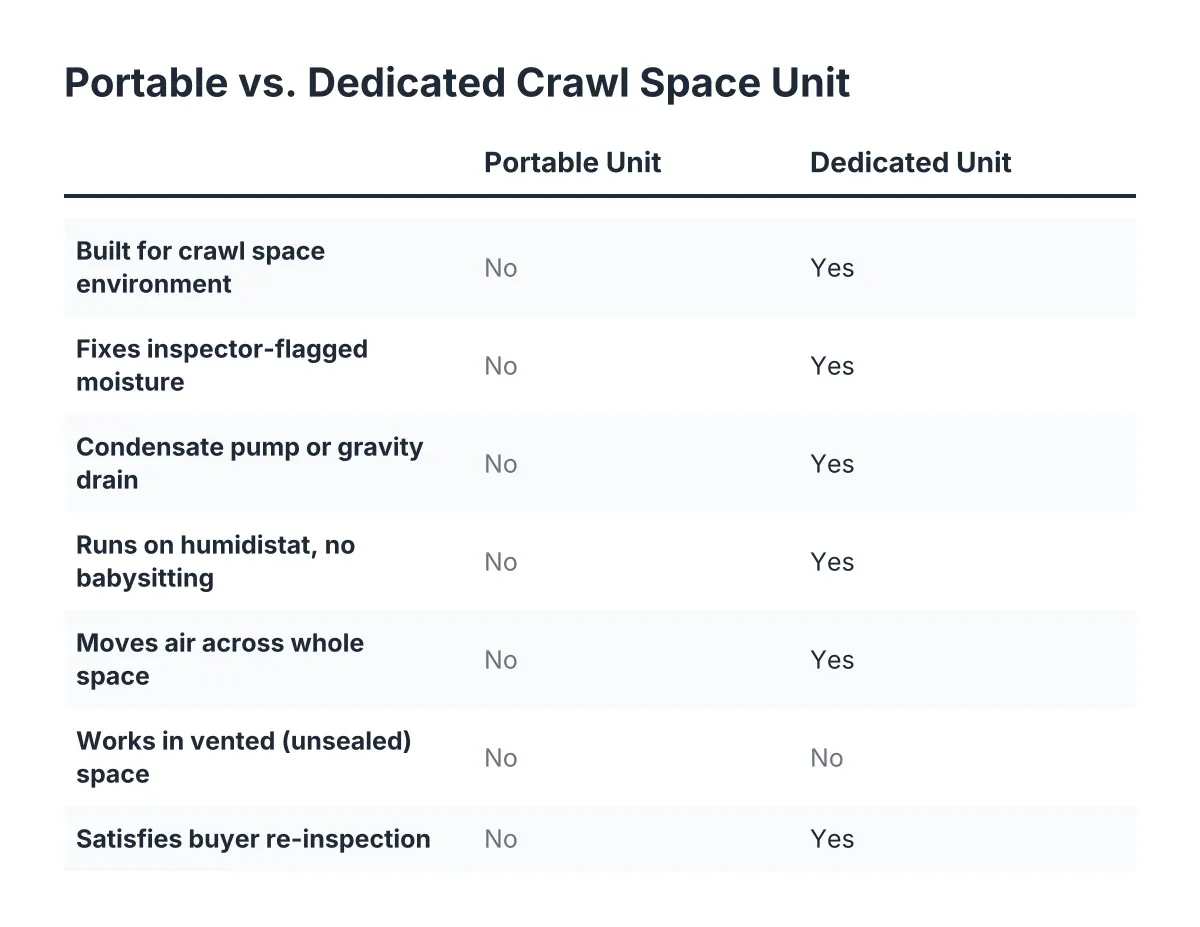
The portable dehumidifiers sold for basements and bedrooms are not built for the conditions under a Charleston house. A crawl space unit is a commercial-grade machine designed for a harsh environment: low clearance, dust, temperature swings, and continuous runtime. Standard residential units fail early in that setting, and most also lack the drainage setup a crawl space demands.
Here is what separates a true crawl space unit from a portable one:
- Ducted or low-profile housing built to sit on or hang above the vapor barrier
- Continuous drain hose connection instead of a collection bucket you would have to crawl under the house to empty
- An integrated condensate pump, or compatibility with one, since the crawl space is usually the lowest point of the house and gravity drainage rarely works
- A removable, cleanable air filter you can slide out during maintenance visits
- A built-in humidistat that cycles the unit automatically to a set humidity level
A crawl space unit with a pump and drain hose can run for months without attention, pushing collected water out to a drain line or sump basin. That is the difference between a system and a moisture absorber you babysit.
6. How often a dehumidifier in the crawl space should run
A crawl space dehumidifier should run whenever relative humidity in the crawl space rises above its setpoint, which in the Lowcountry means frequent cycling from spring through fall. Set the humidistat between 50 and 55 percent relative humidity and let the unit control itself. You do not turn it on and off manually; the machine cycles as conditions demand.
Expect heavy runtime from May through October and lighter cycling in winter. Rather than watching the unit, watch the number: a cheap hygrometer, or a remote humidity sensor, tells you whether the system is holding its setpoint. Sustained readings above 60 percent mean the unit is undersized, the space is leaking humid outside air, or liquid water is getting in. In addition, a drier crawl space helps the rooms above it, since the stack effect pulls crawl space air up into the living space.
7. Energy cost is a sizing question, not just a utility bill question
The cost to run a crawl space dehumidifier depends heavily on whether it is sized and sealed correctly. An undersized unit in a vented, unsealed crawl space runs nonstop against an endless supply of humid outside air; that is the most expensive way to own one. A correctly sized unit in a sealed space cycles on and off and costs far less to operate.
As a rough illustrative estimate, a properly sized unit in an encapsulated Charleston crawl space might add $15 to $40 a month to a power bill in summer, while the same unit fighting open vents could run double that or more. Undersizing has a second cost: a machine that never shuts off wears out its compressor years early. Right-sizing in 2026 is as much about operating cost and lifespan as it is about drying power.
8. Seal the crawl space first, or the sizing math falls apart
Every sizing formula assumes the dehumidifier is drying a defined volume of air, not the entire Lowcountry atmosphere. Before installing a unit, the space needs a ground vapor barrier and sealed vents so it is reasonably airtight. Without that, humid outside air replaces the dried air as fast as the machine can work, and no amount of capacity solves it.
Crawl space encapsulation goes further than a loose sheet of plastic. According to the U.S. Department of Energy, encapsulation means running plastic sheeting across the entire crawl space floor and sealing it to the stem walls and around support beams. This is the core of the dehumidifier vs encapsulation question: it is not either-or. The dehumidifier handles humidity; the encapsulation defines the space it has to handle. Skipping the sealing step to save money usually means buying a bigger unit, paying more to run it, and still fighting a musty smell.
9. If you found standing water, drainage comes before any dehumidifier
Standing water after a storm is a drainage problem, and no dehumidifier fixes drainage. Suppose a homeowner in West Ashley crawls under the house after a tropical system and finds two inches of water pooled across the middle of the crawl space. In that scenario, the fix starts with getting the water out and stopping the next round: an interior perimeter drain, a sump pump, and grading, not a dehumidifier.
According to Building America Solution Center (PNNL/DOE), a perimeter drain installed around the interior of the foundation wall intercepts water entering under the foundation and channels it to a sump pump, and grading the crawl space dirt to slope slightly toward the drain keeps water from pooling in the middle. The same source notes that a sump pump in an encapsulated crawl space acts as an emergency ejector at the lowest point, since a sealed space would otherwise trap water like a pool. The dehumidifier comes last in that sequence. It keeps the air dry after waterproofing and drainage keep the liquid water out. Anyone sizing a unit for a crawl space that still floods is sizing the wrong solution.
10. Plan for maintenance, because sizing only works if the unit keeps working
Crawl space dehumidifiers need routine care to hold the humidity levels they were sized for. The cleanable filter clogs with dust and insulation fibers; a clogged filter chokes airflow, which quietly cuts the unit's effective capacity even though it still sounds like it is running. Condensate pumps and drain hoses can clog or fail, and a failed drain in a sealed crawl space puts water right back where you did not want it.
A reasonable maintenance rhythm for a Charleston home looks like this:
- Clean or check the filter every three to six months, more often the first year
- Test the condensate pump and flush the drain hose at least annually
- Verify the humidistat reading against an independent hygrometer once a year
- Schedule a full crawl space inspection before hurricane season, checking the vapor barrier, sump pump, and dehumidifier together
For households that already have an encapsulated crawl space, this is the ongoing work that protects the original investment. Moisture problems are the norm here, not the exception; more than 60 percent of U.S. homes have had water or moisture problems in their basement or crawl space, according to the American Society of Home Inspectors. A sized, sealed, and maintained system is what keeps your house out of that recurring cycle.
The honest bottom line on sizing
Size to the space, the climate, and the sealing, in that order. A 70 to 100 PPD commercial unit with adequate CFM covers most Charleston crawl spaces, one unit usually beats two, and no unit substitutes for drainage when water is pooling after storms. If your crawl space floods, has visible mold, or has sagging floors above it, get a professional inspection before buying equipment; sizing a dehumidifier for a space with unresolved water intrusion or structural issues wastes money on the wrong fix. Get the water handled, seal the space, then let a right-sized machine do the one job it does well: keeping the air under your house dry.
If you need crawl space encapsulation, Low Country Crawl Space Repair can help.
Prefer to talk it through? Call +18542013678 — a quick call is usually the fastest way to get a straight answer for your situation.