Crawl Space Dehumidifier vs. Portable Unit: Which Actually Controls Moisture?
Your inspection report says "moisture intrusion" in the crawl space, your closing date is set, and someone just suggested dropping a crawl space dehumidifier, portable and cheap from the hardware store, under the house to fix it. Before you spend that money, you need to know one thing: when choosing between a portable vs. dedicated dehumidifier, a portable unit almost never solves the problem the buyer's inspector flagged, and in an open, vented Charleston crawl space it can make you look like you tried to paper over the issue. This list walks through the real differences between a dedicated crawl space dehumidifier and a portable residential unit, when a dehumidifier alone is enough, and when it is a band-aid that a re-inspection will see right through.
Here are eight things to know before you decide, in the order they actually matter.
1. A Portable Crawl Space Dehumidifier Rarely Fixes What the Inspector Found
A portable residential dehumidifier is built for a bedroom or a finished basement, not a dirt-floor crawl space under a Charleston house. Inspectors flag moisture intrusion because water vapor is coming up from the soil, through the vents, or through the foundation walls. A small unit with a bucket cannot keep up with that supply of moisture, so the wood moisture readings that spooked your buyer will not change much. If your goal is documentation that satisfies a buyer's agent, a portable unit sitting in the dirt is not it.
2. Vented Crawl Spaces Defeat Any Dehumidifier, Portable or Not
Most pre-1950s peninsula homes, and plenty on Sullivan's Island and Isle of Palms, sit on pier-and-beam foundations with open vents. Those vents pull in humid coastal air year-round. Run a dehumidifier in a vented crawl space and it tries to dry out the entire Lowcountry, one vent at a time, while the meter spins. The unit runs constantly, the humidity barely drops, and the moisture problem stays on the next inspection report. Sealing the space has to come first; the dehumidifier only works once the air it is drying stays put.
3. Dedicated Crawl Space Units Are Built for the Job — How Portable and Dedicated Dehumidifiers Differ
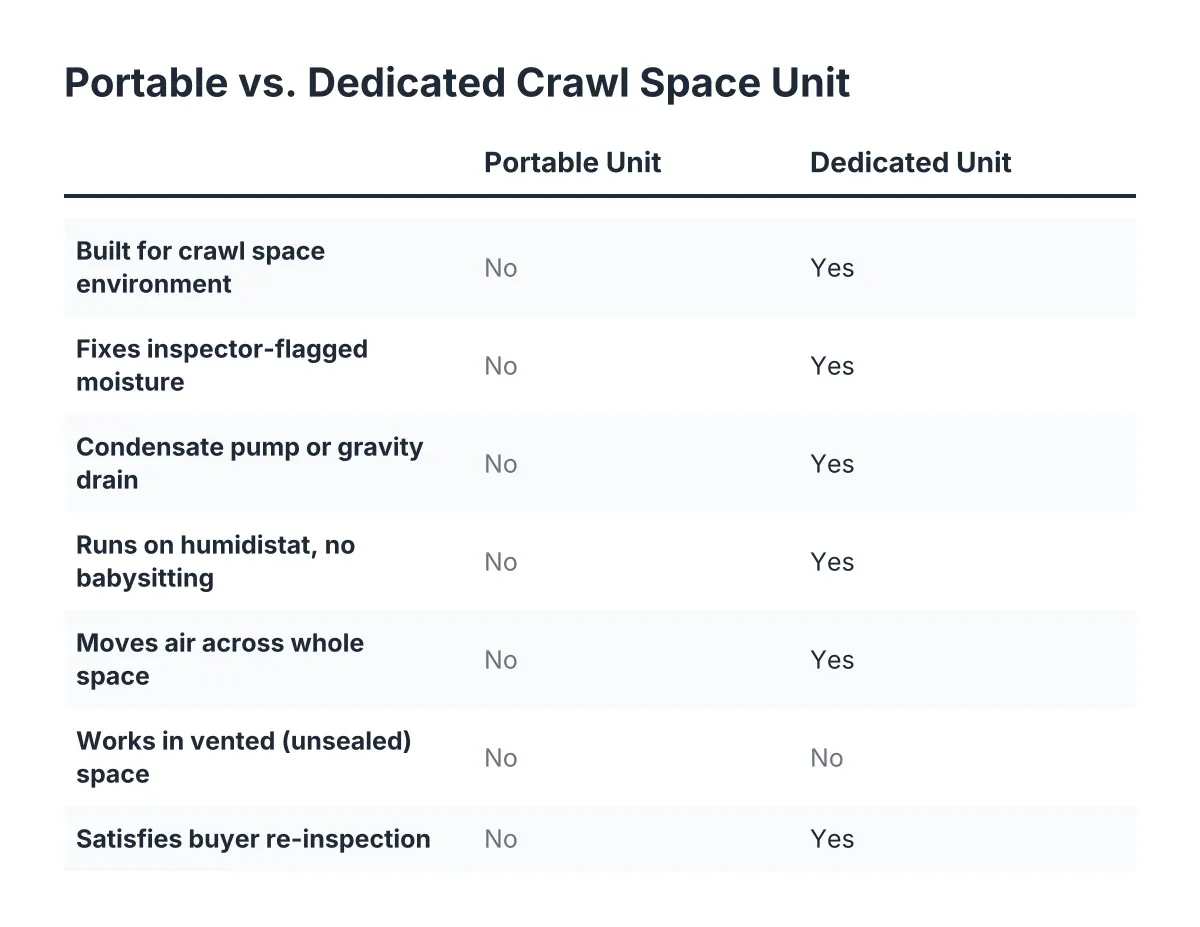
Purpose-built crawl space dehumidifiers differ from portable units in ways that matter under a house:
- They are commercial-grade machines rated for harsh, low-clearance, dusty environments.
- They remove far more water per day at the low temperatures common under a raised home.
- They pull air in through the front and push dry air out the back, moving air across the whole space instead of one corner.
- Most include a condensate pump or gravity drain, so nobody crawls under the house to empty a bucket.
- They wire in permanently and run on a humidistat, holding a set humidity level without babysitting.
A portable unit fails on nearly every one of those points. The bucket fills in hours, the coils ice up in a cool crawl space, and the plastic housing was never meant to sit in dirt and spider webs. Reliability also varies widely between models; some fail within a season while better units run for years, which is another reason the unit choice matters when you are handing paperwork to a buyer.
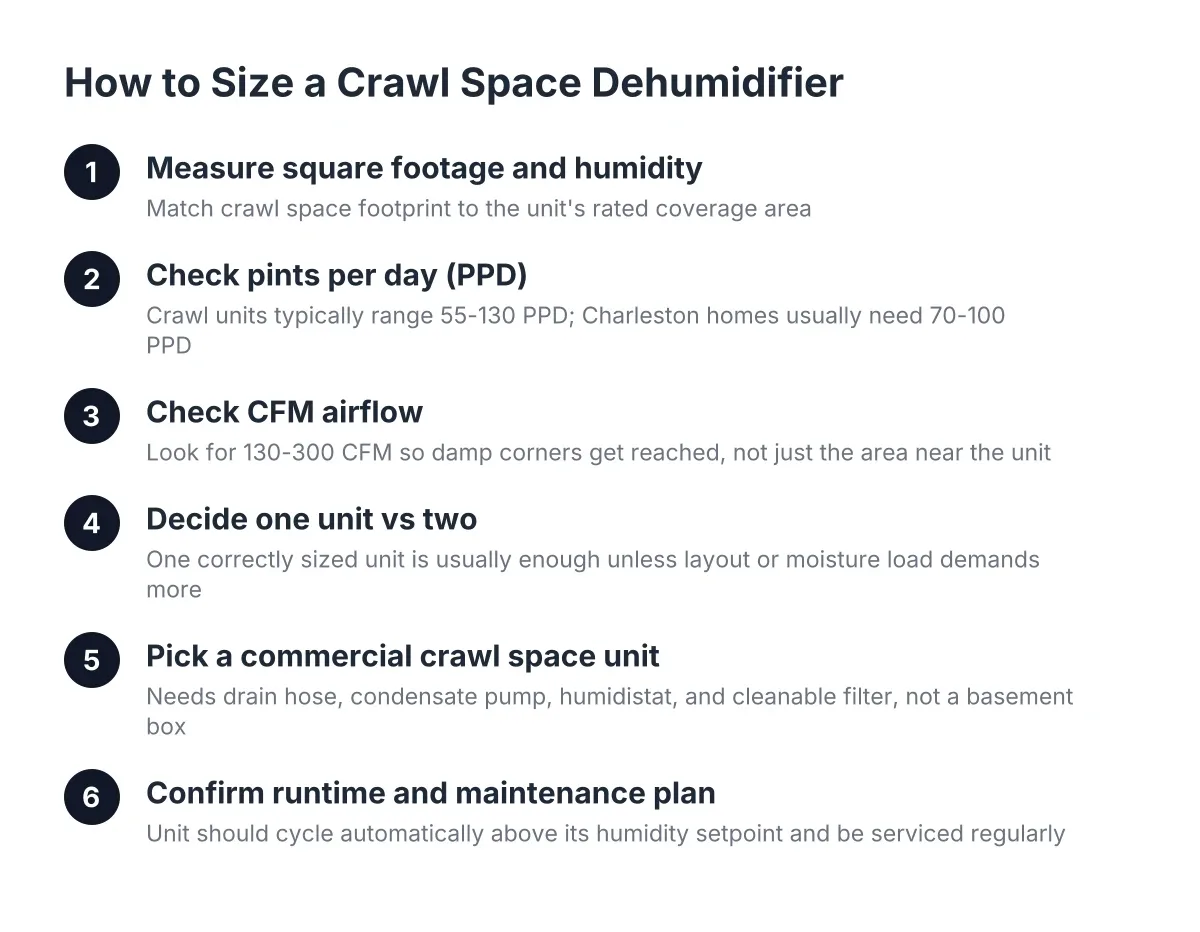
4. Sizing Matters: What Size Crawl Space Dehumidifier Do You Need?
Crawl space dehumidifier sizing depends on square footage, ceiling height, how wet the space is, and whether it is sealed. As a rough guide, a unit rated around 70 pints per day handles a typical sealed crawl space up to about 1,500 square feet, while larger or wetter spaces need a unit in the 90 to 130 pint range. An unsealed space cannot be sized accurately at all, because the moisture load never stops.
For most homes, one well-placed unit is enough. Installing two dehumidifiers in an average crawl space is usually wasted equipment, though a long, segmented crawl space under a large historic home, or a severe moisture problem, can justify a second unit. A specialist measures the space and the moisture load before recommending either.
5. Encapsulation First, Dehumidifier Second
Here is the honest answer to the dehumidifier vs. encapsulation question: they are not competitors. Encapsulation seals the space; the dehumidifier controls what is left. According to the U.S. Department of Energy, crawl space encapsulation means running plastic sheeting across the entire floor and sealing it to the stem walls and around support piers, not laying plastic loosely on the ground. The best vapor barrier for a crawl space in the Lowcountry is a thick, reinforced liner sealed at every seam, because thin plastic tears and gaps defeat the whole system.
Once the space is sealed, the dehumidifier becomes the most important working part of the system. It dials in the moisture level precisely and handles residual water vapor that still sneaks through. In a vented space you are hoping air movement dries things out; in a sealed space you are controlling humidity on purpose. That difference is what turns a red flag on an inspection report into a documented fix.
6. Charleston Conditions Make Half-Measures Fail Faster
Coastal humidity, high water tables, and tidal lots put more moisture pressure on a crawl space here than in most of the country. Charleston set a record of 17 high-tide flood days during the 2023-24 meteorological year, according to NOAA Tides and Currents. That water table pressure means many peninsula and island crawl spaces also need drainage, not just dry air.
According to Building America Solution Center (PNNL/DOE), a perimeter drain inside the foundation wall intercepts water coming in under the foundation and channels it to a sump pump, and the crawl space floor should be graded to slope toward that drain so water does not pool in the middle. When evaluating portable and dedicated dehumidifier options, remember that a dehumidifier cannot remove standing water. If your inspection report mentions ponding, staining on the piers, or an active leak, drainage and waterproofing come before any dehumidifier discussion.
7. Running Costs Are Lower Than Most Sellers Expect, If the Space Is Sealed
A properly sized crawl space unit in a sealed space cycles on and off based on its humidistat, so it does not run around the clock. Illustrative estimate: expect something in the range of $10 to $30 a month in electricity for a sealed Charleston crawl space, depending on the season and the unit. By contrast, a crawl space dehumidifier of the portable type running nonstop in a vented space can cost more than that while accomplishing less, because it never reaches its setpoint.
Set the unit around 50 to 55 percent relative humidity and let it run year-round. Maintenance is light: clean or replace the filter every few months, check the drain line for clogs, and glance at the humidity reading when you are under the house for anything else. Keep those maintenance notes; they are useful paperwork if you sell later.
8. If You Are Selling, Buy the Fix and the Paper Trail, Not the Gadget
Suppose a seller downtown gets an inspection report back flagging "elevated moisture and evidence of mold" in the crawl space, with a closing date five weeks out. In that scenario, the fastest path is not a portable dehumidifier from a big-box store. It is a crawl space inspection with moisture readings, mold remediation where the report calls for it, a sealed vapor barrier, and a permanently installed dehumidifier, all documented with photos and an invoice from a crawl space specialist. That paperwork is what calms a buyer's agent and heads off a price renegotiation.
Sometimes the full scope is smaller than sellers fear. If the space is dry except for humidity, and there is no rot or standing water, sealing plus a single dehumidifier may satisfy the buyer without a complete drainage system. However, a reputable specialist will tell you when the cheaper fix genuinely covers what the report flagged and when it will not survive the buyer's re-inspection.
Portable vs. Dedicated: The Short Answer
A dedicated, installed unit in a sealed crawl space controls moisture. A portable unit in a vented crawl space does not; it fights the outside air and loses. If you searched for a crawl space dehumidifier, portable models look tempting because they are cheap and fast, but the money is better spent sealing the space and installing equipment built to live under a house.
According to the American Society of Home Inspectors, more than 60 percent of U.S. homes have had water or moisture problems in their basement or crawl space, so inspectors look hard at this in 2026 and buyers' agents know what a real fix looks like. One honest caveat: no article can size a system for your specific house. Structural issues like sagging floors, active water intrusion, or widespread mold need eyes under the house before anyone picks equipment. Get a crawl space inspection first, fix moisture at its source, and let the dehumidifier do the job it is actually good at, keeping a sealed space dry for the long haul.
If you need crawl space encapsulation, Low Country Crawl Space Repair can help.
Prefer to talk it through? Call +18542013678 — a quick call is usually the fastest way to get a straight answer for your situation.