Crawl Space Insulation Types Compared: Fiberglass, Rigid Foam, and Spray Foam in Charleston
If you're researching crawl space encapsulation DIY projects, you've probably noticed that most guides skip the hardest question: which insulation actually belongs down there? Fiberglass batts, rigid foam board, and spray foam all show up in contractor quotes, and the line items look interchangeable until you understand how each one handles Charleston humidity. This guide walks you through comparing the three, step by step, so you can judge a proposal on substance instead of price, whether you plan to do the work yourself or hire it out.
One quick note before we start. More than 60% of U.S. homes have had water or moisture problems in their basement or crawl space, according to the American Society of Home Inspectors. In the Lowcountry, with our high water tables and tidal lots, that number feels low. Insulation choice matters more here than in most of the country, because the wrong material becomes a wet sponge under your floor.
Step 1: Decide Whether You're Insulating the Floor or the Walls
Before you compare materials, settle the layout question, because it determines which materials even make sense. There are two basic approaches.
The traditional vented approach puts fiberglass batts between the floor joists, above an open, vented crawl space. The encapsulated approach seals the space, covers the ground with a heavy vapor barrier, and insulates the perimeter walls instead. According to the Building America Solution Center (PNNL/DOE), a conditioned crawl space places insulation at the exterior stem walls and rim joists rather than at the floor level between joists.
In Charleston, the vented layout has a poor track record. Our outdoor air carries moisture most of the year, so vents pull humidity in rather than drying the space out. That humid air condenses on cool ductwork and framing, feeds mold, and creates the musty smell that keeps coming back no matter how many candles you burn upstairs. If the odor in your house gets worse after rain or in August, the crawl space layout is the first suspect.
Therefore, if you're comparing quotes, note which layout each contractor proposes. A quote for new fiberglass batts in a vented crawl space and a quote for wall insulation in a sealed crawl space are not the same job, and price alone won't tell you that.
Step 2: Rule Fiberglass In or Out for Your Situation
Fiberglass is the cheapest option per square foot, and that's why it shows up in low quotes. Judge it honestly.
Fiberglass works by trapping air, and it only insulates when it stays dry and stays in place. In a humid coastal crawl space, it does neither for long. It absorbs moisture from the air, sags out of the joist bays, and ends up hanging in damp strips under the floor. Wet fiberglass also holds moisture against your subfloor and joists, which invites mold and, over time, the kind of rot that leads to sagging floors and structural support work.
Where fiberglass can still make sense: a fully encapsulated, dehumidified crawl space where humidity stays controlled year-round. Even then, most encapsulation specs skip it, because there are better wall materials for the same job.
Red flag when reading quotes: "remove old insulation, install new fiberglass batts" with no vapor barrier, no dehumidifier, and no drainage line item. That replaces the symptom and leaves the moisture problem alone. Expect the musty smell back within a year or two.
Step 3: Why DIY Encapsulation Often Relies on Rigid Foam Board for Crawl Space Walls
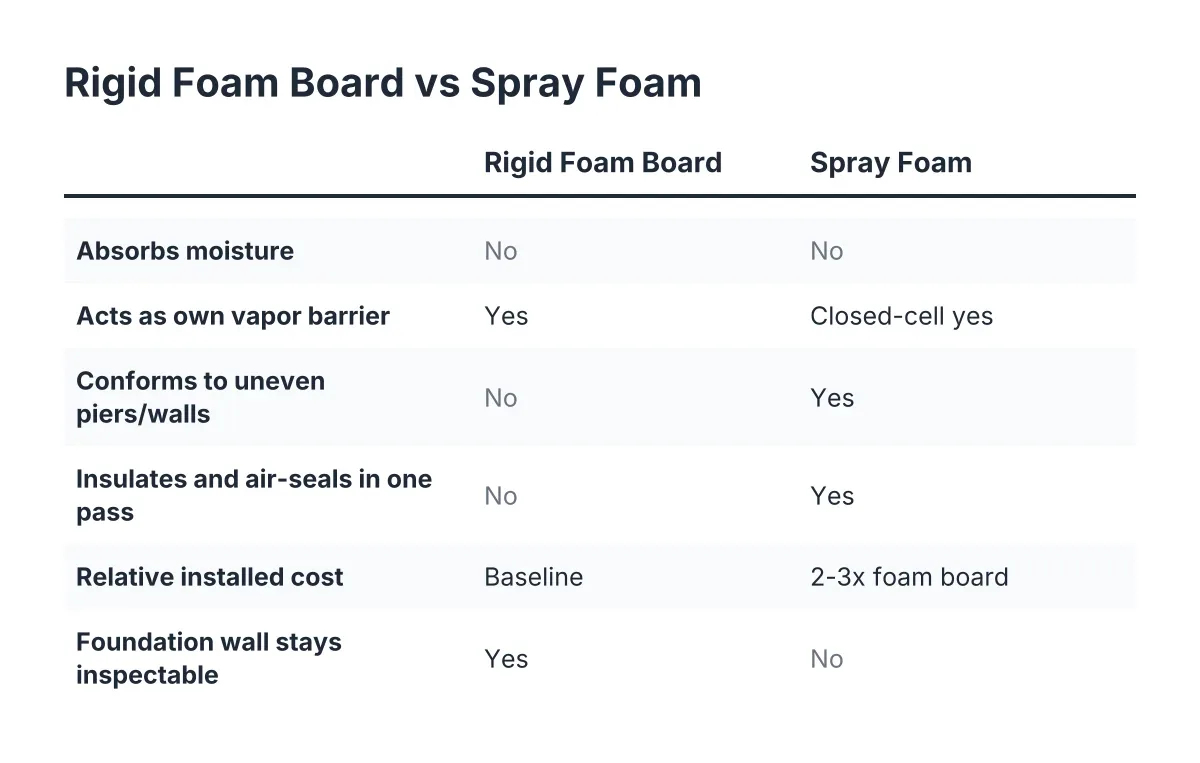
Rigid foam board, usually foil-faced polyisocyanurate or XPS, is the material most quality encapsulation systems put on the crawl space walls. There are practical reasons for that.
- It doesn't absorb water, so Lowcountry humidity can't degrade it the way it degrades fiberglass.
- Foam board can act as its own vapor barrier, so an extra plastic sheet on the walls isn't always needed, according to the Building America Solution Center (U.S. Department of Energy).
- It cuts cleanly into rectangles for rim joist bays and vent openings, then seals with expanding foam that works as both adhesive and air sealant.
- Common thicknesses deliver roughly R-5 to R-6.5 per inch, so two inches on the stem walls gets meaningful R-value in a thin layer.
One verified detail worth knowing when you review a scope of work: the Building America Solution Center (PNNL/DOE) describes taped rigid foam on the interior of stem walls and rim joists, sealed at the rim joist connection with fluid-applied sealant or expanding foam. If a quote says "wall insulation" without mentioning taped seams or sealed rim joists, ask. Untaped foam board leaks air at every joint and defeats the point.
Also check the termite gap. Stego Industries notes that some states require an uncovered inspection strip near the top of the foundation wall so termite tubes stay visible. A contractor who runs foam and vapor barrier to the very top of the wall may be creating a hidden termite highway. Local code knowledge is one of the clearest ways to separate a Charleston specialist from a templated national outfit.
Step 4: Weigh Spray Foam Against Foam Board
Closed-cell spray foam is the premium line item, and the closed cell foam vs fiberglass crawl space debate isn't a real contest in this climate; the real comparison is spray foam versus rigid board.
Spray foam's advantages are legitimate. It conforms to Charleston's uneven old brick piers and rubble stem walls, insulates and air-seals in one pass, and closed-cell foam resists moisture. Below grade, the surrounding masonry buffers it from big temperature swings, so it performs steadily.
The trade-offs are cost and inspectability. Spray foam typically runs two to three times the installed cost of foam board for the same wall, as a rough estimate. Once cured, it also hides the foundation wall behind it, which matters for termite inspections and future foundation repair. Many Lowcountry crews land on a hybrid: rigid foam board on the flat wall runs, spray foam to seal edges, rim joist bays, penetrations, and the odd-shaped gaps around piers.
For a homeowner comparing quotes, neither material is automatically the right answer. A foam board quote with careful taping and sealing details can outperform a rushed spray foam job. Judge the sealing plan, not just the material name.
Step 5: Check the Rest of the System Before You Judge the Insulation
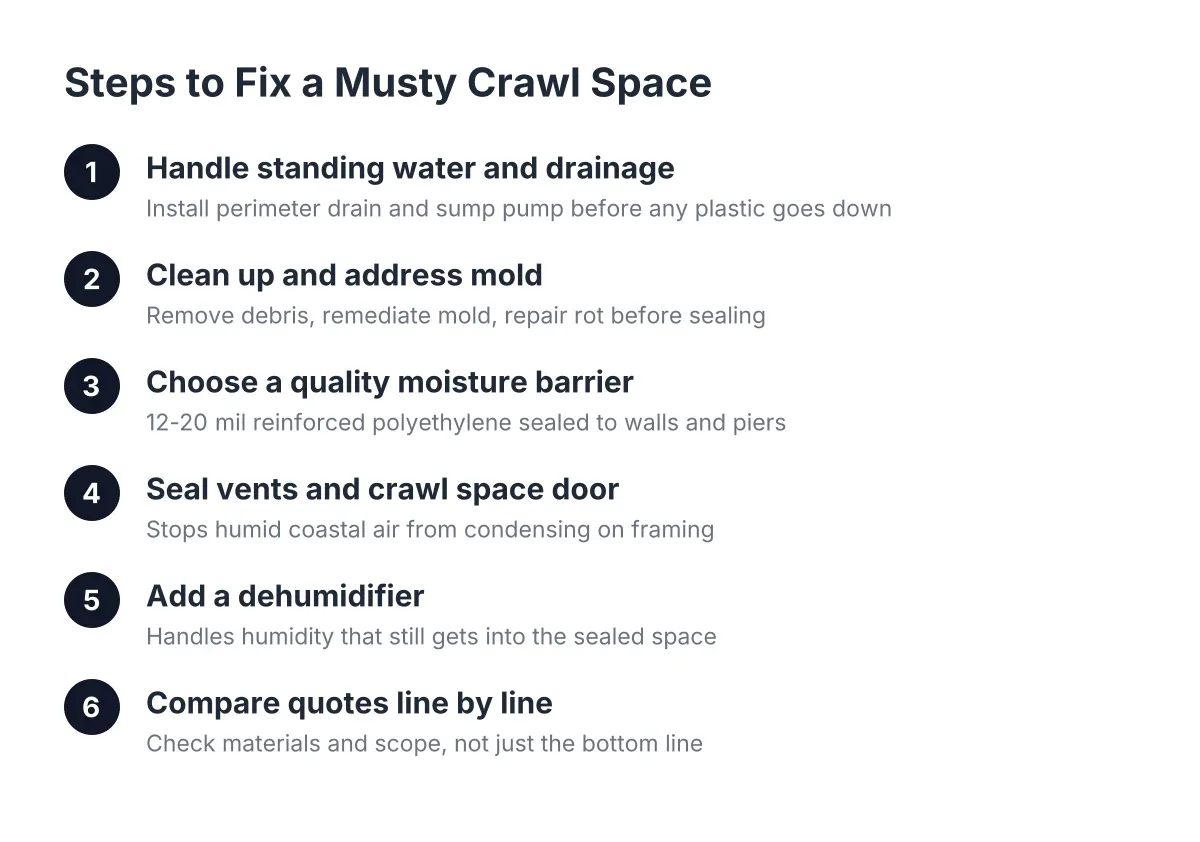
Insulation is one component. In a damp Charleston crawl space, it only works when the rest of the system controls water and air. When you evaluate crawl space encapsulation materials in a proposal, look for these companion line items:
- A heavy ground vapor barrier, 12 to 20 mil, run across the entire floor and sealed to the stem walls and around support piers. The U.S. Department of Energy describes this full sealing, not plastic laid loosely on the dirt.
- Sealed foundation vents, typically closed with cut foam board and taped for a continuous air seal. Sealing crawl space vents has pros and cons in theory, but in this climate the open-vent side loses; open vents feed humidity to whatever insulation you install.
- Drainage and grading where water intrudes. The Building America Solution Center (PNNL/DOE) notes that grading the dirt to slope toward a perimeter drain and sump pump keeps water from pooling under the barrier. With Charleston logging a record 17 high-tide flood days in the 2023-24 meteorological year, according to NOAA Tides and Currents, low lots need this.
- A crawl space dehumidifier, or conditioned air supplied to the space, so humidity stays controlled after everything is sealed.
Suppose a homeowner in West Ashley gets two quotes. One is $4,500 for new fiberglass and a thin plastic ground cover. The other is $9,800 for a sealed system: 15-mil vapor barrier, taped foam board walls, sealed vents, and a dehumidifier. Those illustrative numbers aren't comparable bids for the same work; they're two different products. The cheap one treats a symptom, and in that scenario the musty smell usually returns by the next humid season.
Step 6: Crawl Space Encapsulation DIY or Professional Sealing: Make the Right Choice
Can you DIY crawl space encapsulation? Physically, yes; homeowners do it, and a crawl space encapsulation DIY kit with barrier, tape, and foam board can materially cut costs. Whether you should depends on your time, stamina, tools, and how urgent the air quality problem is.
Be honest about what the job involves. You'll spend long hours on your back in a dark, tight space, often in protective gear, cutting foam board to irregular pier shapes and taping seams overhead. Some of the materials and gear, like true 15-mil reinforced barrier and specialty seam tape, aren't stocked at big-box stores, so plan on specialty suppliers. Grading dirt, installing drainage, and setting a sump pump push most people past the reasonable DIY line.
There are also negatives to crawl space encapsulation done wrong that a careful reader should know. Sealing a crawl space without fixing drainage can trap water under the barrier. Covering the termite inspection strip hides infestations. Skipping the dehumidifier leaves sealed, stagnant humidity with nowhere to go. If your crawl space already shows mold, standing water, or sagging floors, get a professional inspection before you buy materials; mold remediation and structural repair are not DIY territory.
A reasonable middle path for a hands-on homeowner: do the cleanup and debris removal yourself, then price the sealing, drainage, and dehumidification as professional work. You save money where mistakes are cheap and pay for expertise where mistakes are expensive.
What This Means for Your Musty Smell
If your house has smelled musty for years and air fresheners keep losing, the pattern usually traces to a vented crawl space with damp or failed fiberglass under the floor. About 15% of American homes sit on crawl space foundations, according to JSE Labs, and in Charleston's climate those spaces work against you unless they're sealed and dried.
So here's the short version of the comparison. Fiberglass belongs in dry, controlled spaces, which most Charleston crawl spaces are not. Rigid foam board is the workhorse for sealed walls and rim joists when it's taped and sealed properly. Spray foam earns its premium on irregular masonry and tricky gaps, often in a hybrid with board. And no insulation choice matters until the vapor barrier, vents, drainage, and dehumidification are handled first.
Whether you take the crawl space encapsulation DIY route or hire it out in 2026, you now know what a substantive quote looks like. Compare the sealing details, the moisture control plan, and the termite gap, not just the bottom line. That's how you get the smell gone for good instead of paying twice.
If you need crawl space encapsulation, Low Country Crawl Space Repair can help.
Prefer to talk it through? Call +18542013678 — a quick call is usually the fastest way to get a straight answer for your situation.