Crawl Space Moisture Barrier Plus Dehumidifier: How to Fix a Musty Charleston Home
If your Charleston house smells musty every time it rains, a crawl space moisture barrier paired with a dehumidifier is the combination that actually works—this is how to fix musty crawl space problems systematically. One without the other leaves the job half done. The barrier stops ground moisture from rising into the crawl space; the dehumidifier handles the humidity that gets in anyway. This guide walks you through the system step by step, so when contractor quotes land on your kitchen table, you can compare them on materials and scope instead of the sales pitch.
That comparison matters here more than most places. Charleston sits on a high water table, and NOAA Tides and Currents recorded 17 high-tide flood days in the 2023-24 meteorological year, a local record. If you just found standing water under your pier-and-beam house after a storm, you are not alone. According to the American Society of Home Inspectors, more than 60% of U.S. homes have had water or moisture problems in their basement or crawl space. The fix is a system, and each step below is a piece of it.
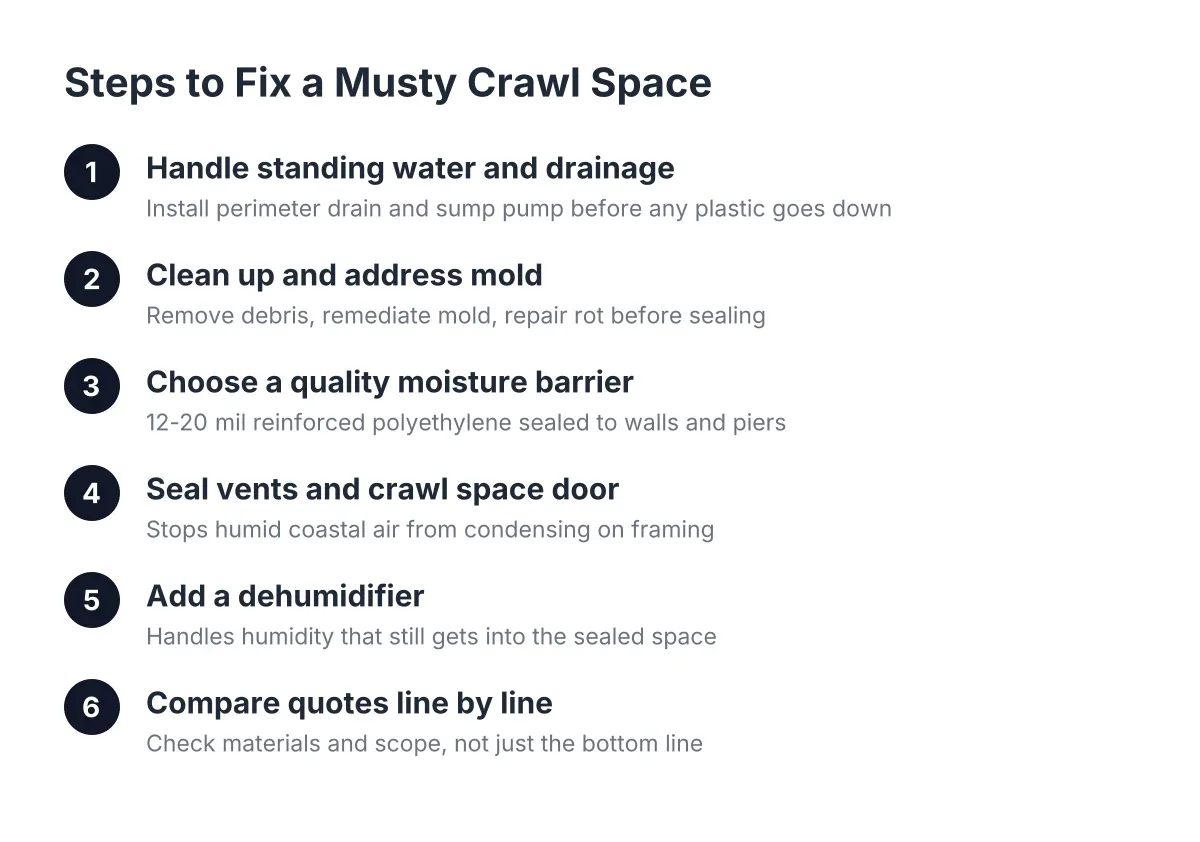
Step 1: Get Standing Water and Drainage Handled First
Before any plastic goes down, get the water out and give future water somewhere to go. A moisture barrier laid over standing water or saturated soil traps the problem instead of solving it. Any quote that skips straight to plastic without addressing drainage should raise a flag.
On a lot with recurring flooding, that means a perimeter drainage system inside the crawl space feeding a sump pump. According to the Building America Solution Center, encapsulated crawl space floors are often built up with several inches of gravel beneath the vapor barrier, with drainage piping around the foundation perimeter to manage moisture. The same source notes that grading the dirt so it slopes slightly toward the drain keeps water moving to the sump pump instead of pooling in the middle.
Ask each contractor these questions about the drainage line item:
- Does the quote include grading and leveling the crawl space floor?
- Is there a perimeter drain (a French drain inside the crawl space), and where does it discharge?
- Does the sump pump have a sealed lid and a check valve, and is a battery backup offered for storms that knock out power?
Suppose a homeowner on the peninsula finds two inches of water under a 1940s house after a tropical system. In that scenario, a drainage system plus sump pump handles the bulk water, and the moisture barrier and dehumidifier in the following steps handle the dampness and musty smell that remain. Skipping straight to encapsulation without the drain would mean pumping water off the top of the plastic after the next storm.
Step 2: Clean Up and Address Mold Before Sealing Anything
Never seal a dirty or moldy crawl space. Encapsulation locks in whatever is under the house on installation day, so debris removal, mold remediation, and any rot repair come first. In older Charleston homes, crews commonly find construction scrap, fallen fiberglass insulation, and mold growth on the underside of the subfloor.
If floors above feel soft or the framing shows rot, this is also the point to handle structural support: sistering damaged joists, repairing beams, or adding support jacks. It costs less to do that work while the crawl space is open than to cut through a finished barrier later. For a pre-1950s home, having a structural engineer look at sagging floors before encapsulation is money well spent.
Step 3: Know What a Quality Crawl Space Moisture Barrier Is Made Of
A quality crawl space moisture barrier is a reinforced polyethylene sheet, usually 12 to 20 mil thick, installed across the entire floor and run up the walls, not a thin sheet of hardware-store plastic laid loose on the dirt. Thickness, reinforcement, and how the seams and piers are sealed determine how long it lasts under a house that gets crawled through for plumbing and inspections.
Here is what to look for on the materials line of each quote:
- Thickness: 6-mil plastic is a ground cover, not an encapsulation liner. Most quality systems use 12 to 20 mil. A 20-mil reinforced liner resists tears from knees, tools, and oyster-shell soil common under older Charleston homes.
- Reinforcement: String or cord reinforcement inside the sheet stops small punctures from spreading into long tears.
- Wall coverage: The liner should extend up the masonry stem walls and wrap the brick piers, mechanically fastened, not just draped.
- Seams: Overlapped 6 to 12 inches and sealed with vapor barrier tape made for polyethylene. Household duct tape fails in crawl space humidity within a season.
According to the U.S. Department of Energy, true encapsulation means running the plastic across the entire floor and sealing it to the stem walls and around support beams, rather than laying it loosely on the ground. That sealing detail is the difference between a moisture barrier and a mere ground cover, and it is where cheap bids cut corners.
One local code note: Stego Industries points out that some states require a termite inspection strip near the top of the foundation wall to be left uncovered by the vapor barrier. A contractor who works Charleston crawl spaces regularly will know the local requirement; ask how they handle it.
Step 4: Seal the Vents and the Crawl Space Door
Sealed vents are what turn a crawl space vapor barrier into an encapsulation system. Those brick vents in your foundation wall were meant to dry the space out, but in the Lowcountry they do the opposite for much of the year. Humid coastal air flows in, hits cooler framing, and condenses. That is why vented crawl spaces here stay damp even in dry weather.
The trade-off is real, and worth understanding before you sign. Open vents cost nothing but feed humid air under the house from roughly April through October. Sealed vents stop that airflow, but they only work as part of a full system with a ground barrier and active moisture control. Sealing vents over bare dirt with no dehumidifier can make things worse, because the moisture that rises from the soil has nowhere to go.
The door matters too. A standard crawl space encapsulation typically includes an airtight, gasketed door or hatch cover. Leave the old plywood door leaking air and you undo a share of the sealing work.
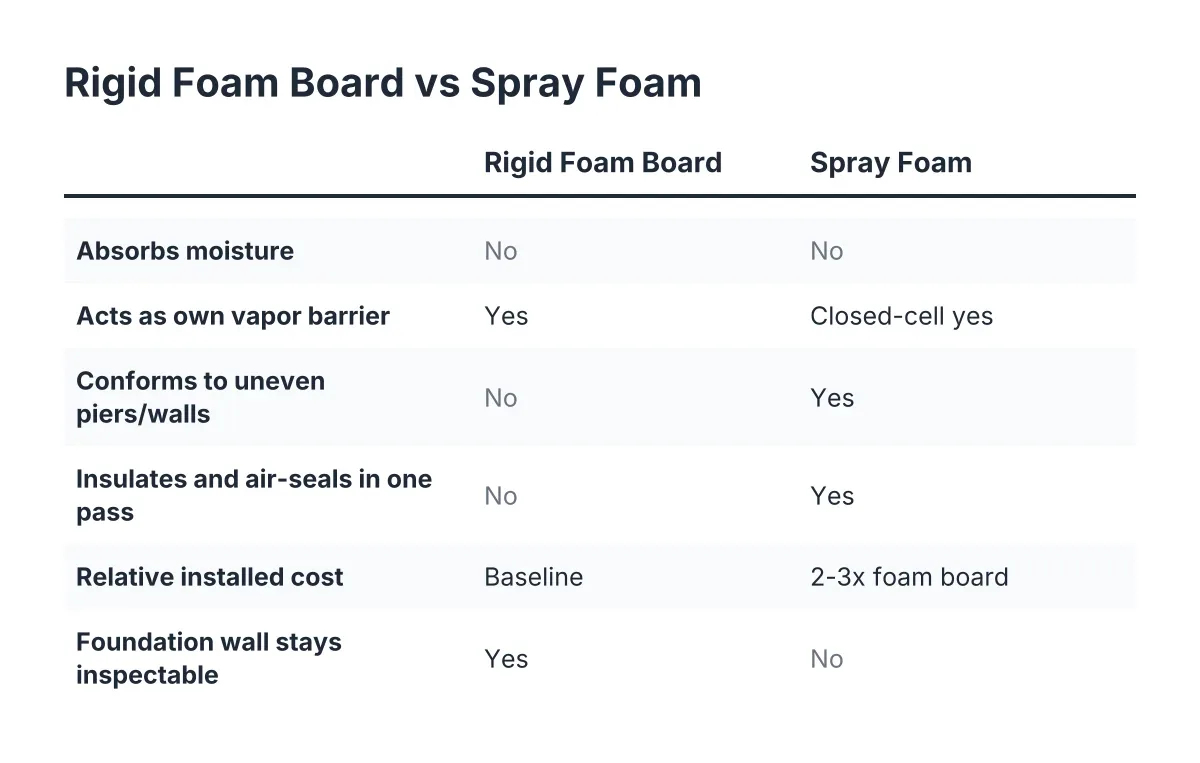
This is also where insulation decisions get made. In a sealed, conditioned crawl space, insulation moves from between the floor joists to the stem walls and rim joists, according to the Building America Solution Center. Taped rigid foam on the interior of the stem walls, sealed at the rim joist with expanding foam or fluid-applied sealant, is one proven method. Foam board can even serve as its own vapor barrier on foundation walls, per the Building America Solution Center, which is why some quotes show wall foam instead of liner running full height.
Step 5: How to Fix Musty Crawl Space Air with a Dehumidifier
A crawl space dehumidifier is the component that controls ongoing humidity after the crawl space moisture barrier stops ground moisture. The barrier blocks water vapor rising from the soil, but it cannot remove the humidity already in the air or the moisture that sneaks in through masonry walls and small gaps. A quality dehumidifier will help fix musty crawl space conditions in Charleston's climate, where that residual humidity is enough to keep a musty smell alive and feed mold on the subfloor.
The order of operations matters. Seal first, then dehumidify. A dehumidifier in a vented or unsealed crawl space fights the entire outdoors and runs constantly. Once the space has a sealed ground barrier, covered vents, and a gasketed door, a properly sized unit maintains humidity below the range where mold grows, and it cycles instead of running around the clock.
On the quote, look for:
- A dedicated crawl space dehumidifier, not a portable household unit set on the plastic.
- A condensate drain line routed to the sump pump or outside, so nobody has to empty a bucket under the house.
- A humidistat setting, typically keeping relative humidity around 50 to 55 percent.
If the budget will not stretch to a dehumidifier right away, sealing and encapsulating still delivers real benefit on its own; homeowners frequently notice the musty, damp-earth odor fade even after heavy rain. The dehumidifier can be added later as the finishing piece. Some contractors offer a fully conditioned crawl space instead, where the space receives supply air from the home's HVAC and is pressure-balanced with the living space above, per the Building America Solution Center. Either approach works; what fails is sealing the space and controlling nothing.
Step 6: Compare Quotes Line by Line, Not by Bottom Line
Now put the proposals side by side and check each one against the system you just walked through. Crawl space encapsulation materials vary widely in quality, and a low bid usually hides a thin liner, taped-shut vents instead of proper vent covers, or a missing drainage plan. In 2026, a full encapsulation with drainage, a sump pump, and a dehumidifier on a historic peninsula home commonly runs into five figures as an illustrative range, so the line items deserve scrutiny.
Run each quote through this checklist:
- Standing water plan: perimeter drain, sump pump with sealed lid, discharge location.
- Prep work: debris removal, mold remediation if needed, grading toward the drain.
- Liner spec: mil thickness, reinforcement, wall height, pier wrapping.
- Seam and attachment method: overlap width, vapor barrier tape, mechanical fasteners on walls.
- Air sealing: vent covers, gasketed door, sealed penetrations.
- Moisture control: dedicated dehumidifier with drain line, or conditioned-air approach.
- Termite inspection strip left visible per local requirements.
One honest caveat: no encapsulation system makes a flood-zone crawl space waterproof against a storm surge event, and homes with active foundation settlement or major rot need a structural assessment before sealing. A contractor who tells you that plainly, instead of promising the plastic solves everything, is the one worth hiring.
The goal is simple. Water drains out instead of standing. Ground moisture stays under the crawl space encapsulation vapor barrier instead of rising into your joists. The dehumidifier holds the air dry so the musty smell does not come back with the next August rain. When every quote is measured against that system, the right choice usually becomes obvious.
If you need crawl space encapsulation, Low Country Crawl Space Repair can help.
Prefer to talk it through? Call +18542013678 — a quick call is usually the fastest way to get a straight answer for your situation.