Do I Really Need a Crawl Space Inspection Before Buying a Charleston Home?
If you are asking, "do I really need a crawl space inspection home in Charleston," the short answer is yes, and the reason is specific to where you live. Charleston homes sit on some of the wettest ground in the country. High water tables, tidal lots, and year-round humidity work on a crawl space every day, and the damage stays hidden because almost nobody crawls under the house to look. This guide walks you through what a real crawl space inspection covers, when to schedule it, and how to read the report you get back, so you can turn inspector jargon into a plain action plan you could hand straight to a buyer's agent, a structural engineer, or a contractor.
That last part matters whether you are buying, selling, or just tired of a musty smell you cannot trace. An inspection is only useful if you understand what the findings mean and what to do about them. So this article treats the report itself as the product, not the crawl.
Why Charleston Crawl Spaces Are a Special Case
Most of the country can treat a crawl space as an afterthought. Charleston cannot. The peninsula and the surrounding islands sit barely above sea level, and the ground under many homes stays damp most of the year. According to NOAA Tides and Currents, Charleston set a record of 17 high-tide flood days during the 2023-24 meteorological year. Water that floods a street also raises the moisture level in the soil under every crawl space nearby.
Add the housing stock. Downtown Charleston, Sullivan's Island, and Isle of Palms are full of pre-1950s homes on pier-and-beam or masonry foundations with vented crawl spaces. That design made sense a century ago. In today's humidity, open vents pull warm, wet coastal air under the house all summer, where it condenses on cooler wood framing and ductwork. The result is the familiar Lowcountry pattern: damp wood, surface mold, a musty smell that drifts up through the floor, and, over enough years, rot and sagging floors.
Moisture problems under homes are common everywhere; according to the American Society of Home Inspectors, more than 60 percent of U.S. homes have had water or moisture problems in their basement or crawl space. In Charleston, the odds run against you harder, and the stakes are higher because the homes are older and worth more.
Do I Really Need an Inspection, or Can I Just Run a Dehumidifier?
You need the inspection first, because a dehumidifier only treats one possible cause and you do not yet know which cause you have. A musty smell can come from humid air through open vents, standing water after rain, a slow plumbing leak, rotted insulation, or active mold on the framing. Each of those has a different fix, and guessing wrong wastes money.
This is the honest answer for the skeptic who has been lighting candles and running fans for a year. A dehumidifier in a vented crawl space fights the entire Atlantic Ocean's worth of incoming humid air; it runs constantly and barely moves the number. A dehumidifier in a sealed, encapsulated crawl space works well because it only has to dry a closed volume. Same machine, opposite results, and only an inspection tells you which situation you have.
The inspection also protects you from the opposite problem: buying more than you need. Suppose the crawl is dry, the wood moisture readings are normal, and the smell traces to a disconnected dryer vent or wet insulation near one pier. In that scenario, you need a small repair and cleanup, not a full encapsulation. A documented inspection with moisture readings is what gives you the standing to say no to an oversized proposal.
When a Crawl Space Inspection Makes the Most Sense
Timing matters more than most homeowners realize. Here are the moments when an inspection earns its cost many times over:
- Before you make an offer on a Charleston home, or during your due diligence window
- Before you list your home for sale, so you find problems before the buyer's inspector does
- When a musty smell keeps coming back, especially after rain or in humid months
- After any flooding event, tidal or storm-driven, that put water near or under the house
- When floors start to feel soft, bouncy, or visibly out of level
- When you have owned the home for years and no one has ever been under it
That last one applies to more people than you would think. Most homeowners never enter their own crawl space, and even the plumbers and HVAC technicians who go under the house usually head straight to their equipment and back out. Damage can sit undetected for a decade. Sellers get surprised at closing for exactly this reason: water intrusion or structural findings under the house can be serious enough to threaten a purchase agreement, and by then you are negotiating repairs on the buyer's timeline instead of your own.
What Does a Crawl Space Inspector Actually Look For?
A thorough crawl space inspection checks the outside of the home first, then covers the full footprint underneath, documenting moisture, mold, structure, plumbing, ductwork, and the condition of any existing vapor barrier. It ends with photos, moisture readings, and a written report. Anything less than that full loop is a walkthrough, not an inspection.
The Exterior Check Most People Skip During Home Crawl Space Inspection
Before anyone crawls under the house, a good inspector walks the perimeter. They look at grading, whether the yard slopes toward or away from the foundation, where downspouts discharge, and whether vents, access doors, and the foundation wall show staining or damage. On a downtown lot that floods during king tides, the exterior tells half the story before the crawl door even opens. Skipping this step is a common shortcut, and it is why some reports treat symptoms without identifying the water source.
Moisture and Mold in Your Home's Crawl Space
Under the house, the inspector measures wood moisture content in joists and beams with a meter, checks relative humidity, and looks for condensation, standing water, and water staining on piers and framing. They document any visible mold growth on wood, insulation, or ductwork. This is where a musty smell usually gets traced. If the wood reads wet and the smell upstairs worsens after rain, you have your answer, in writing, with numbers.
Structure and framing
Next comes the structural review: piers, beams, joists, and sills. In older peninsula homes, the inspector checks for wood rot at beam ends, past termite damage, cracked or leaning masonry piers, and improvised repairs from previous owners. Sagging floors upstairs almost always trace to something visible down here. Serious structural findings are also the point where a specialist inspection should hand off; for a high-value historic home, a structural engineer's review before major foundation repair is money well spent.
Plumbing, ductwork, and everything else
A complete inspection checks every visible plumbing connection for active leaks, because a slow drip in a space no one enters can feed mold for years without a single symptom upstairs except the smell. Ductwork gets the same treatment. Pre-sale home inspections regularly turn up ductwork that has pulled loose or fallen, quietly air-conditioning the crawl space instead of the bedrooms. The inspector also notes debris, old construction scrap, abandoned insulation on the ground, and the condition of any existing plastic sheeting.
One caution on that last item: do not assume whatever is under your house was installed correctly. Many Charleston crawl spaces have a thin sheet of plastic tossed loosely on the dirt by a previous owner. That is not a vapor barrier system. According to the U.S. Department of Energy, true crawl space encapsulation runs sheeting across the entire floor and seals it to the stem walls and around support piers. Loose plastic with wet dirt exposed at the edges does close to nothing.
Reading the Report: From Inspector Jargon to an Action Plan
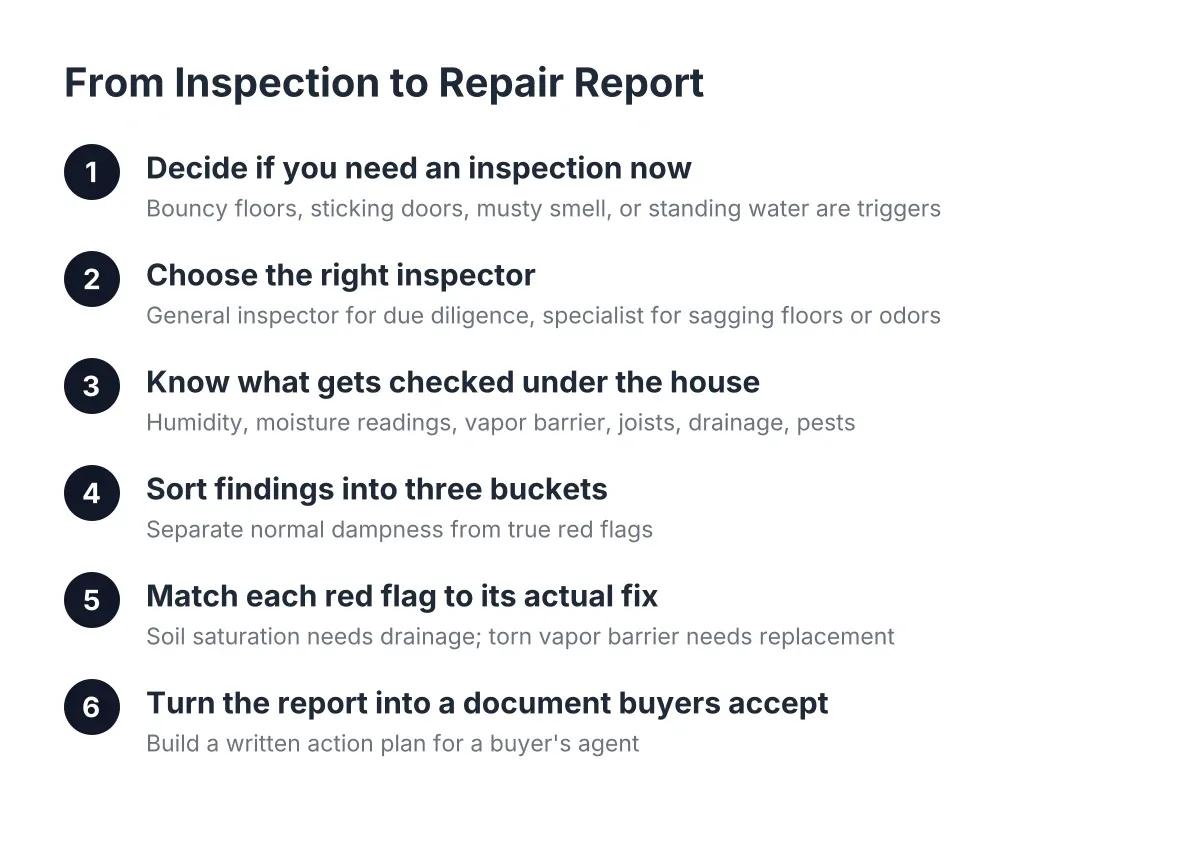
The report is where most homeowners get lost, and where sellers lose leverage. A good crawl space moisture inspection report includes photos of every finding, moisture meter readings with locations, and a description of conditions. Your job is to sort the findings into three buckets.
- Source problems. These are causes: poor exterior grading, open vents pulling in humid air, a plumbing leak, groundwater seeping in, or missing drainage. Fix these first, always. Treating mold without fixing the water source guarantees the mold comes back.
- Damage. These are consequences: mold growth, wood rot, rusted ductwork, sagging framing, ruined insulation. Damage gets remediated or repaired after the source is controlled. Mold removal, beam repair, and structural support jacks live in this bucket.
- Prevention and control. These are the systems that keep the space dry going forward: a sealed vapor barrier, crawl space encapsulation, a dehumidifier, perimeter drainage, or a sump pump. Whether you need these depends on the source problems, not on a sales script.
When a report recommends encapsulation, check that the underlying findings support it. According to the Building America Solution Center, a properly built encapsulated crawl space is graded and leveled first, sloped slightly toward a perimeter drain so water flows to a collection point instead of pooling in the middle. A sump pump in a sealed crawl space is an emergency backstop placed at the low point, since a sealed space would otherwise hold water like a pool if a pipe burst. If a proposal includes a sump pump, the report should show why: a high water table, past flooding, or plumbing overhead.
Local code details matter too. According to Stego Industries, some states require a termite inspection strip left uncovered near the top of the foundation wall so pest inspectors can still see evidence of activity, so the vapor barrier should not run all the way up. A specialist working Charleston homes will know details like this; a generalist may not.
Do I really need every repair the report lists?
No, and a well-written report will not pretend you do. An inspection documents conditions; it does not obligate you to fix everything at once. The test for each line item is simple: is this a source problem, active damage, or an upgrade? Source problems and active leaks need attention now. Cosmetic items and preventive upgrades can wait or be negotiated.
For example, say a homeowner on the peninsula gets a report showing wood moisture at 22 percent near the rear of the crawl, surface mold on three joists, a loose duct connection, and standing water after rain in one corner. A reasonable sequenced plan might look like this, as an illustration: fix the duct and the exterior downspout draining at that corner first, then handle mold remediation on the affected joists, then decide on encapsulation and a dehumidifier as the long-term humidity fix. That is a plan a buyer's agent can read in thirty seconds, with each item tied to a documented finding.
Sellers should hold onto exactly this kind of document. A crawl space inspection report paired with repair invoices turns a scary unknown under the house into a closed item on the buyer's checklist. It is the difference between a buyer's inspector writing "evidence of moisture, further evaluation recommended" and you handing over proof that the evaluation already happened and the work is done.
What a Crawl Space Inspection Costs in Charleston
Crawl space inspection pricing in Charleston generally runs from free to a few hundred dollars as of 2026, depending on who performs it and how deep it goes. A general home inspection includes a look at the crawl space but rarely a detailed one. A specialist inspection goes further, with moisture readings and repair-specific documentation, and many Charleston-area crawl space companies offer the inspection at no charge because they also do the repair work.
The free inspection is where the skeptic's guard goes up, reasonably. A no-cost inspection from a repair company is a sales visit as well as an inspection; both things are true at once. The way to get value from it without getting steered is to demand documentation. Ask for photos of every finding, actual moisture readings with numbers, and a written scope that separates must-fix items from recommended upgrades. A company confident in its findings will hand all of that over. If someone quotes a five-figure encapsulation without showing you a single photo or reading, get a second opinion before signing anything.
Searching for a foundation inspection near me will surface general home inspectors, structural engineers, and crawl space specialists mixed together. For a suspected moisture or odor problem, the specialist is usually the right first call; for visible structural movement in a historic home, bring in the engineer too. The two reports together give you both the diagnosis and an independent check on the proposed fix.
Getting the Most Out of the Inspection Day
Since you have decided to do this, a small amount of preparation makes the results sharper. First, clear a path to the crawl space access door and unlock any gates. Second, write down your symptoms before the inspector arrives: when the musty smell is worst, which rooms it shows up in, and whether it tracks with rain or humid weather. That history helps the inspector connect what they find below with what you experience above.
During the inspection, ask whether the inspector reached all four corners of the crawl space. Full coverage is the mark of a thorough job; if access was blocked somewhere, the report should say so rather than gloss over it. In addition, ask them to photograph the ductwork, every plumbing connection, and the condition of any existing ground cover, even if those items look fine. A finding of "no leaks observed, all duct connections intact" is worth having in writing, especially before a sale.
Afterward, keep everything in one folder: the report, the photos, the moisture readings, and any repair proposals. If you sell within the next few years, that folder becomes part of your disclosure package and your negotiating position. If you stay, it becomes your baseline; the next set of crawl space inspections can be compared against it to show whether conditions are holding steady or getting worse.
The Bottom Line for Charleston Buyers and Sellers
So, do I really need a crawl space inspection before buying a Charleston home? Yes. About 15 percent of American homes have a crawl space foundation, according to JSE Labs, but in historic Charleston neighborhoods the share is far higher, and the local combination of tidal flooding, high water tables, and coastal humidity makes the space under the house the most likely place for expensive hidden problems. An inspection costs little or nothing, takes an hour or two, and converts an unknown into a documented, prioritized list.
For the buyer, that list is negotiating power. For the seller, it is the chance to fix problems on your own schedule instead of during a due diligence standoff. And for the longtime homeowner who is tired of apologizing for a musty smell, it is the straight answer you have been guessing at: where the moisture comes from, what it has damaged, and what actually needs fixing, in that order.
If you need crawl space encapsulation, Low Country Crawl Space Repair can help.
Prefer to talk it through? Call +18542013678 — a quick call is usually the fastest way to get a straight answer for your situation.