French Drain vs. Sump Pump for a Charleston Crawl Space: Which Drains Better?
If water keeps showing up under your house after every heavy rain, you have probably searched some version of "french drain sump pump" and found a pile of answers written for basements in Ohio. Charleston is different. Between the high water table, tidal lots, and hurricane-season downpours, a crawl space here can take on water even when the yard looks dry. This comparison walks through how a French drain and a sump pump each work, where each one falls short, and why most wet crawl spaces in the Lowcountry end up needing both.
Here is the short answer up front. A French drain collects and moves water. A sump pump ejects water. Neither one is a complete drainage system by itself in most Charleston crawl spaces, because our lots rarely have enough slope for gravity to carry water away on its own.
According to the American Society of Home Inspectors, more than 60% of U.S. homes have had water or moisture problems in their basement or crawl space. In Charleston, the odds run worse. NOAA Tides and Currents recorded 17 high-tide flood days here during the 2023-24 meteorological year, a record. Water pressure on Lowcountry foundations is not a rare event; it is a season.
What a French Drain Does in a Crawl Space
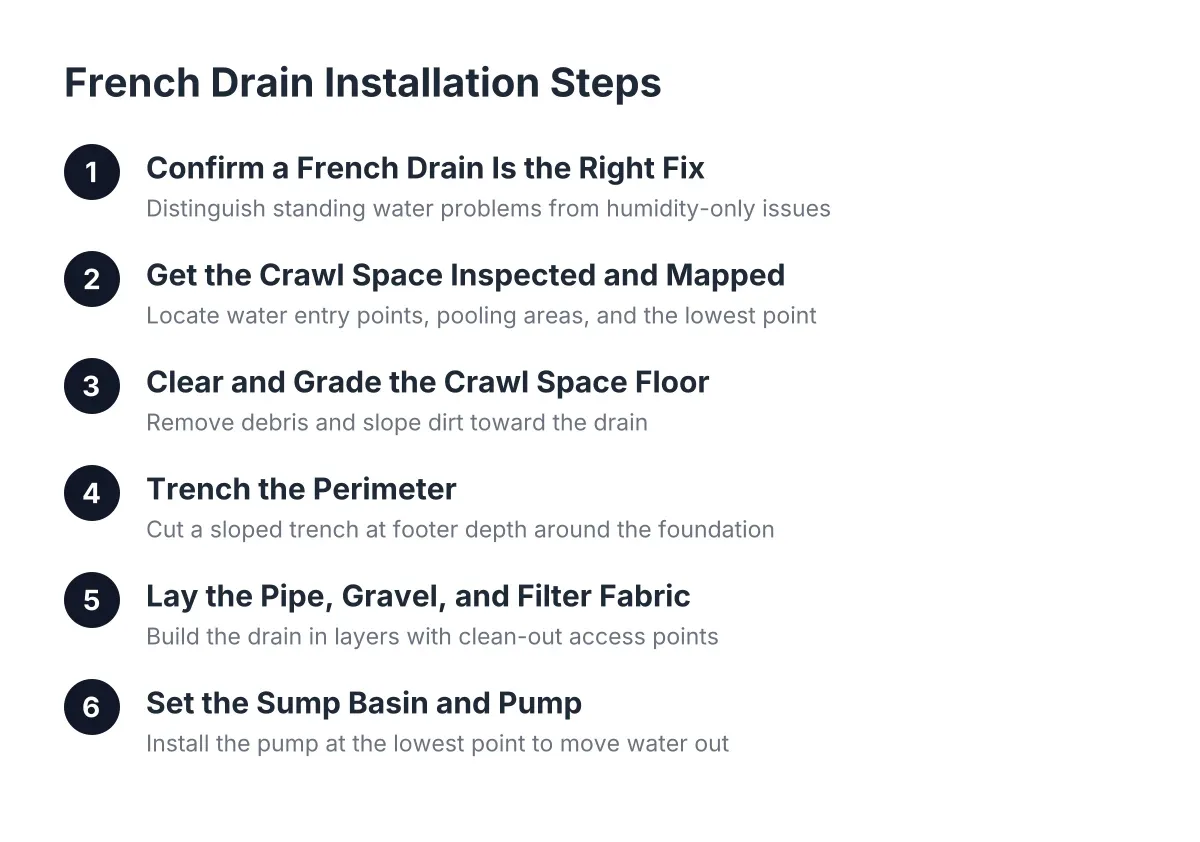
A French drain is a gravity system. Crews dig a trench, usually along the interior perimeter of the foundation, and line it with french drain fabric to keep silt out. Then they lay perforated french drain pipe in gravel, sloped continuously in one direction so water flows on its own.
The job of that trench is interception. According to the Building America Solution Center (PNNL/DOE), a perimeter drain installed around the interior of a crawl space foundation wall is designed to catch water entering under the foundation and channel it away before it spreads across the crawl space floor. Done right, a footer-depth drain along the foundation catches groundwater before it ever reaches the middle of the house, where your floor joists sit.
A French drain has real strengths:
- It works around the clock with no electricity and no moving parts.
- It handles broad, slow seepage along an entire foundation wall, not just one wet spot.
- It protects the soil under your floor framing, which matters if you already have soft or bouncy floors from moisture-damaged joists.
- Paired with grading, it stops water from pooling in the middle of the crawl space.
However, a French drain has one hard limit: water only flows downhill. If the trench cannot daylight to a lower spot in the yard, the water has nowhere to go. On a flat Charleston lot two feet above the water table, "downhill" often does not exist. The drain collects water perfectly and then just holds it.
What a Sump Pump Does in a Crawl Space
A sump pump solves the "nowhere to go" problem. Crews set a sump basin, sometimes called a sump pit, at the lowest point of the crawl space, since that is where water naturally collects. When water in the basin reaches a set level, a float switch kicks the pump on and it pushes the water out through a discharge line, away from the foundation.
The Building America Solution Center (PNNL/DOE) makes an important point about encapsulated crawl spaces: a sealed vapor barrier can trap water like a pool if a pipe bursts or floodwater gets in. A sump pump placed at the low point acts as the automatic exit. For homes in Charleston flood zones, that is not an optional luxury; it is the pressure-relief valve for storm season.
Strengths of a sump pump on its own:
- It removes water even when the lot is flat and gravity cannot help.
- It responds automatically, including during a hurricane when you are not home.
- It handles high-water-table conditions that no passive drain can overcome.
- With a battery backup, it keeps working through the power outages that come with the same storms that flood crawl spaces.
The weakness is coverage. A pump only removes water that reaches the basin. If groundwater seeps in along 120 feet of foundation wall and soaks the soil before trickling toward the pit, the pump is bailing a problem the crawl space has already absorbed. A basin without collection piping is a bucket, not a drainage system.
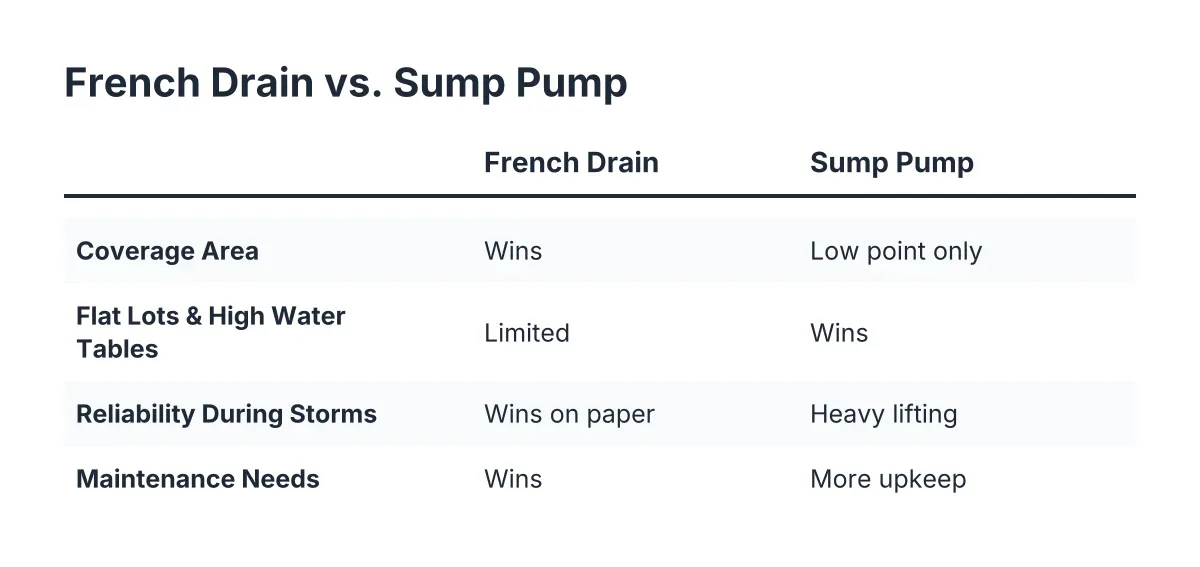
French Drain vs. Sump Pump: Side-by-Side Comparison
Each system answers a different question. The French drain answers "how do we collect the water," and the sump pump answers "how do we get it out." Here is how they stack up on the criteria that matter for a Charleston crawl space.
Coverage Area
The French drain wins. A perimeter trench with perforated pipe intercepts water along the entire foundation. A sump pump covers only the low point where its basin sits. In a crawl space with recurring seepage on multiple walls, a pump alone leaves most of the footprint unprotected.
Flat Lots and High Water Tables
The sump pump wins. Where a trench is dug deep enough and the yard has genuine slope, a French drain can rely on gravity alone and never need a pump. That describes few Charleston-area lots. On flat, low, or tidal-influenced ground, only mechanical ejection moves water up and out.
Reliability During Storms
The French drain wins on paper, since gravity never loses power. In practice, the sump pump does the heavy lifting during a tropical system, when water volume overwhelms what passive drainage can shed. The honest answer is that storm reliability comes from pairing them, plus a battery backup on the pump.
Maintenance Needs
The French drain wins. Quality french drain fabric keeps sediment out, and a properly sloped pipe can run for decades untouched. Smooth-wall perforated pipe holds up better than thin corrugated drain pipe here, because corrugated pipe traps silt in its ridges and clogs sooner in our sandy, wet soils. A sump pump, by contrast, has a motor, a float switch, and a check valve, all of which wear out. Plan on testing it each spring before hurricane season and budgeting for replacement roughly every 7 to 10 years.
Structural Protection for Sagging Floors
Tie here, because the real answer is both. If your hallway floor feels bouncy and an inspection finds moisture-softened joists, the drainage fix has to stop water from re-wetting the soil under the framing. A French drain intercepts that water at the wall; the pump removes it. Fix only half the equation and the humidity that rotted the joists keeps its supply line. Keep in mind that drainage stops future damage but does not repair existing damage; rotted joists or beams still need structural support work such as sistered joists or support jacks, which is a separate repair.
Why Most Charleston Crawl Spaces Need the French Drain and Sump Pump Together
A proper crawl space water retrofit in the Lowcountry typically pairs a full interior perimeter French drain with one or more sump pumps. The trench collects water along the foundation, the pipe carries it by continuous slope to the basin, and the pump ejects it away from the house. The Building America Solution Center (PNNL/DOE) also notes that grading the crawl space dirt to slope slightly toward the drain before installing the system helps water flow into the perimeter drain and sump pump instead of pooling in the middle.
Suppose a homeowner in West Ashley notices a soft spot in the hallway floor after a wet spring. An inspection finds standing water along the back foundation wall after every rain, plus early rot in two joists. In that scenario, a sump basin alone would sit dry while water soaked the soil forty feet away. A French drain alone would fill and hold water, since the flat lot offers no gravity outlet. The combined french drain sump pump system, a perimeter trench draining to a basin at the low corner, is what actually dries the crawl space out.
A few installation details separate a system that works from one that quietly fails:
- The trench must slope continuously toward the basin so water never pools in the line.
- The basin belongs at the true low point of the crawl space, confirmed with a level, not by eye.
- Crawl spaces broken into separate sections by interior footings may need a second basin and pump, because one drain line cannot practically reach every zone.
- The discharge line must carry water well away from the foundation, or the pump just recirculates the same groundwater.
- If the crawl space will be encapsulated, the drain goes in first, under gravel and the vapor barrier, per standard encapsulated-floor construction described by the Building America Solution Center (PNNL/DOE).
One caution before you buy anything: a french drain sump pump combo fixes standing water and groundwater intrusion. It does not fix a mold problem driven by humidity alone. Charleston's coastal air can push crawl space humidity high enough to feed mold on joists even with zero standing water. That problem calls for moisture control, a sealed vapor barrier, and a dehumidifier, not more drainage. A good inspection sorts out which problem you actually have before you spend money on the wrong fix.
What Ongoing Maintenance Looks Like
If you already have crawl space drainage systems installed under an encapsulated space, the work shifts from installation to upkeep, and the pump carries most of that load. As of 2026, a sensible seasonal routine looks like this:
- Test the pump each spring by pouring water into the basin and confirming the float triggers and the discharge flows outside.
- Check the check valve and discharge line for clogs before hurricane season.
- After any named storm or flood event, inspect the crawl space for standing water, shifted vapor barrier seams, and a pump that ran continuously.
- If a dehumidifier drains into the sump basin, confirm the condensate line is clear so the unit does not shut down on a full reservoir.
Homes on annual maintenance plans usually fold these checks into a scheduled visit, which matters most in flood-prone neighborhoods where a dead pump goes unnoticed until the musty smell comes back.
How to Choose
Start with where your water comes from. If water enters along the foundation walls after rain, you need collection, which means a perimeter French drain. If water pools at a low spot, or your lot sits flat and low like most of the Charleston area, you need ejection, which means a sump pump. Additionally, if both are true, and for most damp Lowcountry crawl spaces both are true, plan on the paired system from the start rather than adding the second half after the first one disappoints you.
Then get eyes under the house before committing. A drainage problem and a structural problem often travel together, and only an in-person inspection can tell you whether that bouncy floor needs a drain, a dehumidifier, new support jacks, or all three. Getting the diagnosis right first is what keeps a fixable moisture problem from turning into a foundation repair.
If you need crawl space encapsulation, Low Country Crawl Space Repair can help.
Prefer to talk it through? Call +18542013678 — a quick call is usually the fastest way to get a straight answer for your situation.