Black Mold in Your Crawl Space: How to Test It, Remove It, and Keep It Gone
If your Charleston house has smelled musty for years and you finally found dark staining on the wood under your floor, you want two things: a straight answer on how serious it is, and a plan to fix it. Searching for mold removal near me mostly turns up national restoration franchises and directory sites, and neither one tells you what crawl space mold actually means for a raised, vented Lowcountry home. This guide does. It walks you through identifying the mold, testing it the right way, getting it removed properly, and deciding whether encapsulation belongs in the plan or not.
One note before you start. This is a step-by-step guide, but crawl space work involves confined spaces, wiring, plumbing, and sometimes structural repair. Anything past the inspection steps is a job for a specialist, and this guide will tell you exactly where that line is.
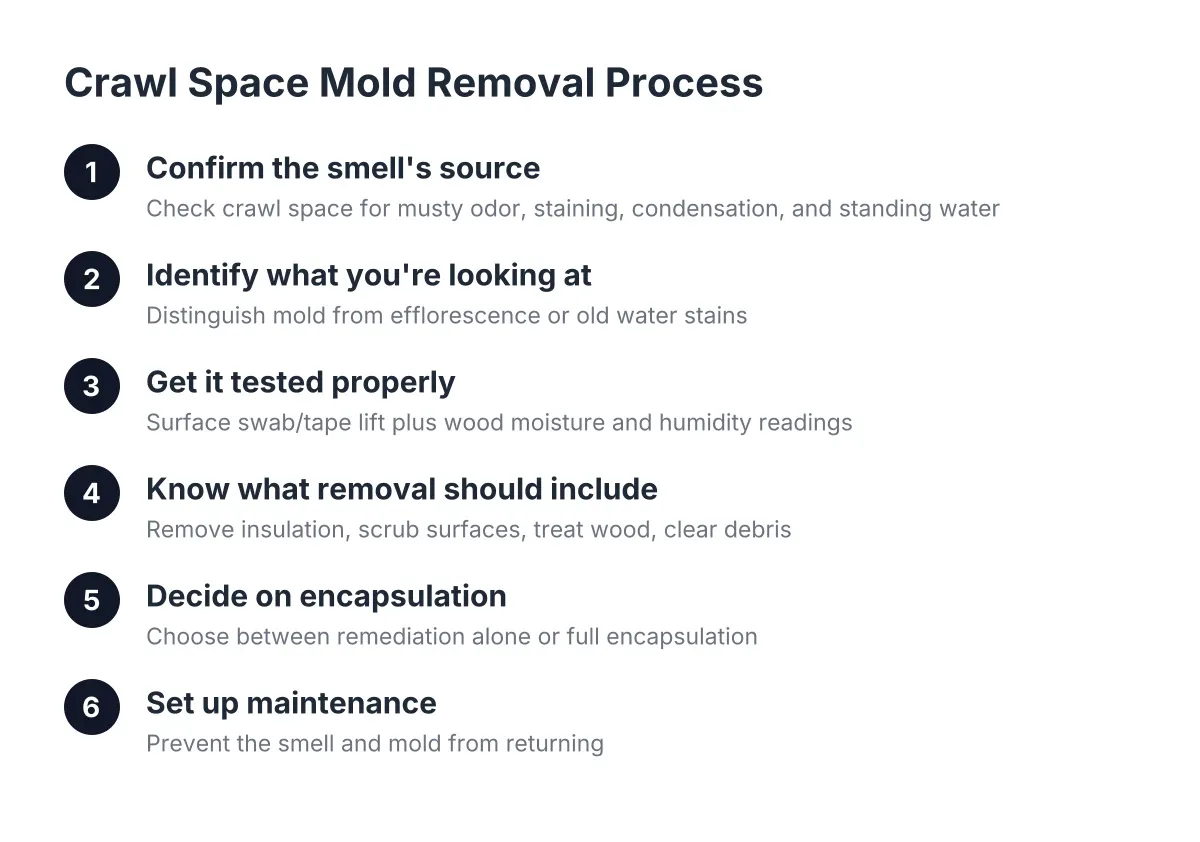
Step 1: Confirm the Smell Is Coming From the Crawl Space
Start at the source, not the living room. If the musty smell gets stronger after rain, in humid weather, or near floor registers and baseboards, the crawl space is the most likely culprit. Air moves upward through a house, so a damp crawl space pushes that odor into the rooms above it. Candles and air fresheners mask it for an afternoon; they never fix it.
Open the crawl space access door and take a look with a flashlight. You do not need to crawl the whole thing. From the opening, check for these signs:
- A strong earthy or musty smell that hits you at the door
- Dark, fuzzy, or splotchy staining on floor joists, beams, or subfloor
- Condensation or water droplets on ductwork or pipes
- Standing water, damp soil, or a torn plastic sheet on the ground
- Sagging or fallen fiberglass insulation between the joists
If you see two or more of these, the smell in your house and the conditions under it are almost certainly connected. Unencapsulated crawl spaces in this climate commonly grow mold on floor joists and sweat moisture onto ductwork, because Charleston's humidity sits in that vented space year-round.
Step 2: Identify What You Are Actually Looking At
Not every dark stain is black mold, and not every mold problem is an emergency. Mold on crawl space wood usually shows up as black, green, white, or gray patches, often fuzzy or powdery. White crystalline deposits on brick or block are usually efflorescence, which is mineral residue from moisture, not mold. Old water stains can look dark but flat, with no growth texture.
Here is the honest part that a fear-based sales pitch will not tell you. "Black mold" is a color, not a diagnosis. Several mold species look black, and you cannot identify the species by eye. What matters more than the species is the extent of the growth, the moisture source feeding it, and whether that air is reaching your living space. A few small patches near a vent are a different problem than joists coated end to end.
Take photos of anything you find. You will want them when you talk to a mold removal service, so you can compare what different companies say about the same evidence.
Step 3: Get the Crawl Space Tested the Right Way
Proper crawl space mold testing means surface testing, not air sampling. A crawl space is not conditioned living space, so an air sample down there tells you little; open vents and outdoor air skew the numbers. A surface test, which is a swab or tape lift taken directly from a joist or subfloor, confirms whether the staining is active mold growth and how widespread it is.
Pair the mold test with moisture readings. A good inspector measures wood moisture content in the joists and relative humidity in the crawl space. Those two numbers drive the whole plan. As a reference point, moisture problems are the rule rather than the exception in American homes; more than 60% of U.S. homes have had water or moisture problems in their basement or crawl space, according to the American Society of Home Inspectors.
The results sort you into one of three situations:
- High humidity, no active mold. You do not need remediation. A crawl space dehumidifier and moisture control can stop mold before it starts. This is the lower-budget outcome, and an honest specialist will tell you when it applies.
- Active mold with a humidity problem. You need mold remediation plus a fix for the moisture source, which in Charleston usually means a vapor barrier, dehumidification, or full encapsulation.
- Active mold with standing water or drainage problems. You need remediation plus waterproofing, which may include a French drain, a sump pump, and grading before anything gets sealed.
Step 4: What Real Mold Removal Near Me Should Include
Legitimate crawl space mold removal is physical work, not a spray-and-leave visit. When you compare quotes from different providers, the scope of work is where good and bad providers separate. A thorough remediation includes:
- Removing contaminated insulation. Fiberglass batts between the joists hide mold behind them. Any crew that treats exposed wood but leaves old insulation in place is leaving mold in your crawl space.
- Scrubbing every affected surface. The mold has to be physically removed from joists, beams, and subfloor. A treatment spray alone kills surface growth but leaves the material and the staining, and regrowth follows.
- Treating the cleaned wood. After scrubbing, an antimicrobial treatment helps prevent regrowth on the cleaned surfaces.
- Debris removal and cleanup. Old plastic, fallen insulation, and construction debris hold moisture and should come out.
DIY chemical treatments are the common shortcut, and they usually disappoint. A single spray treatment often does not eliminate crawl space mold, and follow-up inspections and repeat treatments over the following weeks are typically needed to see continued improvement. In a tight, dark space with hundreds of square feet of joist surface, professional removal is more thorough and does a better job preventing regrowth.
On timing, plan for the remediation itself to take from a day to several days depending on the size of the crawl space and how far the growth has spread. Cost varies with square footage, access, and how much insulation and debris must come out, so treat any price quoted before an inspection as a guess.
Step 5: Decide Between Remediation Alone and Encapsulation
Mold remediation removes the mold that exists today. Encapsulation controls the moisture that grows tomorrow's mold. They solve different problems, and the test results from Step 3 tell you whether you need one or both.
Crawl space encapsulation means running heavy plastic sheeting across the entire crawl space floor and sealing it to the stem walls and around support piers, rather than laying plastic loosely on the dirt, according to the U.S. Department of Energy. A full system typically wraps the piers, seals the vents and the access door, and adds a dehumidifier to hold humidity down year-round. In homes with drainage issues, crews grade the dirt to slope toward a perimeter drain and sump pump so water cannot pool in the middle, an approach described by the Building America Solution Center.
Two rules protect you here. First, remediation must happen immediately before encapsulation, never after; sealing a crawl space with active mold inside locks the problem in. Second, encapsulation is not always necessary. If testing shows moderate humidity and limited growth, remediation plus a dehumidifier may hold the line at a fraction of the cost. Be skeptical of any company that quotes full encapsulation before anyone has measured moisture or tested a joist.
Suppose a homeowner in West Ashley has lived with a musty smell for three years, and a surface test confirms mold across about a third of the joists with crawl space humidity in the high seventies. In that scenario, a reasonable plan is remediation of the affected wood, removal of the old insulation, a sealed vapor barrier, and a dehumidifier. A sump pump only enters the picture if the inspection finds standing water or the lot sits low. That is what a proportionate fix looks like.
Step 6: Find Mold Removal Services Near Your Charleston Home
Directory results for mold removal near me will show national franchises, general handymen, and pest control companies that treat crawl spaces as a side job. Charleston crawl spaces deserve better than a templated approach. High water tables, tidal lots, and vented pier-and-beam construction change how moisture behaves under a house here. Charleston set a record of 17 high-tide flood days during the 2023 to 24 meteorological year, according to NOAA Tides and Currents, and that groundwater pressure shows up under homes long before it shows up in the street.
When you interview providers in 2026, ask these three questions:
- Will you do surface testing and moisture readings before quoting? A fair quote follows an inspection, not a phone call.
- Does your remediation scope include insulation removal and physical scrubbing? If the answer is a spray treatment only, keep looking.
- Under what conditions would you say I do not need encapsulation? A specialist who can describe the dehumidifier-only scenario is diagnosing; one who cannot is selling.
One trade-off to weigh honestly: encapsulation costs more upfront than remediation alone, but if your crawl space has a chronic moisture source, skipping it usually means paying for crawl space mold removal again in a few years. Structural issues like sagging floors or damaged beams also change the plan, and those call for a professional assessment before any sealing work begins. Local code details matter too; some states require a termite inspection strip near the top of the foundation wall to remain uncovered by the vapor barrier, according to Stego Industries, so the installer should know the local requirements.
Step 7: Set Up Maintenance So the Smell Never Comes Back
Removal without maintenance is a temporary win in this climate. Once the mold is gone and the moisture system is in, protect the investment with a simple annual routine:
- Have the dehumidifier serviced and its filter changed at least once a year
- Test the sump pump before hurricane season, if you have one
- Walk the vapor barrier for tears, gaps, or lifted seams during any service visit
- Schedule a post-storm inspection after any flooding or named storm
Many Charleston homeowners with encapsulated crawl spaces put this on a recurring schedule with the company that did the work. It is a modest annual cost compared to a second round of remediation, and it means someone with a flashlight actually looks under your house every year instead of waiting for the smell to come back.
If your house has smelled musty long enough that guests mention it, the fix starts with one inspection, not a leap of faith on a big contract. Have a Charleston-area crawl space specialist test the joists, measure the moisture, and lay out the options from smallest to largest. Book that inspection, and you will finally know what is under your floor and exactly what it takes to make the smell gone for good.
If you need crawl space encapsulation, Low Country Crawl Space Repair can help.
Prefer to talk it through? Call +18542013678 — a quick call is usually the fastest way to get a straight answer for your situation.