Crawl Space Mold Health Risks: 8 Straight Answers Before You Panic or Pay
If your house smells musty and you suspect the crawl space, you deserve straight answers about crawl space mold health risks, not a scare pitch. Some mold situations genuinely affect the air you breathe. Others are minor surface growth that a big restoration franchise will happily turn into a five-figure invoice. This guide walks through eight things Charleston homeowners should know: how mold affects the people living above it, when it is dangerous, and how to get it removed without paying for work you do not need. Understanding crawl space mold symptoms helps you decide whether the problem under your house requires urgent action or routine monitoring.
Here in the Lowcountry, the deck is stacked against dry crawl spaces. Year-round coastal humidity, high water tables, and vented pier-and-beam foundations under older Charleston homes create the exact conditions mold likes. More than 60% of U.S. homes have had water or moisture problems in their basement or crawl space, according to the American Society of Home Inspectors, and Charleston sits well above average on the moisture scale. So the question is rarely whether your crawl space has some moisture. The question is whether it has crossed the line into a mold problem that affects your home and the people in it.
1. Yes, Crawl Space Mold Can Affect the Air You Breathe Upstairs
Air in your crawl space does not stay in your crawl space. Warm air rising through the house pulls crawl space air up through gaps in the subfloor, around plumbing penetrations, and through ductwork. Builders call this the stack effect, and it means mold spores and humid air from below end up in your living room, bedrooms, and kitchen.
This is why a crawl space you never enter can still change your indoor air quality. If mold spores are active under the house, some portion of them is circulating through the rooms above. That persistent musty smell you have been covering with candles is often the first sign of exactly this air movement.
2. Recognizing Crawl Space Mold Symptoms and Health Effects
People living above a moldy crawl space commonly report allergy-like symptoms: a chronic runny nose, frequent sneezing, itchy eyes, and irritation for anyone with asthma or respiratory sensitivities. Symptoms that ease when you leave the house for a few days and return when you come home are a classic pattern worth paying attention to. These crawl space mold symptoms often prompt homeowners to investigate conditions below.
To be clear, no contractor can tell you mold is causing your symptoms. That is a question for a doctor. What a crawl space specialist can tell you is whether mold and moisture exist under your house, how widespread they are, and whether the conditions that feed them are still active. Fixing those conditions is the practical step a homeowner controls.
3. When Crawl Space Mold Exposure Is Actually Dangerous
Crawl space mold becomes a genuine concern in three situations: when growth is widespread across joists and subfloor, when the moisture source is active and feeding it, and when someone in the home has asthma, allergies, or a weakened immune system. A few patches of surface mildew on a beam are a different situation than fuzzy growth covering half the framing.
Sensitivity also varies by person. Two people in the same house can react differently to the same conditions; kids, older adults, and anyone with existing respiratory issues tend to notice it first. If someone in your home falls into those categories and the crawl space shows active mold, treat it with more urgency, not panic.
4. Black Mold in a Crawl Space Is Not Automatically an Emergency
Homeowners hear "black mold" and picture a hazmat scene. In reality, many mold species look dark, and color alone tells you little about risk. Plenty of black or dark green growth on floor joists is common surface mold that responds to standard remediation. Meanwhile, lighter-colored mold can be just as much of a problem if it is widespread and the wood underneath is staying wet.
Therefore, the useful questions are not about color. They are: how much mold is there, is the wood damp right now, and where is the moisture coming from? A restoration company that leads with the phrase "toxic black mold" before answering those three questions is selling fear, not a fix.
5. How to Tell If Your Musty Smell Is Really Crawl Space Mold
A musty smell that gets stronger after rain, during humid stretches, or when the HVAC kicks on usually points to the crawl space. However, crawl space odors have several possible sources: mold and mildew, rodents, a sewage pipe leak, stagnant water, or decaying debris under the house. The smell alone does not confirm mold.
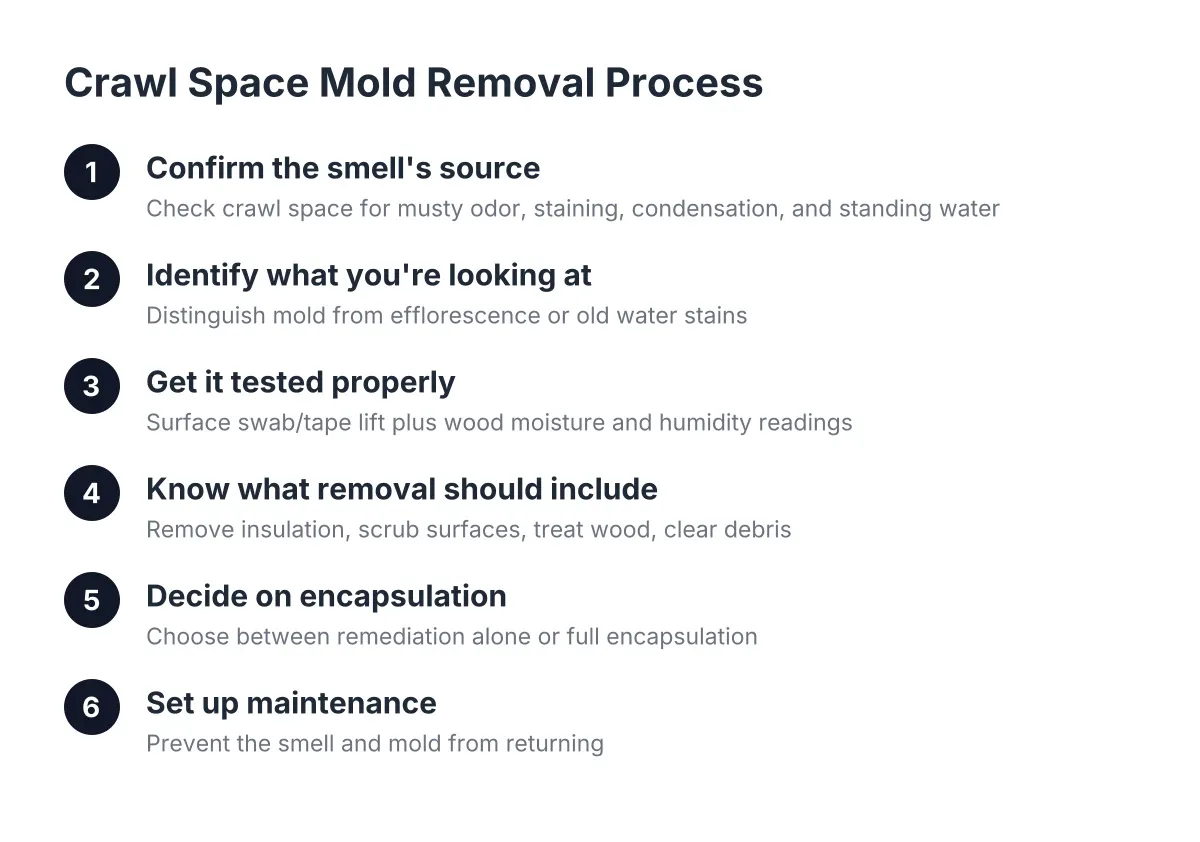
The reliable way to find out is a crawl space inspection paired with testing when needed. For crawl spaces, a surface test on the joists or subfloor gives a truer answer than an air sample, because the crawl space is not conditioned living space and air samples down there skew the results. Signs an inspector will check for include:
- Visible growth on floor joists, beams, or the subfloor
- Condensation on ductwork, pipes, or the vapor barrier
- Standing water or damp soil
- Sagging insulation or a torn, incomplete vapor barrier
- Wood moisture readings above the safe range
A homeowner in Charleston can do a first check with a flashlight from the access door. But confirming the extent, and reading wood moisture levels, is a job for someone who crawls the whole footprint.
6. What Kills Mold Permanently: Fix the Moisture First
Nothing kills mold permanently if the moisture that feeds it is still there. Sprays and fogging treatments remove existing growth, but mold returns within months when humidity stays high or water keeps getting in. Any honest crawl space mold removal plan starts by finding and fixing the moisture source: a plumbing leak, poor yard drainage, groundwater intrusion, or humid outside air pouring through foundation vents.
This is where Charleston works against you. High tides and flood-prone lots keep soil wet, and NOAA Tides and Currents recorded 17 high-tide flood days in Charleston during the 2023-24 meteorological year. Vented crawl spaces then pull in humid coastal air all summer. As a result, remediation without moisture control is a temporary fix here, no matter what chemical gets sprayed on the wood.
One safety note: treating mold in an enclosed crawl space calls for gloves, a respirator, eye protection, and covered skin, because sprays splash back in a tight space. That alone is a reason most homeowners leave treatment of joists and subfloor to a crew with the right gear.
7. Mold Remediation vs. Encapsulation: You May Not Need Both
Remediation removes the mold that exists today. Encapsulation controls the moisture that would grow tomorrow's mold, by sealing heavy plastic sheeting across the entire crawl space floor and up the stem walls, as the U.S. Department of Energy describes it, usually paired with a dehumidifier. They solve different problems, and a good specialist will tell you which one your crawl space actually needs.
Suppose a longtime Charleston homeowner finds light surface mold on a few joists, with humidity as the only moisture source. In that scenario, remediation plus a crawl space dehumidifier and a sound vapor barrier might solve it for an estimated $2,000 to $4,000, without full encapsulation. Now suppose a seller gets an inspection report two weeks before closing that flags widespread mold, standing water, and a failed vapor barrier. That situation typically calls for remediation plus encapsulation and drainage, often in the $5,000 to $10,000 range as a rough estimate, because the moisture sources are multiple and active.
The honest trade-off: skipping encapsulation saves money up front but leaves the crawl space exposed to Lowcountry humidity, so mold can return. Paying for encapsulation when a dehumidifier would have handled it wastes thousands. The right call depends on your actual moisture readings, not a sales script.
8. What Crawl Space Mold Removal Costs, and What Inflates the Bill
Mold removal cost depends on the square footage affected, how bad the growth is, access under the house, and whether debris, old insulation, or standing water must be handled first. As a rough range, treating mold on floor joists in a typical Charleston crawl space runs from the low thousands for moderate surface growth to more when structural wood repair or drainage work enters the picture. Mold remediation cost quotes vary widely, so get the scope in writing.
For a seller under a closing deadline, watch for two traps. First, franchises that quote a flat "whole package" price without documenting what the inspection found. Second, quotes that bundle encapsulation, dehumidifier, sump pump, and remediation as a single non-negotiable line item. Ask for the scope broken out by task. A legitimate specialist can tell you which parts the inspection report requires and which parts are optional protection.
Getting a Straight Answer on Crawl Space Mold and Your Health
Crawl space mold health concerns are real, but they run on facts, not fear. The practical path looks like this:
- Get a full crawl space inspection with moisture readings, not a peek from the access door.
- Confirm mold with a surface test on joists or subfloor if the visual findings are unclear.
- Identify and fix the moisture source before any treatment.
- Remove the existing mold with proper protective equipment.
- Decide on moisture control, whether a dehumidifier, vapor barrier, drainage, or full encapsulation, based on your crawl space's actual conditions.
If any contractor jumps straight to step five without doing steps one through three, keep looking. And if anyone in your home has ongoing respiratory symptoms, talk to a doctor about the health side while a specialist handles the crawl space side. In Charleston's climate, mold under the house is common, fixable, and worth taking seriously; it is not a reason to sign anything under pressure.
If you need crawl space encapsulation, Low Country Crawl Space Repair can help.
Prefer to talk it through? Call +18542013678 — a quick call is usually the fastest way to get a straight answer for your situation.