Musty Crawl Space Smell: How to Trace It, Fix It, and Document the Repair
A musty smell before closing is a critical issue that can derail a sale, especially when it shows up at the worst time—like the week after a home inspection when your buyer's agent starts asking questions. Before you pay for any fix, you need to confirm the crawl space is actually the source. Plenty of Charleston sellers have paid for treatments that masked an odor without touching the cause, and the smell came back before closing. This guide walks you through a step-by-step process: trace the smell, confirm the source, fix the real problem, and get the paperwork that satisfies a buyer's agent.
That order matters. Odor is a symptom. In the Lowcountry, the cause is almost always moisture, and moisture has to be found before it can be fixed.
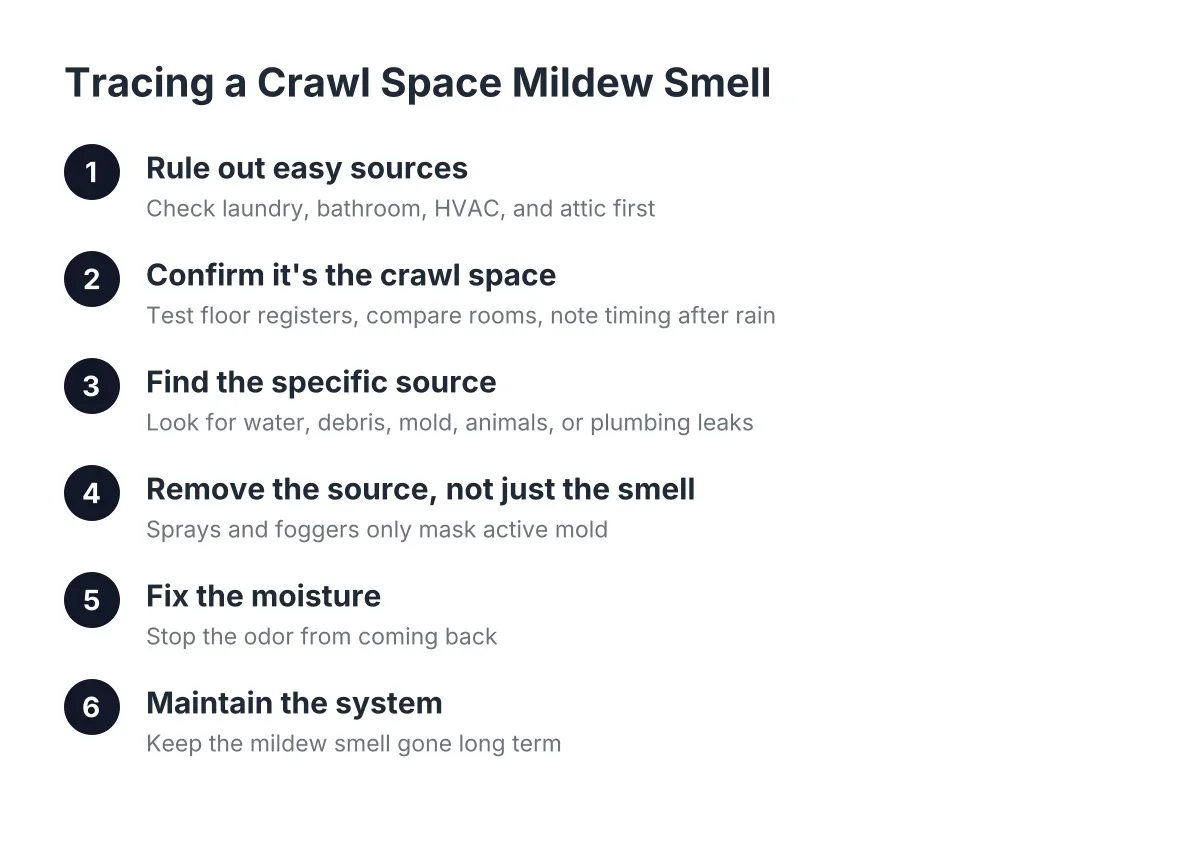
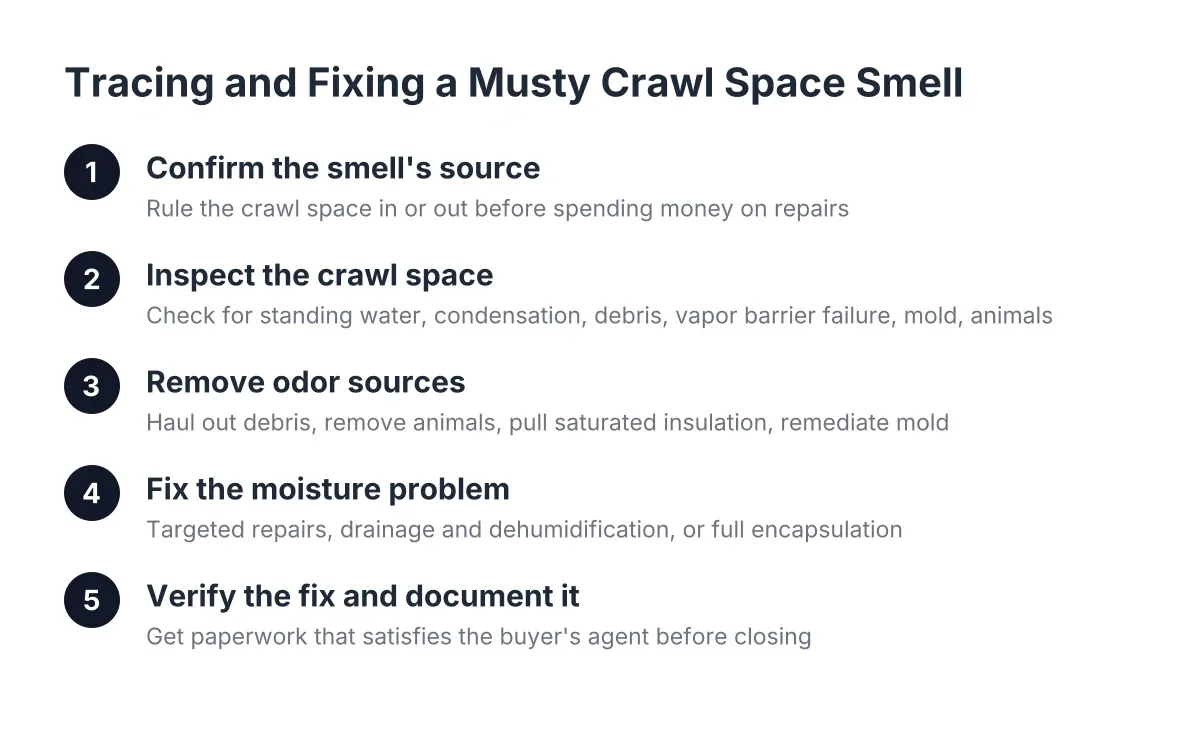
Step 1: Confirm the Smell Is Coming From the Crawl Space
Start by ruling the crawl space in or out before you spend a dollar. A mildew smell in a house can also come from an HVAC drain pan, a leaking washing machine hose, a roof leak in the attic, or wet carpet padding. If you fix the crawl space and the smell was the dishwasher, you have wasted time you do not have before closing.
Run these quick checks over one or two days:
- Notice the timing. If the odor gets stronger when the heat or air conditioning kicks on, air is likely being pulled up from the crawl space through gaps in the floor and ductwork.
- Check the location. A musty smell that is strongest near floor registers, in first-floor closets, or in rooms directly above the crawl space points down, not up.
- Test after rain. A crawl space that smells musty after rain, then fades over a few dry days, signals ground moisture or drainage problems under the house.
- Do the door test. Open the crawl space access door and take a breath. If the smell under the house matches the smell in your living room but stronger, you have found your source.
So what does mold smell like, exactly? Most people describe it as earthy, damp, and stale, like wet cardboard or old books left in a garage. Mildew smells similar but sharper. A sweet, sickly, or rotten odor is different; that usually means a dead animal or a sewage leak, which changes the fix in Step 3.
Step 2: Inspect the Crawl Space to Identify Musty Smell Before Closing
Next, get eyes on the space, either yours or a professional's. If your home inspection report already flagged "moisture intrusion" or "evidence of mold," this step confirms what the inspector saw and how bad it is. Wear old clothes, bring a bright flashlight, and look for these specific things:
- Standing water or damp soil. Puddles, dark wet patches, or mud mean water is getting in through the ground or the foundation walls.
- Condensation. Water droplets on ductwork, pipes, or the subfloor mean humid outside air is condensing on cool surfaces. This is the classic Charleston pattern: warm, humid coastal air pours through foundation vents, hits cooler surfaces under the house, and condenses. That dampness feeds mold and rot over time.
- Organic debris. Old cardboard, scrap lumber, carpet remnants, and construction trash soak up moisture and hold odor for years. Debris is one of the most overlooked causes of a persistent musty crawl space smell.
- A failed or missing vapor barrier. Plastic that is torn, shifted, or covering only part of the dirt floor lets ground moisture evaporate straight into the crawl space. Loose plastic thrown over dirt is not a moisture control system, and homes with that setup tend to have a musty smell in the house that never fully goes away.
- Mold growth. Look for fuzzy or stained patches on floor joists, beams, and the subfloor, especially near vents and in corners.
- Animal evidence. Droppings, nesting material, or a strong rotten odor point to rodents or a dead animal, which must be physically removed before anything else will help.
This is not an unusual problem, and it is not a sign you neglected the house. More than 60 percent of U.S. homes have had water or moisture problems in their basement or crawl space, according to the American Society of Home Inspectors. On Charleston's high water tables and flood-prone lots, vented crawl spaces under older pier-and-beam homes are especially prone to it. Charleston set a record of 17 high-tide flood days during the 2023 to 2024 meteorological year, according to NOAA Tides and Currents; ground that wet does not stay out of your crawl space on its own.
If you are under contract with a closing date, this is the point where a professional crawl space inspection earns its keep. A specialist can measure wood moisture content and humidity, photograph the conditions, and give you a written scope of work, which is exactly the documentation trail a buyer's agent wants to see.
Step 3: Remove the Odor Sources Before Treating the Air
Physically remove every visible source of odor before any air treatment. Foggers, ozone machines, and sprays applied over wet debris and active mold buy you a few odor-free days at best. For a pending sale, that is a risk you cannot afford, because the smell can return before the final walkthrough. Detecting a musty smell before closing inspections complete means the source must be eliminated, not masked.
Cleanup means:
- Hauling out all debris: cardboard, wood scraps, old insulation, carpet, and trash.
- Removing any dead animals and droppings, then cleaning the affected soil or surfaces.
- Pulling out saturated or mold-covered insulation that cannot be salvaged.
- Professional mold removal on affected joists and subfloor where growth is confirmed. Mold remediation on structural wood is not a spray-and-walk-away job; the surfaces need to be treated and the moisture source corrected, or the growth returns.
Only after the sources are gone does crawl space odor removal work as a finishing step rather than a cover-up. Air scrubbing and odor treatment then remove what lingers in the air and the wood, instead of fighting a source that keeps producing smell.
Step 4: Fix the Moisture Problem That Caused the Smell
However, cleanup alone will not keep the smell from coming back, because the moisture that created it is still there. This is the step where sellers face a real decision, so it helps to see the options side by side.
Option A: Targeted repairs
If the inspection found a single, specific cause, a targeted fix may satisfy the buyer. Examples include repairing a plumbing leak, replacing a torn vapor barrier with a properly installed one, or correcting exterior grading and gutters so rainwater stops running under the house. Proper vapor barrier installation matters here. Real encapsulation-grade work runs the plastic across the entire floor and seals it to the stem walls and around support piers, according to the U.S. Department of Energy, rather than laying sheets loosely on the dirt.
The trade-off: targeted repairs cost less and go faster, but they leave the crawl space vented to Charleston's humid outside air. In this climate, humidity alone can keep a crawl space damp even after the original leak is fixed.
Option B: Drainage and dehumidification
Where standing water shows up after rain, drainage comes first. A perimeter drain and sump pump move water out before it can sit and feed mold. Grading the crawl space soil so it slopes slightly toward the drain helps water reach the sump instead of pooling in the middle, a detail noted by the Building America Solution Center. Pair drainage with a crawl space dehumidifier and you control both liquid water and airborne humidity.
Option C: Full crawl space encapsulation
Encapsulation seals the crawl space off from ground moisture and outside air entirely: sealed vapor barrier, closed vents, insulated walls, and usually a dehumidifier, with a sump pump as a backstop for flooding. For a home in a flood zone or with recurring moisture findings, this is the fix that ends the cycle. Homeowners who encapsulate commonly report that the musty smell they noticed upstairs disappears, and does encapsulation stop musty smell is one of the most common questions sellers ask; when the moisture sources are handled first, the honest answer is yes in most cases.
The trade-off: it costs the most and takes longer to schedule. For a pre-sale fix, many Charleston sellers land somewhere between Options A and C based on what the inspection report actually flagged and what the buyer is asking for. As an illustrative scenario, suppose a seller on James Island gets a report citing "elevated moisture and surface mold on floor joists" three weeks before closing. Mold remediation plus a sealed vapor barrier and dehumidifier might resolve the findings and produce clean documentation, without the full cost of encapsulating a dry-but-humid crawl space. A specialist can price both paths so the seller, and the buyer's agent, can compare.
One honest caution: if the inspection also noted sagging floors, damaged beams, or foundation movement, moisture work alone will not close that gap. Structural support and foundation repair need their own scope, and that is not a do-it-yourself call.
Step 5: Verify the Fix and Get Documentation for the Buyer
Finally, prove the problem is solved. For a pre-sale repair, the paperwork is nearly as important as the work itself. Before you consider the job done, collect:
- A written scope of work describing what was found and what was done.
- Before-and-after photos of the crawl space.
- Moisture and humidity readings taken after the repair, showing the space is in a healthy range.
- An invoice or receipt from the company that did the work.
That packet gives your realtor something concrete to hand the buyer's agent, which is usually what keeps a spooked buyer from renegotiating. Then confirm the result yourself: after a week, walk the house on a humid day and after a rain. The mildew smell in the house should be gone, not fainter. If you are wondering how to get rid of the mildew smell that lingers in fabrics or carpet upstairs, wash or clean those items once the crawl space is fixed; they hold old odor even after the source is gone.
Why a Musty Crawl Space Smell Keeps Coming Back
A musty crawl space smell returns when only the symptom was treated. Odor sprays, a few sheets of plastic, or opening the vents wider do not remove moisture; in Charleston, open vents often make humidity worse. The smell comes back because mold and dampness are still active under the floor.
It is also worth knowing that a sealed crawl space can smell musty too. An encapsulated crawl space that still smells usually has a moisture problem inside the sealed envelope: a plumbing leak, a gap in the vapor barrier seal, or a dehumidifier that failed or was never installed. Encapsulation is a system, not a plastic liner, and every part has to work.
Is it normal for a crawl space to have some odor? A faint earthy smell in a vented dirt crawl space is common; about 15 percent of American homes sit on crawl space foundations, according to JSE Labs, and most vented ones smell like the ground beneath them. What is not normal is that odor reaching your living space, getting stronger after rain, or coming with visible mold. That is a moisture problem announcing itself, and in a real estate transaction it is a problem worth fixing correctly, once, with the receipts to show for it.
If you need crawl space encapsulation, Low Country Crawl Space Repair can help.
Prefer to talk it through? Call +18542013678 — a quick call is usually the fastest way to get a straight answer for your situation.