Charleston’s Humidity and Tidal Water: Why Crawl Spaces Fail Faster Here
If your inspection report just flagged moisture or mold under your house, the first thing to understand is that Charleston's humidity and tidal water push crawl spaces harder than almost anywhere else in the country. A crawl space that would stay dry for decades in Charlotte or Atlanta can rot out in a few years on the peninsula or Sullivan's Island—which is why understanding why crawl spaces fail faster in Charleston matters whether you are trying to close a sale on schedule or trying to keep an already-encapsulated crawl space working for the long haul. This guide explains why the Lowcountry is so hard on crawl spaces, what a maintained system looks like, and how to catch problems before they show up in someone else's inspection report.
Why Charleston's Humidity and Tidal Water Wreck Crawl Spaces Faster
Charleston sits on a coastal plain with a high water table, salt marshes on three sides, and air that stays humid most of the year. Under an older home, those three forces work together. Ground moisture rises from the soil, tidal water pushes up from below during king tides and storms, and humid outside air pours in through foundation vents all summer.
The numbers back this up. Charleston set a record of 17 high-tide flood days during the 2023-24 meteorological year, according to NOAA Tides and Currents. Those are days when tidal water rose high enough to flood streets and low lots, and much of that water ends up under houses. When the tide recedes, the moisture stays behind in the soil, the wood, and the air trapped beneath your floor.
This is not a rare problem. More than 60% of homes in the U.S. have had water or moisture problems in their basement or crawl space, according to the American Society of Home Inspectors. Charleston homes sit at the wet end of that statistic. About 15% of American homes have a crawl space foundation, according to JSE Labs, but on the peninsula and the barrier islands, raised pier-and-beam construction is closer to the rule than the exception.
Moisture is the root of everything that follows. Damp soil and humid air feed mold on the joists. Mold and sustained wetness lead to wood rot. Rot weakens beams and causes sagging floors. Soft, damaged wood then attracts pests. Every item an inspector flags in a Charleston crawl space, from the musty smell to the fungal growth on the subfloor, traces back to moisture that was never controlled.
Why Crawl Spaces Fail Faster in Vented Designs During Coastal Humidity
Older Charleston homes were built with vented crawl spaces on the theory that airflow would dry things out. In a hot, humid coastal climate, the opposite happens. Summer air here often carries more moisture than the air already under the house. When that humid air hits cooler framing and ductwork, it condenses, the same way a glass of sweet tea sweats on a porch in July.
As a result, a vented crawl space in Charleston can be wetter with the vents open than closed. Humidity soaks into fiberglass insulation until it sags, falls, and crumbles when touched. Bare soil under the house makes it worse, because exposed dirt, especially clay, holds tidal and ground moisture and releases it upward day after day. That is the cycle encapsulation is designed to break, and it is the cycle that restarts the moment an encapsulation system stops being maintained. This is why understanding how and why crawl spaces fail faster in challenging coastal climates is essential to preventing long-term damage.
What a Healthy Encapsulated Crawl Space Looks Like
Before you can maintain a system or judge whether a repair quote is fair, you need to know what "done right" means. Crawl space encapsulation runs heavy plastic sheeting across the entire crawl space floor and seals it to the stem walls and around support piers, according to the U.S. Department of Energy. It is not a loose sheet of plastic tossed on the dirt, which is what many pre-sale sellers discover their house actually has.
A complete moisture control system for a Charleston home usually includes several parts working together:
- A sealed vapor barrier covering the floor and foundation walls, with seams taped and edges fastened
- Sealed or closed foundation vents so humid outside air stays out
- A crawl space dehumidifier sized for the square footage, draining automatically
- Perimeter drainage and a sump pump on lots with a high water table or tidal flooding history
- Insulation at the stem walls and rim joists rather than between the floor joists
- Structural repairs first, such as support jacks or beam repair, if rot has already weakened framing
Two details matter for coastal lots specifically. First, grading and leveling the crawl space soil before installing the drainage system, sloped slightly toward the drain, helps water move to the perimeter drain and sump pump instead of pooling in the middle, according to Building America Solution Center (PNNL/DOE). Second, a sump pump in an encapsulated crawl space acts as the emergency exit for water; without one, a sealed space can trap floodwater like a pool, according to the same source. On a flood-zone lot downtown or near the marsh, skipping the pump to save money is a false economy.
One code note worth knowing before a sale: some states require a termite inspection strip near the top of the foundation wall to be left uncovered by the vapor barrier, according to Stego Industries. A buyer's inspector may look for that strip, so confirm your installer followed local requirements.
Homeowners sometimes ask about basement waterproofing because that is the term they know from up north. The logic transfers, but the methods differ. Waterproofing basement walls from the inside makes sense for a below-grade basement in Ohio. Under a raised Charleston single house, the equivalent work is sealing the crawl space, managing ground water with drainage, and drying the air. Likewise, the best dehumidifier for a basement is not automatically right for a crawl space; crawl space units are built low-profile, ducted for tight spaces, and plumbed to drain without anyone emptying a bucket.
Selling a House With a Flagged Crawl Space: What Actually Satisfies the Buyer
If you are under contract and the inspection report says "moisture intrusion" or "evidence of mold," you have two jobs: fix the actual problem, and produce documentation the buyer's agent will accept. Those are different jobs, and a specialist can usually handle both faster than a general contractor who does crawl spaces on the side.
Suppose a seller on the lower peninsula gets an inspection report back three weeks before closing. It notes elevated moisture readings on the subfloor, fungal growth on two joists, and a torn, incomplete vapor barrier. The buyer's agent asks for "professional remediation with documentation." In that scenario, the realistic scope is mold remediation on the affected framing, a new sealed vapor barrier, and a dehumidifier to keep readings down through closing and beyond. Full encapsulation with drainage may be the better long-term fix, but the seller's decision hinges on what the buyer requested and what the house needs to pass a re-inspection.
Here is the honest trade-off. A minimal fix, meaning mold removal plus a proper vapor barrier, can satisfy many buyers and costs less. However, it leaves the underlying humidity problem partly unsolved, and a sharp buyer's inspector may note that on re-inspection. A fuller moisture control system costs more up front but gives the buyer's side less to negotiate against, because the documentation shows the cause was addressed, not just the symptom. Neither answer is wrong; it depends on the buyer, the timeline, and the condition of the framing.
Whatever scope you choose, get the paperwork. A legitimate crawl space company should provide a written scope of work, before-and-after photos, moisture readings, and an invoice describing exactly what was done. That packet is what your realtor hands to the buyer's agent, and it is often the difference between closing on schedule and a price renegotiation.
Maintaining an Encapsulation Against Charleston's Humidity and Tidal Cycles
An encapsulation system is not a one-time product. It is a set of machines and materials standing between your framing and Charleston's humidity, tidal water, and hurricane-season rain, and each part needs periodic attention. This is where a maintenance-first company differs from a one-and-done installer: the goal is a system still working in year ten, not just a clean photo on install day.
Think of crawl space maintenance as a short recurring checklist rather than a project. As a working baseline for 2026, most Charleston encapsulations stay healthy on this schedule:
- Monthly, from the hatch: Glance at the humidity readout if your dehumidifier has one, and listen for the unit cycling. Target range is generally 45 to 55 percent relative humidity.
- Quarterly: Check the dehumidifier filter and drain line. Coastal air carries dust and salt that clog filters faster here than inland.
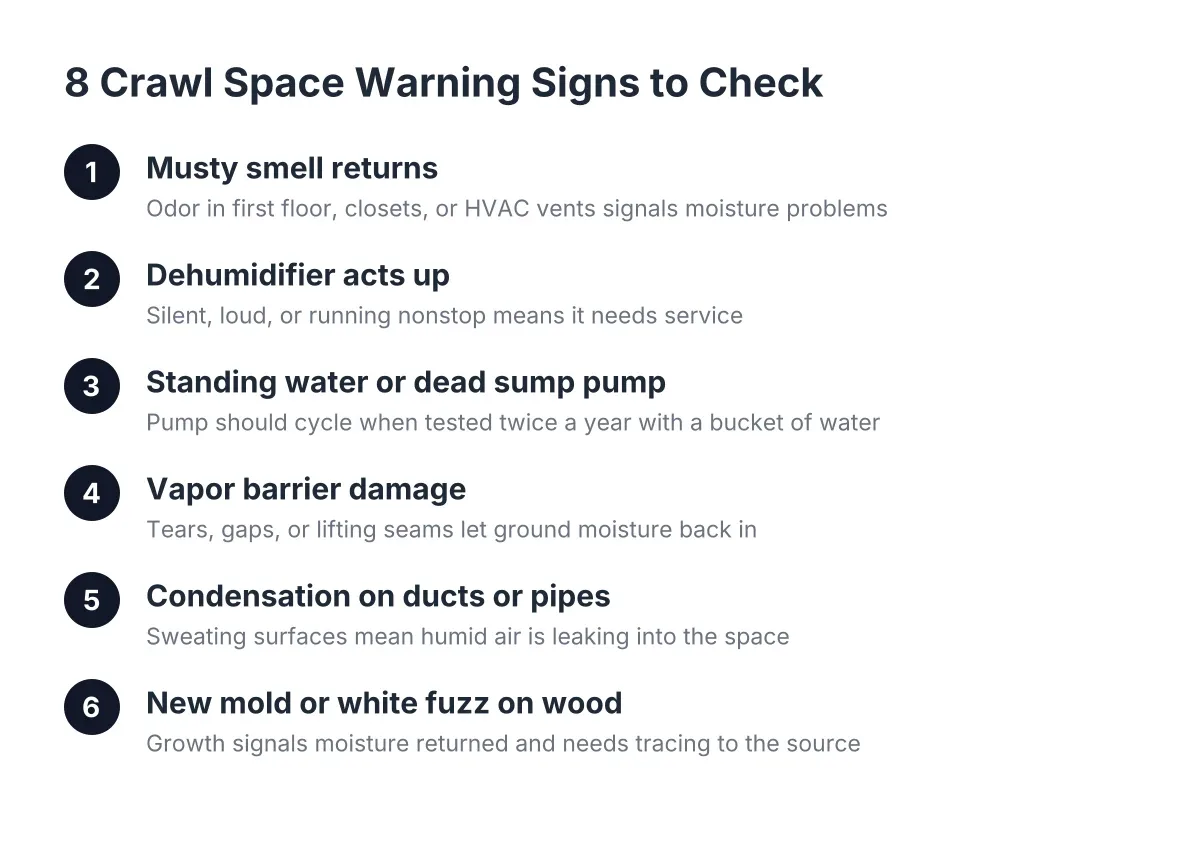
- Twice a year: Test the sump pump by pouring a bucket of water into the basin and confirming it ejects. Do this before hurricane season starts in June, and again after it ends.
- Annually: Walk or crawl the full space, or have it inspected. Look for vapor barrier tears, loose seams, standing water, new musty smells, rust on support jacks, and condensation on ducts.
- After any flood event or named storm: Do a post-hurricane crawl space checkup within a week. Tidal surge and wind-driven rain can overwhelm drainage, shift the barrier, and leave silt in the sump basin.
The dehumidifier deserves the most attention because it does the daily work. In Charleston, a crawl space dehumidifier runs harder and longer than the same unit would in a drier climate, so plan on servicing it at least once a year: clean the coils, clear the condensate line, and confirm the humidistat still reads accurately. A unit that quietly failed in March can produce visible mold by August, and if your system carries a warranty, an unserviced or dead dehumidifier is a common reason coverage gets questioned. Read your encapsulation warranty terms; most require the homeowner to keep the equipment powered and maintained.
Sump pumps fail silently too. A pump that has not cycled in months can seize, and you will not find out until a king tide pushes water under the house. The twice-a-year bucket test takes five minutes and catches most failures before they matter.
Signs Your Encapsulation Needs Repair When Crawl Spaces Fail Faster Than Expected
Some problems go beyond routine upkeep. Call a specialist rather than waiting for the annual inspection if you notice any of these:
- A musty smell returning inside the house, especially in first-floor rooms
- Humidity readings holding above 60 percent despite the dehumidifier running
- Standing water on top of the vapor barrier, which means water got past the drainage
- New sagging or bouncy spots in the floors above
- Visible mold on framing at the crawl space entrance
- The dehumidifier running constantly without ever reaching its set point
Standing water on the barrier after a tidal flood is the one not to ignore. A sealed liner holds that water in place against your foundation and piers until someone removes it, which is exactly the situation a working sump pump exists to prevent.
When Maintenance Is Not Enough: Structural and Air Quality Issues
Moisture problems that ran unchecked for years leave damage that no dehumidifier can reverse. Rotted beams, crushed sills, and failing piers need foundation repair and structural support: sistered or replaced beams, steel support jacks, and in some historic homes, masonry pier work. On a pre-1950s peninsula house, this work often runs into five figures, and it should involve a structural engineer, especially where preservation rules constrain what materials and methods you can use. That is a limitation worth stating plainly: an encapsulation contractor manages moisture and installs supports, but significant structural design decisions on a historic home belong with an engineer.
Air quality is the other reason maintenance pays off in a sealed system. Once a crawl space is encapsulated and conditioned, it effectively becomes part of the house; a conditioned crawl space receives supply and exhaust air and is pressure-balanced with the living space above, according to Building America Solution Center (PNNL/DOE). Air under the house and air in the house mix, so a clean, dry crawl space means less musty odor and fewer moisture-driven problems upstairs. It is also worth knowing that the average indoor radon level in South Carolina is about 1.9 pCi/L, above the national average of 1.3 pCi/L, according to Radon.org, which is one more reason a sealed ground barrier under the house is worth keeping intact.
The Bottom Line for Charleston Homeowners
Charleston's humidity and tidal water are not going away; the flooding data trends the other direction. A crawl space here fails faster than the same crawl space inland, which means both the fix and the upkeep have to be taken more seriously here than the national advice suggests.
For a seller facing an inspection report, the practical path is a scoped repair with real documentation, sized to what the buyer asked for and what the framing actually needs. For an owner protecting a historic home for the long term, the practical path is a full encapsulation with drainage, followed by the maintenance rhythm above: quarterly filter checks, twice-yearly pump tests, an annual inspection, and a checkup after every storm. The system you can hand off to a buyer, or rely on for the next thirty years, is the one somebody kept looking after once the installers drove away.
If you need crawl space encapsulation, Low Country Crawl Space Repair can help.
Prefer to talk it through? Call +18542013678 — a quick call is usually the fastest way to get a straight answer for your situation.