8 Signs Your Crawl Space Needs Maintenance Before Damage Gets Worse
If your home already has an encapsulated crawl space, or you just paid to fix one before a sale, the work is not finished. Knowing the crawl space warning signs your crawl space needs maintenance is what protects that investment, keeps your warranty intact, and keeps a buyer's inspector from flagging the same problem twice. Encapsulation systems in Charleston work hard year-round against coastal humidity, high water tables, and hurricane-season rain. Small problems show up early if you know where to look, and they cost far less to fix at that stage.
This matters even more if you are selling. Suppose an inspector flagged "moisture intrusion" in your crawl space two years ago, you had it encapsulated, and now you are listing the house. The buyer's inspector will go under that house. A well-maintained system with a service record reads as a solved problem. A neglected system with a torn vapor barrier and a dead dehumidifier reads as a red flag, and that can trigger a price renegotiation days before closing.
Moisture problems in crawl spaces do not fix themselves. They follow a predictable chain: moisture leads to mold, mold leads to wood rot, rot leads to structural damage, and structural damage attracts pests. According to the American Society of Home Inspectors, more than 60% of U.S. homes have had water or moisture problems in their basement or crawl space. Catching the early links in that chain is the whole point of maintenance. Here are eight signs to watch for.
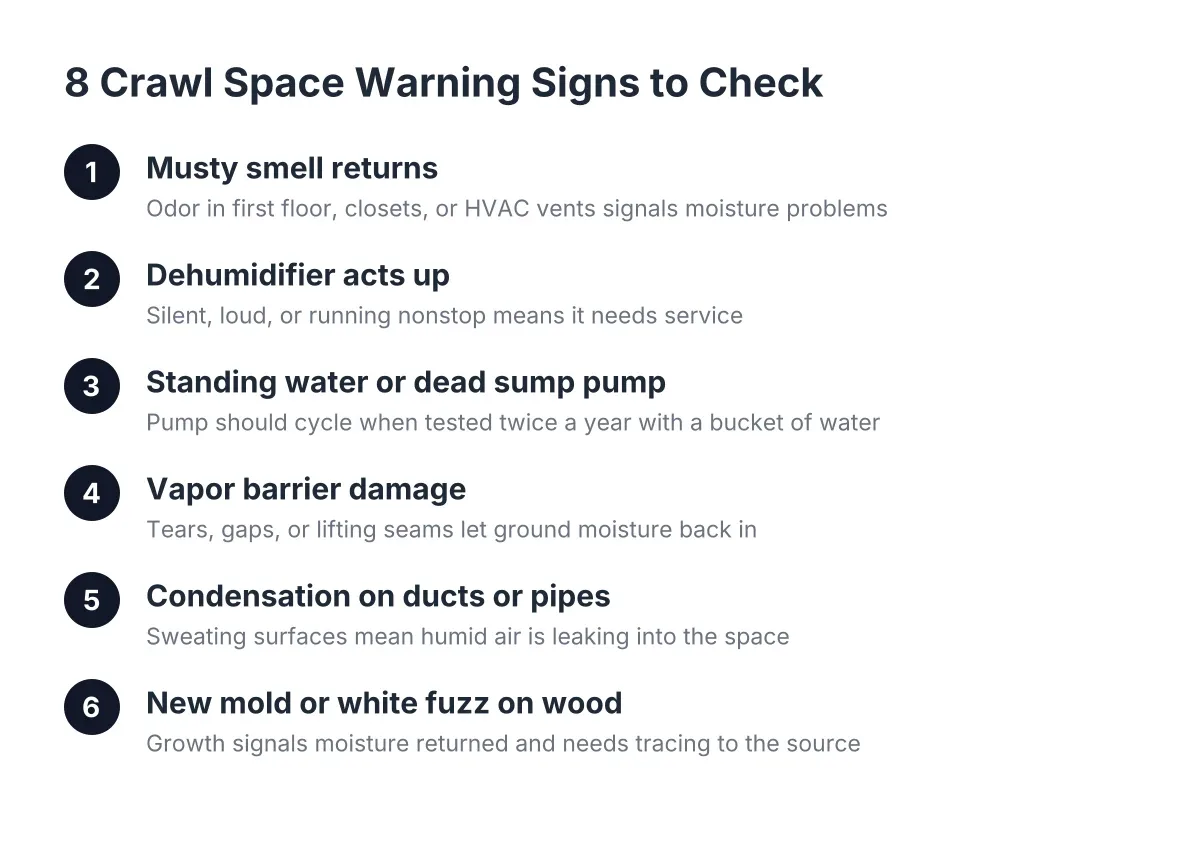
1. The Musty Smell Is Back
A properly encapsulated crawl space should not smell. If the musty smell you paid to eliminate returns to your first floor, closets, or HVAC vents, something under the house has changed. Odor is often the first warning sign of a moisture problem, and it can even signal a slow plumbing leak that has gone unnoticed for months. Do not wait for it to fade; it will not. Get under the house or schedule an inspection, because whatever is producing that smell is also feeding mold growth and degrading your air quality.
2. Your Dehumidifier Is Silent, Loud, or Running Nonstop
A crawl space dehumidifier is the workhorse of your system, and it needs regular service to keep up with Charleston humidity. Three behaviors tell you it needs attention: it never turns on, it makes new grinding or rattling noises, or it runs constantly without bringing humidity down. Most units need their filter cleaned or replaced every three to six months, and the condensate drain line checked for clogs at the same time.
Here is a simple rule: if you cannot remember the last time anyone serviced the dehumidifier, it is overdue. A unit that fails quietly in June can leave your crawl space at 80% humidity all summer, which is exactly the condition mold needs to restart.
3. Standing Water or a Sump Pump That Never Cycles
Water leaking into a basement or crawl space after heavy rain is one of the clearest signs your crawl space drainage needs attention. If your system includes a sump pump, test it at least twice a year by pouring a bucket of water into the basin. The pump should kick on, move the water, and shut off. A pump that never cycles may have a stuck float switch, a clogged discharge line, or a failed motor.
In flood-prone Lowcountry lots this is not optional upkeep. Charleston set a record of 17 high-tide flood days during the 2023-24 meteorological year, according to NOAA Tides and Currents. A perimeter drain is designed to intercept water coming in under the foundation and channel it to the sump pump, per the Building America Solution Center. If the pump is dead, that whole drainage system is dead with it.
4. Tears, Gaps, or Lifting Seams in the Vapor Barrier
The vapor barrier is your ground-level moisture barrier, and it only works if it stays sealed. Proper encapsulation runs plastic sheeting across the entire crawl space floor and seals it to the stem walls and around support piers, according to the U.S. Department of Energy, not just loose plastic laid on the dirt. Over time, seam tape can lift, plumbers and cable technicians can tear the liner, and settling soil can pull seals away from the wall.
Check the barrier once a year and after any trade works under the house. Look for these problems specifically:
- Seams where the tape has peeled or the overlap has separated
- Punctures or drag tears, especially along access paths
- Sections pulled loose from stem walls or support columns
- Dirt, standing water, or condensation on top of the liner
Small tears are cheap patch jobs. A barrier that has been open to ground moisture for a year is a reinstallation, and possibly a mold remediation job on top of it.
5. Condensation on Ducts, Pipes, or Foam Board
Sweating surfaces mean humid air is getting into the crawl space and hitting cool metal or plastic. In a sealed, conditioned crawl space that should not happen; the space is treated as part of the home's conditioned interior and pressure-balanced with the living area above, per the Building America Solution Center. Condensation usually points to a failed door seal, an open or damaged vent cover, a gap in the rim joist insulation, or a dehumidifier that is not keeping up. Find the air leak first. Drying the space without sealing the leak just runs your equipment harder for the same result.
6. New Mold Spots or White Fuzz on Wood
Mold on floor joists or beams after encapsulation means moisture got back in somewhere. Look for dark staining, green or white surface growth, or white crystalline deposits on masonry, which signal water moving through the block. Do not paint over it or spray it and call it done. Mold removal only holds if the moisture source is fixed, so treat visible growth as a symptom and trace it back to a barrier gap, a plumbing leak, or failed humidity control. Homeowners often ask whether a crawl space can make you sick; the honest answer is that damp, moldy air from under the house does mix with the air you breathe upstairs, and people in the home may notice musty odors and irritation. That is reason enough to fix it without needing a scary diagnosis.
7. Floors That Feel Soft, Bouncy, or Newly Unlevel
Sagging floors are a late-stage sign, and they mean the moisture chain has already reached wood rot or stressed structural supports. If a floor that felt solid last year now bounces near the middle of a room, or interior doors have started sticking, have the crawl space structural support checked. Support jacks can settle in soft Lowcountry soil, and rotted beam sections lose load capacity gradually, then fail suddenly. For a seller, this is the sign that turns a $500 service visit into a foundation repair line item on a buyer's inspection report. This is also the point where you need a professional evaluation, not a DIY fix; structural repairs and load calculations are not a homeowner project.
8. You Have Not Looked Under the House in Over a Year
The most common sign your crawl space needs maintenance is simply that nobody has checked it. About 15% of American homes sit on a crawl space foundation, according to JSE Labs, and most owners never go under the house. Damage in an unvisited crawl space can grow for years before it shows upstairs. So how often should you check your crawl space? Twice a year is a sound baseline: once in spring before humidity peaks, and once in fall after hurricane season. Add a post-storm check after any flooding rain or tropical system, since storm surge and saturated soil can overwhelm even a good drainage system.
Understanding Crawl Space Warning Signs for Your Home
Consistent crawl space maintenance is also warranty protection. Most encapsulation warranties assume the system is kept in working order; a dehumidifier that sat dead for a year or a barrier torn during unrelated plumbing work can complicate a claim. A simple calendar covers it:
- Every 3 to 6 months: Clean or replace the dehumidifier filter and confirm the unit holds its humidity setpoint.
- Twice a year: Test the sump pump with a bucket of water, walk the vapor barrier for tears and lifted seams, and check plumbing connections for drips.
- Once a year: Full inspection of insulation, seals, structural supports, and any signs of pests or new moisture. Verify termite inspection strips at the top of the foundation wall stay visible where local code requires it, a detail noted by Stego Industries.
- After every major storm: Quick check for standing water, pump operation, and barrier damage.
Keep the receipts and inspection notes in one folder. If you sell the house, that documentation does real work. A buyer's agent who sees dated service records next to the original encapsulation paperwork treats the crawl space as an asset, not an open question. In that scenario, a seller with a firm closing date hands over a maintenance file instead of scrambling to schedule an emergency repair, and the deal keeps moving.
Responding to Early Crawl Space Warning Signs Saves Time and Money
The pattern behind all eight signs is the same. Moisture is the root cause, and everything else, from mold to rot to sagging floors, is downstream of it. Catch the moisture early, and the rest of the chain never starts. Recognizing crawl space warning signs when they first appear prevents minor issues from becoming expensive structural failures that derail a home sale or compromise indoor air quality and structural integrity.
If you need crawl space encapsulation, Low Country Crawl Space Repair can help.
Prefer to talk it through? Call +18542013678 — a quick call is usually the fastest way to get a straight answer for your situation.