
Crawl Space Maintenance — Complete Guide
Your encapsulation is installed, the dehumidifier hums along, and your crawl space finally stays dry. However, Charleston's coastal humidity and tidal water never stop working against that system, which means crawl space maintenance is what protects your investment from here forward. This guide explains what to service and when, how to check on your system after a hurricane, and how to catch small problems before they turn into warranty headaches. You will also find links to detailed articles on costs, warning signs, terminology, and why the Lowcountry punishes crawl spaces harder than almost anywhere else. Think of this page as your home base for keeping an already-encapsulated crawl space in top shape for decades.
What You'll Find in This Guide
- Best Crawl Space Maintenance in Charleston, SC: How to Choose
- How Much Does Crawl Space Maintenance Cost?
- Crawl Space Maintenance Terms Explained: A Plain-English Glossary
- 8 Signs Your Crawl Space Needs Maintenance Before Damage Gets Worse
- Charleston's Humidity and Tidal Water: Why Crawl Spaces Fail Faster Here
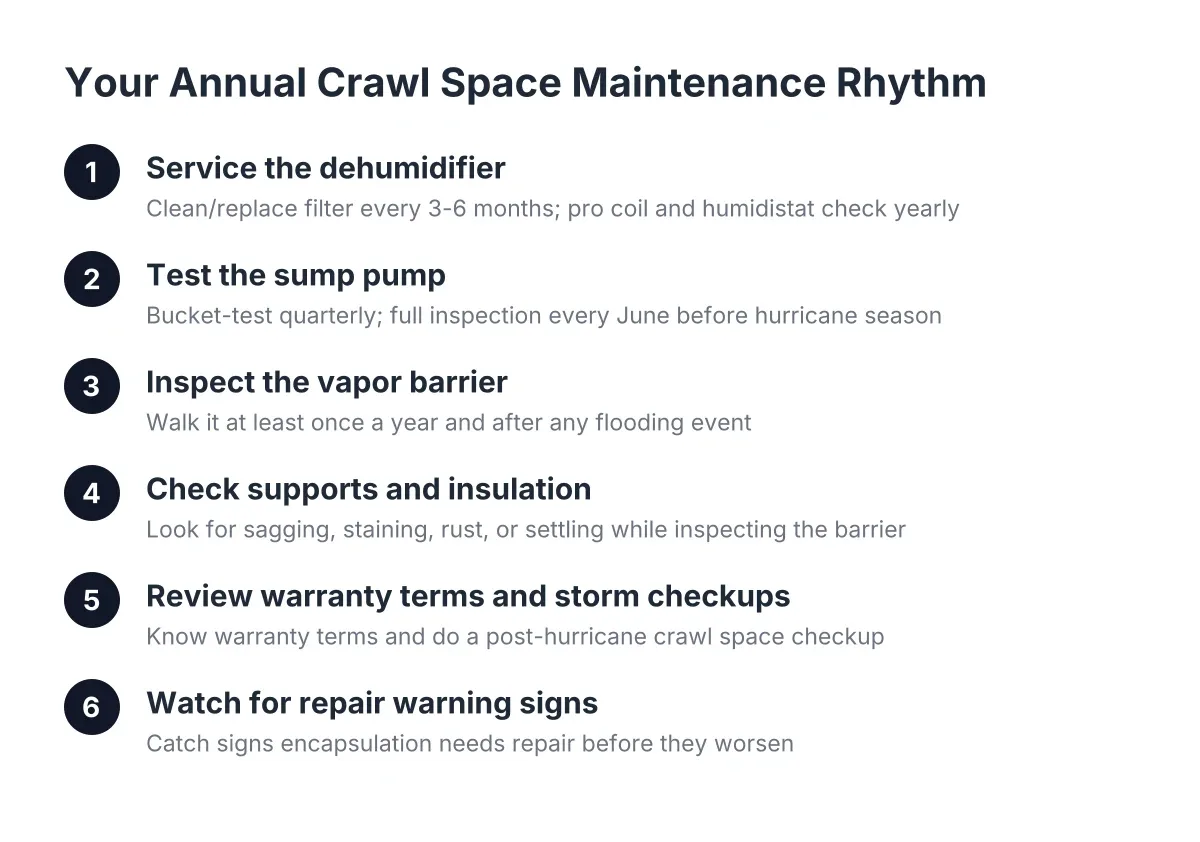
Your Crawl Space Maintenance Schedule: What Needs Service and When
An encapsulated crawl space is a system, not a product. As a result, each component has its own service rhythm, and skipping one weakens the others. Here is the schedule that keeps a Charleston-area system healthy.
Dehumidifier Servicing: Every Six Months
Your crawl space dehumidifier runs harder here than it would almost anywhere inland. Charleston humidity stays high nearly year-round, so the unit rarely gets an off-season. Plan on a professional service check every six months. That visit should cover cleaning or replacing the filter, checking the coils, confirming the condensate drain flows freely, and verifying the humidistat still reads accurately. Between visits, glance at the unit monthly. If it runs constantly but humidity readings keep climbing, something is wrong. A struggling dehumidifier often signals a bigger issue, such as a vapor barrier gap letting ground moisture back in.
Sump Pump Checks: Quarterly, and Before Hurricane Season
A sump pump that fails during a June deluge is worse than no pump at all, because you assumed you were protected. Consequently, test yours quarterly. Pour a bucket of water into the basin and confirm the pump kicks on, moves the water, and shuts off cleanly. Additionally, check that the discharge line outside is clear and drains away from the foundation. Before hurricane season starts, have a professional inspect the float switch, check valve, and battery backup if you have one. Pumps in tidal and flood-zone lots cycle far more often than pumps inland, so they wear out faster.
Vapor Barrier Inspection: Annually, Minimum
Your vapor barrier is the backbone of the whole encapsulation. Once a year, someone needs to get under the house and look at every seam, every pier wrap, and every wall attachment. Tears from settling, seam tape peeling in humidity, or water pooling on top of the liner all demand quick repair. To put it simply, a small breach today becomes a moisture problem next season. If you are not sure what the inspector's report means when it mentions seam failure or capillary moisture, our plain-English glossary of crawl space terms translates all of it.
Hurricane Season and Tidal Flooding: The Post-Storm Checkup
Maintenance schedules built for Ohio or Colorado do not survive contact with Charleston. Here, the calendar bends around two local forces: hurricane season and tidal flooding. According to NOAA Tides and Currents, Charleston set a record of 17 high-tide flood days during the 2023-24 meteorological year. That water does not politely stay in the street. On low-lying lots, it pushes up through the soil under your home and tests every seam and sump basin you own. Our article on why crawl spaces fail faster in Charleston's tidal environment explains the mechanics in detail.
What a Post-Storm Checkup Covers
After any named storm, tropical system, or major king tide event, schedule a crawl space checkup even if your house looks fine from the street. The inspection should confirm four things. First, that no standing water sits on top of or beneath the vapor barrier. Second, that the sump pump ran, kept up, and still works. Third, that the dehumidifier is pulling humidity back down to its setpoint rather than fighting a losing battle. Fourth, that storm surge or wind-driven rain did not compromise vents, crawl space doors, or drainage lines.
Beyond that, a post-storm visit catches subtler damage. For example, saturated soil can shift piers slightly, which stresses beams and opens gaps at vapor barrier attachment points. Debris washed against foundation vents can block airflow or trap moisture against the block. None of these problems announce themselves. Instead, they compound quietly until you smell mustiness upstairs or notice a floor starting to bounce.
Why Timing Matters
Moisture damage is a race against biology. Mold can establish itself on damp wood within days, not months. Therefore, the window between a storm and your checkup matters more than most homeowners realize. If you wait until fall to look at June flooding, you are inspecting the aftermath instead of preventing it. With this in mind, we recommend booking post-storm checkups within two weeks of any significant flood event. Homeowners on maintenance plans get priority scheduling during those crunch periods, which is exactly when every crawl space company's phone rings at once.
Protecting Your Warranty: Catch Small Problems Before They Void Coverage
Most encapsulation warranties come with fine print, and the fine print usually says the same thing: coverage depends on maintaining the system. Skip your dehumidifier service for two years, and a warranty claim for mold or liner failure gets complicated fast. However, this is not just a contractual technicality. The warranty terms exist because an unmaintained system genuinely fails faster, and the failure modes are predictable.
Know What Your Warranty Actually Requires
Pull out your encapsulation paperwork and read the maintenance clause. Typically, warranties require documented service at set intervals, use of compatible replacement parts, and prompt repair of any damage you discover. Additionally, some warranties exclude damage from events you could have prevented, like a sump pump failure you knew about but ignored. Keep records of every service visit, every filter change, and every inspection report. If you ever need to file a claim, that paper trail is your best friend. Documentation also matters at resale, because buyers and home inspectors increasingly ask for proof that an encapsulated crawl space received real crawl space maintenance rather than a one-time install and years of neglect.
The Early Signals That Something Needs Attention
You do not need to crawl under your house monthly to protect your system. Instead, learn the upstairs symptoms that point to trouble below. A returning musty smell, humidity readings creeping above 60 percent, condensation on ductwork, cupping hardwood floors, or a dehumidifier that never cycles off all deserve a call. Our guide to the 8 warning signs your crawl space needs maintenance walks through each symptom and what it usually means. Moisture problems are common enough that ignoring early signals is a genuine gamble. In fact, more than 60 percent of U.S. homes have had water or moisture problems in their basement or crawl space, according to the American Society of Home Inspectors. An encapsulation dramatically improves your odds, but only while it stays intact.
Budget for Upkeep, Not Just Repairs
Routine crawl space maintenance costs a fraction of what a failed system costs to rebuild. Replacing a torn liner section, servicing a dehumidifier, or swapping a worn sump pump are all modest line items. Conversely, re-encapsulating a moldy crawl space means paying for remediation, new materials, and labor all over again. For a realistic breakdown of what ongoing service runs in the Charleston area, see our crawl space maintenance cost guide. The EPA's guidance on moisture control in homes reinforces the same principle: controlling moisture continuously is always cheaper than fixing what moisture destroys.
Choose a Partner, Not a One-Time Installer
Plenty of companies will encapsulate your crawl space and disappear. That model works fine in dry climates. In the Lowcountry, it leaves homeowners maintaining a complex system alone in one of the most punishing moisture environments in the country. That said, not every local contractor approaches maintenance the same way either. If you are weighing options, our guide to choosing the best crawl space maintenance in Charleston covers the questions worth asking, from service plan structure to how a company handles post-hurricane demand. Look for a company that knows your system, keeps your service history, and treats your crawl space as an ongoing relationship rather than a finished job.
Ready to Get Started?
Your encapsulation was the investment. Consistent maintenance is what makes it pay off for the next twenty years instead of the next five. Reach out to Low Country Crawl Space Repair to set up a maintenance plan built around Charleston's humidity, tides, and hurricane seasons, and let a local specialist keep your system, and your warranty, in good standing.