Crawl Space Flooding Causes: How Water Gets Under Charleston Homes
If you just found standing water under your house after a storm, or a home inspector flagged moisture in your crawl space right before closing, you need to know two things fast: where the water came from and how to stop it from coming back. Understanding crawl space flooding causes is the first step to both. In Charleston, water gets under a house through a handful of predictable paths, and each one points to a different fix. This guide walks through those paths, how to tell which one you are dealing with, and what a real repair looks like, whether you have a closing date bearing down on you or you just want your house dry before hurricane season.
First, Take a Breath: Water Under the House Is Common Here
Finding water in your crawl space feels like an emergency, and sometimes it is. But you are not alone, and your house is not condemned. More than 60% of homes in the U.S. have had water or moisture problems in their basement or crawl space, according to the American Society of Home Inspectors. In the Lowcountry, that number is not surprising to anyone who has crawled under a house near the marsh.
Charleston stacks the deck against dry crawl spaces. The water table sits high, many lots sit in or near flood zones, and coastal humidity runs year-round. Tidal flooding is a real factor too; Charleston set a record of 17 high-tide flood days during the 2023–24 meteorological year, according to NOAA Tides and Currents. Add a summer of afternoon downpours and a tropical system or two, and the ground around your foundation stays saturated for weeks at a time.
The good news is that water intrusion follows physics, not luck. Once you know the entry path, you can block it. The rest of this guide breaks down the specific crawl space flooding causes we see under Charleston homes and how each one gets fixed.
What Causes Crawl Space Flooding in Charleston Homes
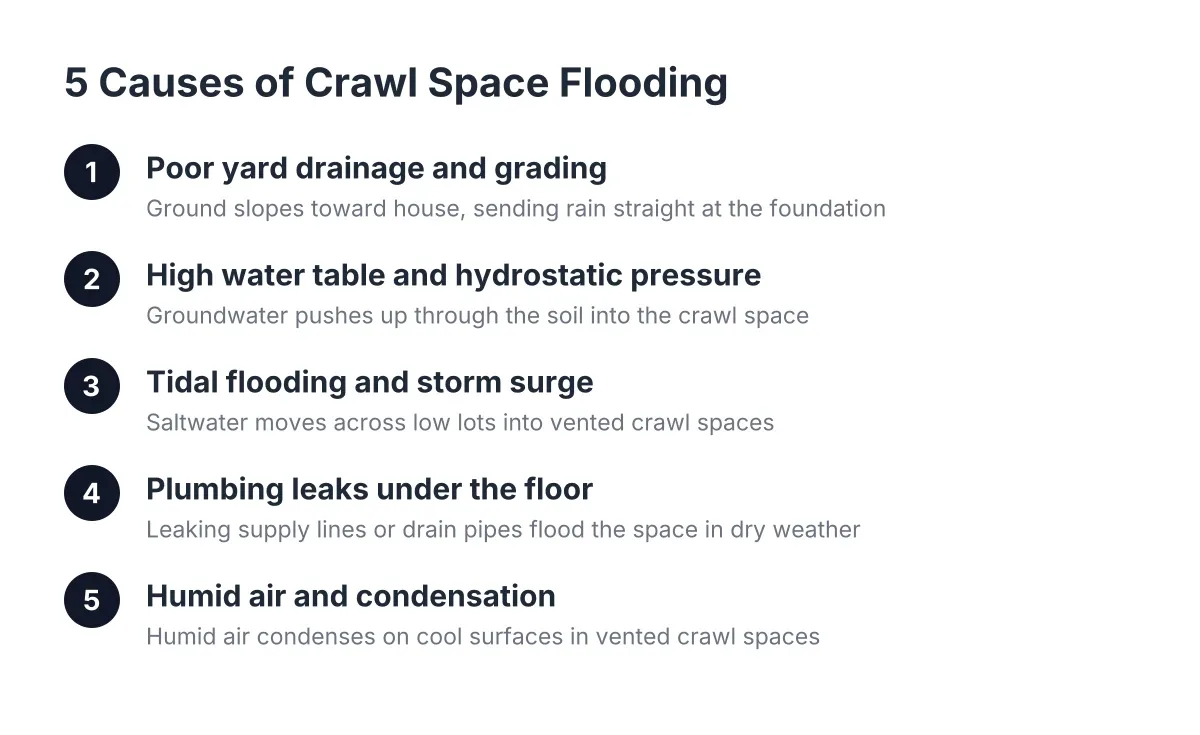
Crawl space flooding in Charleston homes comes from five main sources: surface water from poor yard drainage, a high water table pushing up from below, tidal and storm surge intrusion, plumbing leaks, and humid air condensing inside a vented crawl space. Most flooded crawl spaces involve two or more of these at once, which is why a single cheap fix often fails.
Poor yard drainage and grading
This is the most common path, and the one homeowners can sometimes see from the driveway. When the ground slopes toward the house instead of away from it, every rainstorm sends water straight at the foundation. That water pools against the stem wall, finds a low spot, and seeps under the footing into the crawl space.
Clogged gutters and short downspouts make it worse. A downspout that dumps roof water two feet from the foundation is delivering hundreds of gallons per storm to exactly the wrong place. If you see a high waterline on your crawl space piers or walls, plus failed gutters and soggy soil around the house, that combination points to a chronic flooding problem, not a one-time event.
High water table and hydrostatic pressure
In much of the Charleston area, groundwater sits only a few feet below the surface. After a week of heavy rain, it can rise to the level of your crawl space floor. When that happens, water does not flow in through a gap; it pushes up through the soil itself. You will see water appearing in the middle of the crawl space with no visible entry point.
No amount of gutter work fixes this cause. Water rising from below has to be collected and pumped out, which is why homes on low lots often need interior drainage and a sump pump rather than just exterior grading.
Tidal flooding and storm surge
Homes near the harbor, the rivers, and the marsh face a cause most of the country never deals with. During king tides and tropical systems, saltwater can move across low lots and directly into vented crawl spaces. Older Charleston homes built on raised pier-and-beam foundations were designed with this in mind; the house sits above the water. But the crawl space below still takes on water, and saltwater is harder on metal fasteners, ductwork, and equipment than rainwater.
If your home has flooded from tide or surge even once, plan on it happening again. Prevention here means managing the water when it arrives, not pretending it will not.
Plumbing leaks under the floor
Not all water under the house falls from the sky. A leaking supply line, a failed water heater drain, or a cracked drain pipe can flood a crawl space slowly for months. The tell is water that appears in dry weather, or a wet zone concentrated under a bathroom or kitchen. This cause is worth ruling out first because the fix is a plumber, not a drainage system, and no waterproofing work will hold up while a pipe keeps leaking.
Humid air and condensation in vented crawl spaces
This one surprises people because there is no flood, just constant dampness. Most older Charleston homes have vented crawl spaces, built on the theory that outside air would dry things out. In our climate, the opposite happens. Humid summer air pours through the vents, hits cooler surfaces like ductwork and floor joists, and condenses into water droplets. Day after day, that condensation soaks insulation, drips onto the vapor barrier, and feeds mold on the wood above.
An unsealed crawl space open to outside air also lets that humidity migrate up into your living space. If your house smells musty every summer, this is often why.
How to Tell Which Flooding Cause You Have
You can narrow down the cause of crawl space flooding by reading the evidence: when the water appears, where it enters, and what it leaves behind. Water after every rain points to drainage or grading. Water in dry weather points to plumbing or the water table. Dampness without standing water points to humidity and condensation.
Here is a quick diagnostic checklist:
- Water only after storms, near the perimeter: surface drainage, grading, or gutter failure.
- Water rising in the middle of the space with no entry point: high water table and hydrostatic pressure.
- Water after king tides or named storms, sometimes with a salt residue: tidal intrusion.
- A wet zone under one bathroom or the kitchen, in any weather: plumbing leak.
- No standing water, but wet wood, sagging insulation, and a musty smell: condensation in a vented crawl space.
- Muddy trails, stained gravel, or a visible waterline on piers: evidence of past crawl space flooding, even if it is dry today.
That last point matters for sellers. A home inspector does not need to see water to flag "moisture intrusion." Waterlines, mud staining, mold on joists, and rusted ductwork straps all tell the story of water that came and went. Buyers read those findings the same way.
Keep in mind the cascade that follows water. Moisture feeds mold, mold and sustained wetness lead to wood rot, rot weakens joists and beams, and weakened wood invites pests. Sagging floors upstairs are often the last symptom of a moisture problem that started years earlier. Fixing the water source early is far cheaper than foundation repair later.
What to Do When You Find Water Under the House
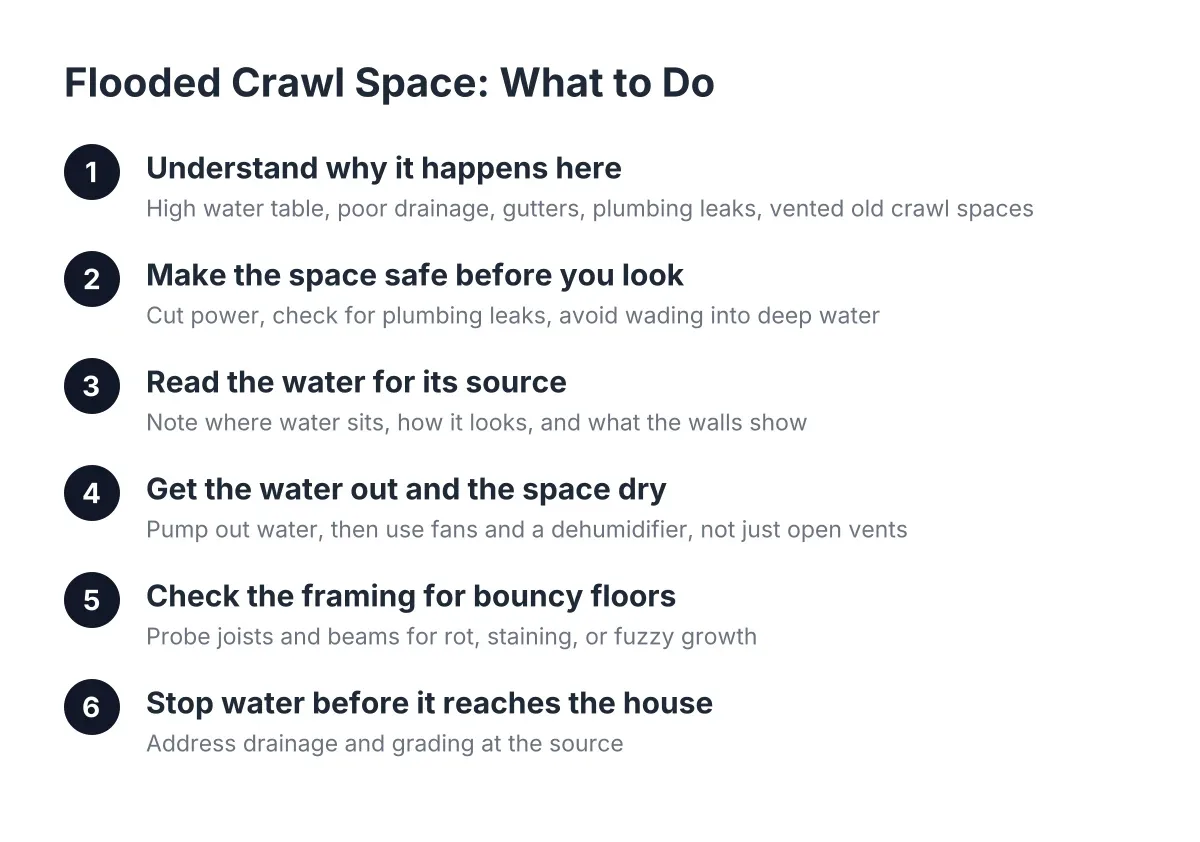
When you find standing water in your crawl space, act in this order: stop any active source you can control, remove the water, dry the space, then diagnose the entry path before paying for a permanent fix. Skipping the diagnosis step is how homeowners end up buying a repair that does not match their problem.
- Check for a plumbing source first. Shut off water to the house briefly and watch your meter. If it keeps spinning, call a plumber before anything else.
- Pump or drain the standing water. A utility pump and a discharge hose handle most cases. Send the water well away from the foundation, downhill if possible.
- Dry the space. Fans and a dehumidifier speed this up. Wet insulation that has fallen or sagged usually needs to come out; it will not dry in place.
- Document everything. Photos with dates matter, especially if you are selling or filing an insurance claim.
- Diagnose before you buy a fix. Match the evidence to the causes above, or have a crawl space inspection done by someone who works under Lowcountry houses for a living.
One caution: standing water can hide hazards. Sagging ductwork, exposed wiring, and unstable piers are all reasons to let a professional make the first entry after a serious flood, particularly after storm surge.
Matching the Fix to the Cause
Each crawl space flooding cause has a matching repair, and the honest answer is that the right fix depends on your diagnosis, not on any one product.
For surface drainage problems: extend downspouts, clean gutters, and regrade soil so it slopes away from the house. Exterior French drains can intercept water before it reaches the foundation. These are the least expensive fixes and sometimes solve the whole problem on higher lots.
For water table and chronic flooding: interior drainage does the work. A perimeter drain installed along the inside of the foundation wall intercepts water entering under the foundation and channels it to a sump pump, according to Building America Solution Center (PNNL/DOE). Grading the crawl space dirt to slope toward the drain helps water reach the sump instead of pooling in the middle.
For humidity and condensation: sealing is the answer. Crawl space encapsulation runs heavy plastic sheeting across the entire floor and seals it to the stem walls and around support piers, rather than laying plastic loosely on the ground, per the U.S. Department of Energy. Sealed vents, insulated stem walls, and a crawl space dehumidifier keep the space dry year-round. One detail worth knowing: some jurisdictions require an uncovered termite inspection strip near the top of the foundation wall, according to Stego Industries, so the vapor barrier should not run wall to ceiling without checking local code.
For homes with any flood history: pair encapsulation with drainage. A sealed crawl space without a drain traps water like a pool if a pipe bursts or floodwater gets in, which is why Building America Solution Center (PNNL/DOE) recommends a sump pump at the lowest point as an emergency backstop. In Charleston, given our tides and storms, treating the sump as optional is a gamble most low-lot homeowners should not take.
There are trade-offs. Full encapsulation costs more up front than a vapor barrier and gutter work, and encapsulation cost varies with the size of the space, the amount of standing water and mold to address, and whether structural support work like joist or beam repair is needed. On the other hand, a cheap fix that ignores the real cause tends to get paid for twice. A house with condensation problems does not need a sump pump; a house sitting on a high water table will flood right over a new vapor barrier.
Selling a House With a Flagged Crawl Space
If a buyer's inspection flagged crawl space moisture or mold, the fastest path to closing is a targeted repair with documentation, not necessarily the largest repair available. What buyers and their agents want to see is that a legitimate crawl space specialist identified the cause, fixed it, and put it in writing.
Suppose a seller in West Ashley gets an inspection report back ten days before closing that reads "moisture intrusion and evidence of microbial growth in crawl space." In that scenario, the practical sequence is a professional crawl space inspection to confirm the cause, mold remediation on the affected joists, correction of the water source, and a written scope of completed work with photos. That paperwork goes to the buyer's agent, and in many cases it settles the objection without a price renegotiation.
Two honest notes for sellers. First, if the inspection revealed a chronic cause like a high water table with a visible waterline, a surface-level cleanup may not satisfy a careful buyer, and it should not; the underlying drainage problem is what threatened the sale. Second, some findings, such as active structural damage or extensive rot, genuinely require foundation repair or new structural support before the house is sound. A specialist can tell you which situation you have and give you options at more than one price point.
Timing matters too. Mold removal and a drainage correction can often move faster than a full encapsulation, so be direct about your closing date when you schedule the inspection.
Preparing Your Crawl Space Before Hurricane Season
Preventing a flooded crawl space is mostly about preparation done in calm weather. Before hurricane season peaks, homeowners in the Charleston area should walk the perimeter of the house, check drainage paths, and test any installed equipment.
A reasonable pre-storm checklist for 2026:
- Clean gutters and confirm downspouts discharge at least several feet from the foundation.
- Walk the yard during a hard rain and note where water pools or flows toward the house.
- Test the sump pump by pouring water into the pit; confirm it kicks on and discharges outside.
- Check the dehumidifier, empty or clear its drain line, and replace the filter.
- Look under the house for new waterlines, mud trails, or a stronger musty smell than usual.
- Inspect the vapor barrier for tears, gaps at seams, or sections pulled away from the stem wall.
For households that already had encapsulation done, seasonal maintenance is the whole ballgame. A sump pump that has sat idle for two years is an unknown. A dehumidifier with a clogged filter runs constantly and dries nothing. An annual or storm-season service visit that checks the pump, the dehumidifier, and the vapor barrier seams costs a fraction of what a failed system costs after a tropical storm, and it keeps warranty terms intact on installed equipment.
The Bottom Line on Water Under Your House
Crawl space flooding causes in Charleston come down to five paths: surface water, groundwater, tides, plumbing, and humid air. Every one of them is diagnosable, and every one has a matching fix, from regraded soil and extended downspouts to interior drains, sump pumps, and full crawl space encapsulation. The mistake to avoid is buying a fix before you know the cause, whether you are panicking after a storm or racing a closing date.
Start with an inspection of the crawl space itself. The waterlines, stains, and wet zones under your house will tell an experienced eye exactly where the water is coming from, and from there the path to a dry crawl space is a plan, not a mystery.
If you need crawl space encapsulation, Low Country Crawl Space Repair can help.
Prefer to talk it through? Call +18542013678 — a quick call is usually the fastest way to get a straight answer for your situation.