Home Inspection Crawl Space Red Flags That Kill Charleston Home Sales
If you are selling a home in Charleston, the home inspection crawl space report can make or break your closing date. Buyers rarely walk away over a leaky faucet. They walk away over standing water under the house, mold on the floor joists, and sagging beams the inspector photographed with a flash. A professional crawl space inspection can reveal red flags that halt or accelerate your sale. This guide covers the specific crawl space findings that stall or kill deals in the Lowcountry, how fast each one can realistically be fixed, and what documentation a buyer's agent will actually accept so your contract stays on schedule.
Charleston is harder on crawl spaces than almost anywhere else in the country. Year-round coastal humidity, a high water table, tidal lots, and hurricane-season rain all push moisture into the vented pier-and-beam crawl spaces under older peninsula homes. More than 60% of U.S. homes have had water or moisture problems in their basement or crawl space, according to the American Society of Home Inspectors. In Charleston, the odds run worse, and inspectors here know exactly where to point the flashlight.
Do Home Inspectors Actually Go Under the House?
Yes. A home inspector will crawl under the house whenever the access hatch opens and there is enough clearance to move safely. If the space is blocked, locked, or flooded, the inspector notes it as inaccessible, which reads to a buyer's agent as a red flag on its own. Some inspectors now send a camera on a pole, or in tight spaces a small crawl space inspection robot, so assuming nobody will see under there is a losing bet.
This matters because most homeowners never enter their own crawl space. Even plumbers and HVAC techs who go under the house tend to head straight for their equipment and back out. Damage can sit undetected for years. Then the buyer's inspector spends 45 minutes down there with a moisture meter and a camera, and every one of those years shows up in the report at once.
Sellers of historic peninsula homes face an extra wrinkle. Pre-1950s houses on brick piers were built with vented crawl spaces, and decades of owners assumed whatever was down there when they bought was the correct setup. Often it was not. Loose plastic thrown over the dirt, insulation falling out of the joist bays, and open gaps cut during old remodels all end up in the inspection report, whether or not you knew they existed.
What Home Inspectors Look for in a Crawl Space Inspection Red Flags
A home inspector checking a crawl space looks for moisture, mold, structural damage, and system defects. That means standing water, damp soil, water stains on piers, fungal growth on framing, rotted or sagging beams, failed supports, plumbing leaks, disconnected ductwork, and missing or damaged vapor barrier. In Charleston, they also look for flood evidence and termite damage. Knowing what inspectors discover during a crawl space inspection red flags process helps sellers understand which findings require immediate attention.
Here are the findings that most often trigger a repair request, a price renegotiation, or a walked deal:
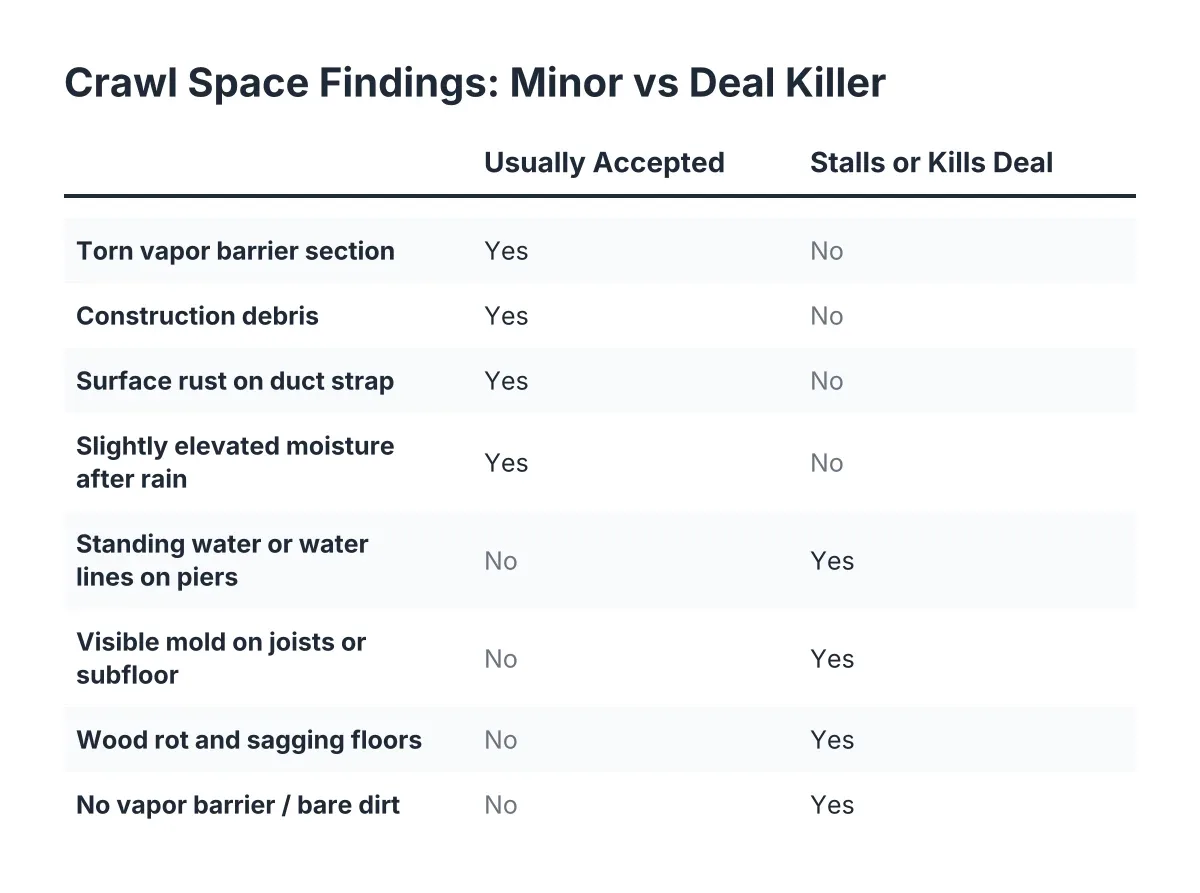
- Standing water or water lines on piers. Evidence of flooding, even old flooding, raises questions no buyer wants to answer. Charleston set a record of 17 high-tide flood days during the 2023-24 meteorological year, according to NOAA Tides and Currents, so inspectors here treat water evidence seriously.
- Visible mold on joists or subfloor. When a home inspection finds mold in the crawl space, most buyers' agents will not proceed without professional mold remediation and a receipt to prove it.
- Wood rot and sagging floors. Soft, rotted beams and floors that dip near the center of the house point to structural repair, which is the single most expensive category on the report.
- No vapor barrier, or shredded plastic. Bare dirt under a Charleston home reads as a moisture problem waiting to happen, and inspectors write it up that way.
- Plumbing leaks. A slow drip under the house can run for years unnoticed. Inspectors check every visible connection, and an active leak goes straight into the summary section.
- Disconnected or crushed ductwork. Loose ducts dump conditioned air into a humid crawl space, which drives up energy bills and feeds mold. It is a common find and a common repair request before closing.
- Musty smell rising into the house. Odor is subjective, but inspectors note it, and buyers notice it the moment they walk in the door.
Notice that most of these trace back to one root cause: uncontrolled moisture. Humidity condenses on cool framing, feeds mold, rots wood, and rusts ductwork. Fix the moisture and you fix the list. Patch items one by one without addressing moisture, and the buyer's re-inspection may find new problems in the same places.
The Red Flags That Kill Deals Versus the Ones That Don't
Not every crawl space finding threatens your contract. Buyers and their agents sort findings into three buckets: cosmetic notes, negotiable repairs, and deal killers. Knowing which bucket you are in tells you whether you need a repair receipt by Friday or a full remediation plan.
Findings buyers usually accept or negotiate
Minor items rarely stop a sale. A torn section of vapor barrier, some construction debris, surface rust on a duct strap, or slightly elevated moisture readings after a rainy week will usually turn into a small repair credit or a punch-list item. Crawl space cleanup and debris removal, a vapor barrier patch, or reattaching a duct can often be handled in a single day.
Findings that stall closings
Mold found in the crawl space before selling a house sits in the middle. It will not always kill a deal, but it will almost always pause one. Buyers' agents in Charleston have seen enough moldy crawl spaces to know the difference between surface staining and active growth, and they will ask for professional mold removal with documentation, not a fogger and a promise.
Standing water lands here too. Water in the crawl space during a home inspection sends the buyer's lender and insurer into questions about flood exposure, especially on tidal and flood-zone lots downtown and on Sullivan's Island and Isle of Palms. The fix, typically drainage, a sump pump, and moisture control, is well understood, but the buyer wants proof it was done right.
Findings that kill deals outright
Structural damage is the deal killer. Rotted sill beams, failed piers, and sagging floors tell a buyer the house has been eating itself for years. On a historic peninsula home, buyers at the $600k to $2M price point often bring in a structural engineer before releasing contingencies, and an engineer will not sign off on softened framing. Without a credible repair plan and a specialist lined up, many buyers exit at this stage rather than negotiate.
The second deal killer is an inaccessible crawl space. If the inspector could not get under the house, the buyer assumes the worst. A blocked hatch with red flags creates suspicion and lengthens the escrow. Sellers sometimes think a blocked hatch buys them time, but in practice it buys a second inspection, a suspicious agent, and a longer process.
How Fast Can Crawl Space Inspection Red Repairs Be Done Before Closing?
Most crawl space repairs that come out of a home inspection can be completed within one to two weeks, and many within days. Mold remediation on an average Charleston crawl space typically takes one to three days. Full crawl space encapsulation with a dehumidifier usually runs two to five working days. Structural repairs vary the most, from a two-day jack-and-beam job to multi-week projects.
Timeline is the whole game when you are under contract. A typical Charleston purchase agreement gives the seller a short window, often 10 to 14 days after the repair request, to complete agreed work before the next contingency deadline. Here is how the common repairs map to that clock, as general estimates for an average-sized crawl space:
- Plumbing leak repair and duct reconnection: usually one day.
- Vapor barrier installation or replacement: one to two days.
- Mold removal and remediation: one to three days, depending on how much framing is affected.
- Drainage system with sump pump: two to four days, including grading the crawl space floor.
- Full encapsulation with dehumidifier: two to five days.
- Structural support with jacks and beam repair: two days to several weeks, depending on scope.
Two things stretch these timelines in Charleston specifically. First, weather. A tropical system or a week of king tides can push standing water into the work area and delay drainage installs. Second, access. Historic homes downtown often have low clearance, brick pier foundations, and preservation considerations that slow the work. A specialist who measures the space carefully up front, rather than guessing from the hatch, avoids the callbacks and delays that blow past a contingency deadline.
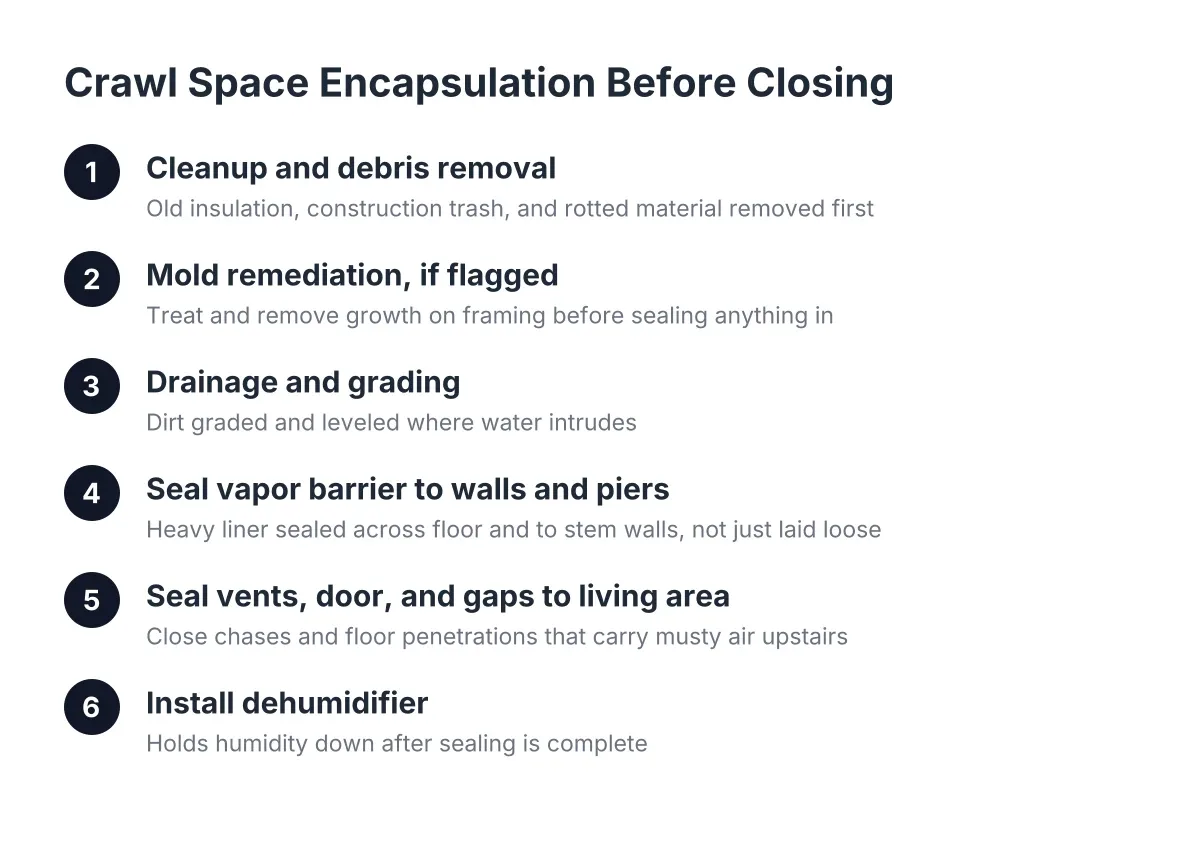
If your deal is on a tight clock, sequence matters. Say a seller on Wadmalaw gets a repair request citing mold on the joists, damp soil, and no vapor barrier, with 12 days to closing. In that scenario, the workable order is mold remediation first, then drainage if water is present, then vapor barrier or encapsulation, then the dehumidifier, with photos taken at every stage. Trying to encapsulate over untreated mold just seals the problem in, and a sharp re-inspector will catch it.
What a Buyer's Agent Wants in Your Repair Documentation
A buyer's agent wants three things after crawl space repair for a home sale: proof of what was found, proof of what was done, and proof it worked. That means a written scope of work, dated before-and-after photos, an itemized paid invoice from a crawl space specialist, and any post-work readings such as wood moisture or humidity levels.
Documentation is where sellers lose deals they had already saved. Suppose a homeowner near Hampton Park pays a handyman cash to spray the joists and lay down plastic. The work might even hold up. However, when the buyer's agent asks for a crawl space repair receipt for closing and gets a text message and a Home Depot receipt, the agent orders a re-inspection, the timeline slips, and the negotiation reopens.
A documentation package that agents and closing attorneys accept without pushback includes:
- A pre-repair inspection report describing conditions found, with photos of the mold, water, or damaged framing.
- A written scope of work listing each repair: mold remediation, vapor barrier, drainage, sump pump, dehumidifier, or structural support.
- After photos from the same angles as the before photos, so the buyer can compare directly.
- An itemized paid invoice on company letterhead showing the work is complete and paid, not pending.
- Post-repair readings where relevant, such as wood moisture content or crawl space relative humidity.
- Equipment documentation for any installed dehumidifier or sump pump, including model and warranty registration info.
One honest caveat: for structural findings, paperwork from a repair contractor alone may not satisfy the buyer. If floors were sagging or beams were rotted, expect the buyer's side to want a structural engineer's letter confirming the repair was adequate. Budget time for that visit inside your contingency window rather than after it.
Repair, Credit, or Price Cut: Choosing Your Move Under Deadline
When the home inspection turns up crawl space problems, a seller has three options: complete the repair before closing, offer a repair credit, or reduce the price. Completing the repair usually protects the most value, because a documented fix removes the buyer's fear premium. Credits and price cuts trade speed for money, and buyers typically ask for more than the repair costs.
Negotiating a crawl space repair credit sounds easier than managing a repair under deadline, and sometimes it is the right call. If closing is six days out and the finding is a full structural repair, a credit backed by a specialist's written estimate keeps the deal alive. The trade-off is that buyers pad credits for uncertainty. A repair a specialist would estimate at, say, $4,000 often becomes a $6,000 to $8,000 credit request, because the buyer is pricing in the hassle and the unknown.
There is also a disclosure angle. Once you know about mold or water in the crawl space, you must disclose it to future buyers if this deal falls through. A completed, documented repair converts a scary disclosure into a selling point: this crawl space was professionally remediated and encapsulated, here is the paperwork. An undone finding follows the house into every future negotiation.
One more note on scope. Crawl space work is not basement work, and the terms are not interchangeable. A basement waterproofing membrane or basement waterproofing exterior excavation applies to homes with full basements, which are rare in Charleston's high water table. Under a Lowcountry pier-and-beam home, the equivalent tools are a sealed vapor barrier, perimeter drainage, a sump pump, and a dehumidifier. If a bidder proposes basement-style exterior excavation for a vented Charleston crawl space, get a second opinion from a crawl space specialist before signing anything under deadline pressure.
Why Encapsulation Often Beats Spot Fixes in a Sale
Encapsulation frequently costs less than the sum of spot fixes plus the price concessions a nervous buyer demands. Instead of patching mold here and plastic there, crawl space encapsulation seals the entire space: heavy plastic sheeting runs across the whole floor and up the stem walls, sealed around every pier and support beam, according to the U.S. Department of Energy. Loose plastic laid on the dirt does not qualify, and inspectors know the difference.
Done right, an encapsulation for a home sale in 2026 typically includes grading the crawl space soil so water flows toward a perimeter drain instead of pooling in the middle, a practice described by the Building America Solution Center. A sump pump at the low point acts as the emergency backstop, since a sealed crawl space can otherwise trap water like a pool if a pipe bursts, per the same source. A dehumidifier then holds humidity down year-round, which matters in a climate where outdoor air stays damp from May through October.
For the buyer's side, an encapsulated crawl space changes the story. The inspection photo goes from dark dirt and stained joists to bright white liner and a humidity readout. For a musty smell that has embarrassed you for years, this is also the fix that holds, because the smell was never the plastic or the candles; it was humid crawl space air rising into the living space through gaps in the floor. Old remodels often left openings that connect the crawl space directly to the rooms above, so sealing those gaps belongs in the scope too.
Two caveats keep this honest. Encapsulation does not repair structural damage; rotted beams and sagging floors need jacks and beam work first, and mold needs remediation before anything gets sealed. Also, local code details matter. Some jurisdictions require a termite inspection strip near the top of the foundation wall left uncovered by the vapor barrier, according to Stego Industries, so the installer should confirm Charleston-area requirements rather than wrapping the wall to the sill.
A Realistic Pre-Listing Move for Charleston Sellers
The cheapest crawl space repair is the one you scope before a buyer's inspector scopes it for you. A pre-listing crawl space inspection costs little, takes about an hour, and tells you whether you are looking at a one-day vapor barrier job or a structural repair that needs an engineer. Only about 15% of American homes sit on a crawl space foundation, according to JSE Labs, but in historic Charleston that share runs far higher, and local buyers' agents check under the house early.
Start outside, the way a thorough inspector does. Walk the perimeter and look at grading, downspouts, and vent openings before anyone goes under the house, because yard drainage problems drive crawl space problems. Then get eyes on the framing, the soil, the plumbing, and the ducts. If you find issues six weeks before listing, you control the timeline, the contractor, and the story. If the buyer's inspector finds them ten days before closing, the buyer controls all three.
Either way, the findings that kill Charleston deals are predictable: water, mold, rot, and missing moisture control. Every one of them is fixable on a closing timeline if you move early, hire a crawl space specialist rather than a generalist, and document the work the way a buyer's agent expects. The sellers who lose deals are not the ones with problems under the house. They are the ones who found out last.
If you need crawl space encapsulation, Low Country Crawl Space Repair can help.
Related guide: crawl space repair for home sale — Complete Guide
Prefer to talk it through? Call +18542013678 — a quick call is usually the fastest way to get a straight answer for your situation.