
Crawl Space Repair for Home Sale — Complete Guide
When a home inspection flags moisture, mold, or sagging beams under a house that is already under contract, the clock starts ticking on everything. Crawl space repair for a home sale is a different animal than routine maintenance: you need the right scope of work, done in the right order, and documented in a way the buyer's agent will accept before closing. This guide walks Charleston-area sellers through what inspectors find under Lowcountry homes, how repair negotiations actually play out, and how to get the work finished and papered without blowing your closing date. Along the way, it points you to deeper guides on costs, red flags, encapsulation timing, and the terms you will see in every report and quote.
What You'll Find in This Guide
- Best Crawl Space Repair for Home Sale in Charleston, SC: How to Choose
- Home Inspection Crawl Space Red Flags That Kill Charleston Home Sales
- Crawl Space Repair for Home Sale Terms Explained: A Plain-English Glossary
- How Much Does Crawl Space Repair for Home Sale Cost?
- Crawl Space Encapsulation Before Selling: What Buyers Inspect For
Why Crawl Space Findings Derail Charleston Closings
Buyers rarely kill a deal over cosmetic issues. However, moisture under the house is different—it suggests hidden damage, future expense, and risk the buyer cannot assess. According to the American Society of Home Inspectors, more than 60% of U.S. homes have had water or moisture problems in their basement or crawl space.
Charleston stacks the deck further. The region combines year-round coastal humidity with high water tables, tidal lots, and flood-prone neighborhoods. NOAA Tides and Currents recorded 17 high-tide flood days in Charleston during the 2023-24 meteorological year, a record for the city. Many older Charleston homes sit on raised pier-and-beam foundations with vented crawl spaces, a design that invites humid outside air under the house all summer. That air condenses on cool ductwork and framing, feeding mold on joists, rusting hangers, and saturating insulation.
As a result, Charleston inspection reports repeat the same findings: elevated wood moisture readings, fungal growth on floor framing, torn or missing vapor barriers, standing water or efflorescence, and beams or jacks showing movement. Some are quick fixes; others signal structural work. The difference matters enormously when negotiating under deadline, which is why it pays to understand which crawl space red flags actually threaten a sale and which ones sound worse than they are.
The inspection report itself is often the first time a seller has read anything about their crawl space. Terms like "encapsulation," "hygrometer reading," "sistered joist," and "moisture remediation" appear without definitions. Before responding to repair requests, knowing exactly what the buyer's inspector describes helps. A plain-English glossary of crawl space repair terms can prevent agreeing to more scope than the findings require or dismissing something the buyer will not let go.
Repair, Credit, or Price Cut: How Sellers Respond to a Buyer's Request
Once the buyer's agent sends a repair addendum, you generally have three paths. You can complete the repair before closing, offer a credit so the buyer handles it after closing, or reduce the price and sell the issue as-is. Each option has trade-offs, and the right choice depends on your timeline, your market, and what the inspection actually found.
Completing the repair keeps the most value in the deal. Buyers discount aggressively when they estimate repair costs themselves, because they price in uncertainty and hassle. By contrast, a completed repair with a transferable paper trail removes the unknown. For moisture and mold findings in particular, finished work tends to survive the buyer's re-inspection far better than a promise or a credit, since the buyer's inspector can verify dry wood, clean framing, and an intact vapor barrier with their own meter and camera.
When a Credit Makes Sense for Crawl Space Repair in Your Home
However, repair before closing is not always realistic. If structural work requires engineering review, or if your closing date is days away rather than weeks, a credit may be the only workable path. In that case, the number you negotiate should rest on a written scope and estimate from a crawl space contractor, not a guess. The factors that drive the figure include the square footage under the house, the extent of mold or wood damage, whether drainage work like a sump pump or French drain is needed, and how much structural correction the framing requires. The full cost guide for crawl space repair during a home sale breaks these drivers down so you can sanity-check any number that lands on the negotiating table.
Whichever path you take, vet the contractor carefully. Ask for a written scope tied to the specific inspection findings, confirm the company is licensed and insured, and get any warranty terms in writing before work begins. Additionally, confirm who will produce the completion documentation and photos, because that paperwork is half the point of the repair. Choosing well under pressure is its own skill, and this guide on selecting crawl space repair for a home sale in Charleston covers the questions worth asking before you sign.
Getting Crawl Space Repair for a Home Sale Done on Deadline
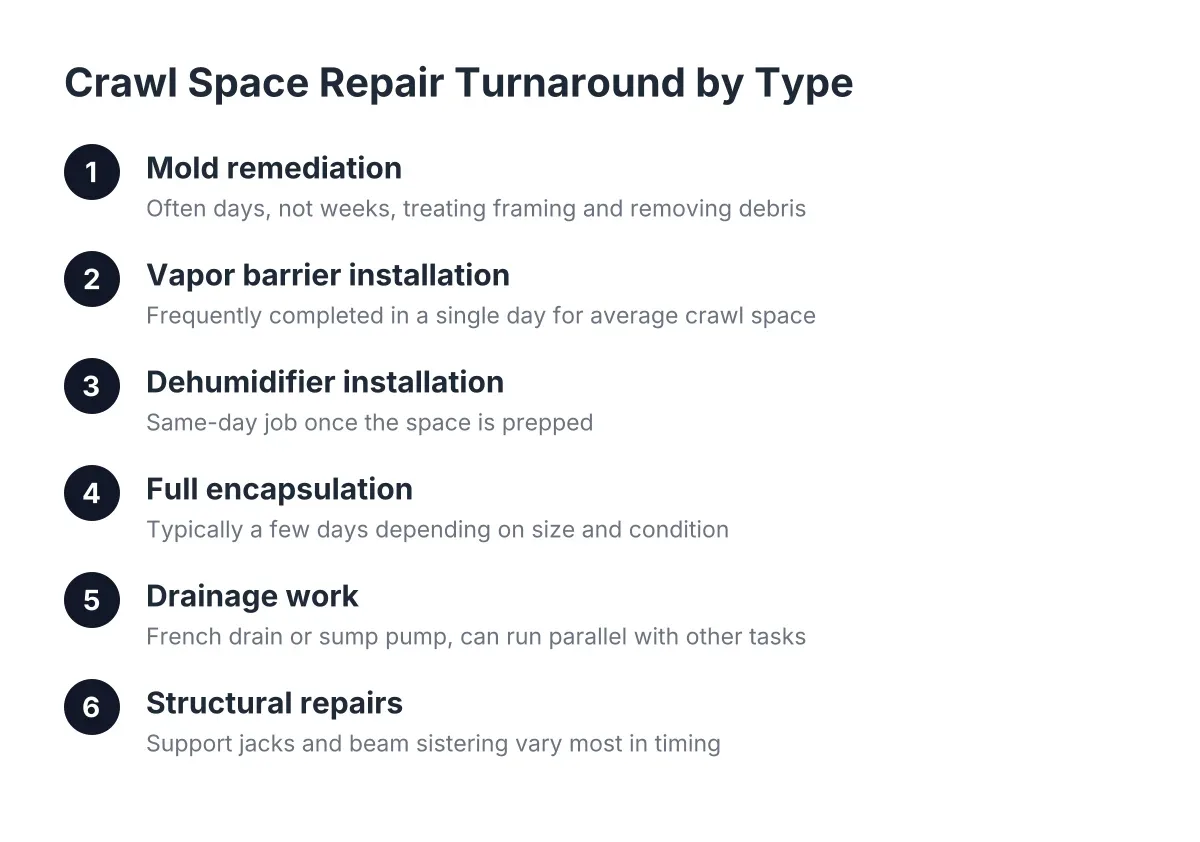
Speed matters, but sequence matters more. Crawl space work done out of order fails re-inspection, and a failed re-inspection costs you the time you were trying to save. In practice, the work follows a logical progression: resolve water intrusion first, then remediate mold, then dry the space, and only then install the vapor barrier, sealing, insulation, and dehumidification that make up encapsulation.
To put it simply, you cannot seal moisture in. If standing water or active intrusion exists, drainage comes first, whether that means grading correction, a French drain, or a sump pump. Next comes mold remediation on the framing, because wrapping moldy joists in a sealed, conditioned space does not solve the problem the inspector flagged. The EPA's guide to mold cleanup and moisture control is a useful neutral reference for understanding why moisture control, not just surface cleaning, is the core of remediation. Only after the wood dries to acceptable moisture readings does encapsulation make sense, and the buyer's inspector will often check those readings directly.
The Documentation Buyers' Agents Expect
Beyond the work itself, the paperwork decides whether your closing stays on track. A buyer's agent reviewing crawl space repair before a home sale typically wants to see a written scope matched to the inspection findings, before-and-after photos, moisture readings taken after the work, any warranty terms that transfer to the new owner, and a final invoice or receipt showing the work is paid and complete. For example, a receipt that simply says "crawl space work" raises questions, while one that itemizes mold remediation, vapor barrier installation, and dehumidifier placement answers them. Gather this package as the work happens, not after, and send it through your agent so it enters the transaction record cleanly.
Timeline questions come up constantly: how fast can encapsulation realistically happen, what happens if rain hits mid-project, and what the buyer's re-inspection will check. The answers depend on the size of the space, the drying time the wood needs, and how much remediation precedes the encapsulation itself. The guide to encapsulation before closing and what buyers inspect for walks through that sequence in detail, including the order of operations that keeps a project from stalling at the finish line.
With this in mind, the single best move a seller can make is to start early. A crawl space inspection before you list, rather than after the buyer's inspector crawls under the house, turns a closing crisis into a line item you control.
Ready to Get Started?
Low Country Crawl Space Repair handles crawl space encapsulation, moisture control, mold remediation, drainage, and structural repair for homeowners in Charleston and its surrounding communities, including sellers working against a closing date. If an inspection report just flagged your crawl space, call or send us a request and tell us what the report found and when you need to close. We will inspect the space, scope the work against the findings, and document the results for your transaction.