Crawl Space Encapsulation Before Selling: What Buyers Inspect For
If your home is under contract and the inspection report just flagged moisture, mold, or a failed vapor barrier under the house, you are on a clock. Completing crawl space encapsulation before closing can keep the deal together, but only if the work is done in the right order and documented in a way the buyer's agent will accept. This guide walks through what buyers and their inspectors actually look for under a Charleston home, how fast the work can realistically move, and what paperwork you need in hand before the final walkthrough.
Moisture findings are common, not a sign your house is falling apart. More than 60% of U.S. homes have had water or moisture problems in their basement or crawl space, according to the American Society of Home Inspectors. In Charleston, with year-round coastal humidity, high water tables, and vented crawl spaces under older pier-and-beam homes, that number surprises no one who works under houses here. The buyer's inspector expects to find something. What matters is whether the seller responds with a real fix or a cover-up.
Why Crawl Space Findings Kill Deals in Charleston
Crawl space water intrusion found during a home inspection can be serious enough to jeopardize a purchase agreement. Buyers see standing water, mold on floor joists, or a shredded vapor barrier and start imagining structural rot, air quality problems, and a five-figure repair they will inherit. Their agent, protecting them, either asks for a steep credit or walks.
Charleston conditions make these findings routine. The city set a record of 17 high-tide flood days during the 2023-24 meteorological year, according to NOAA Tides and Currents. Add hurricane-season moisture cycles and lots that sit near tidal creeks, and a vented crawl space here spends much of the year pulling humid air in through its own vents. That air condenses on cool ductwork and framing. The result is the damp, musty crawl space that shows up in inspection photos.
For sellers, the practical question is not whether the finding is fair. It is which response keeps the sale on schedule: a repair credit, a spot fix, or full crawl space encapsulation before the buyer's re-inspection. Each has a place, and the next sections explain how to choose.
What the Buyer's Inspector Checks Under the House
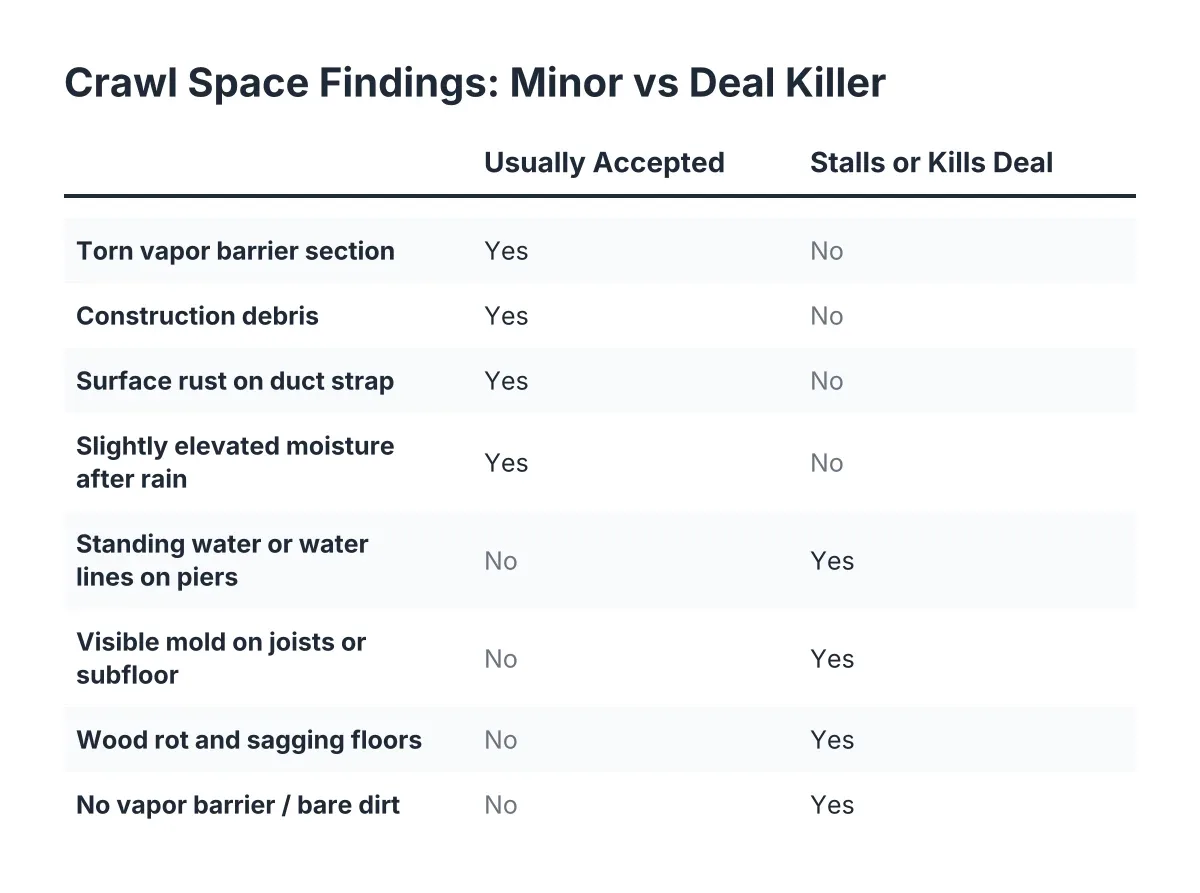
A buyer's inspector evaluating a crawl space checks moisture readings in the wood framing, visible mold or fungal growth, the condition of the vapor barrier, standing water or water staining, sagging floors or damaged beams, and the state of insulation and ductwork. Any one of these can land in the summary section of the report, which is the part agents negotiate from.
Here is the typical checklist, roughly in the order an inspector works it:
- Exterior grading and drainage first. Good inspectors check outside the home before going under it. Downspouts dumping at the foundation, soil sloping toward the house, and clogged perimeter drainage all get noted.
- Standing water or ponding. Even a damp low spot in the dirt gets photographed.
- Vapor barrier condition. Loose plastic thrown on the dirt, torn sheets, or bare soil are flagged. Buyers' agents know the difference between a real sealed liner and a contractor-grade tarp.
- Wood moisture content. Inspectors probe joists and sills with a moisture meter. High readings suggest ongoing humidity, not a one-time spill.
- Visible mold or staining on framing. This is the finding that scares buyers most and the one most likely to trigger a mold remediation demand.
- Structural condition. Sagging floors above, cracked or shimmed piers, and rotted beam ends move the conversation from moisture control to foundation repair.
- Ductwork and air sealing. Disconnected or loose ducts in the crawl space waste conditioned air and pull crawl space air into the system. Inspections regularly catch these, and they are cheap to fix compared to what they cost you in negotiation if ignored.
In addition, inspectors look for gaps between the crawl space and the living area above. Past remodeling work often leaves open chases and cut floor penetrations that connect the crawl space directly to the house. Those gaps carry the musty smell upstairs, and they undermine any encapsulation that ignores them.
What Encapsulation Before Closing Actually Involves
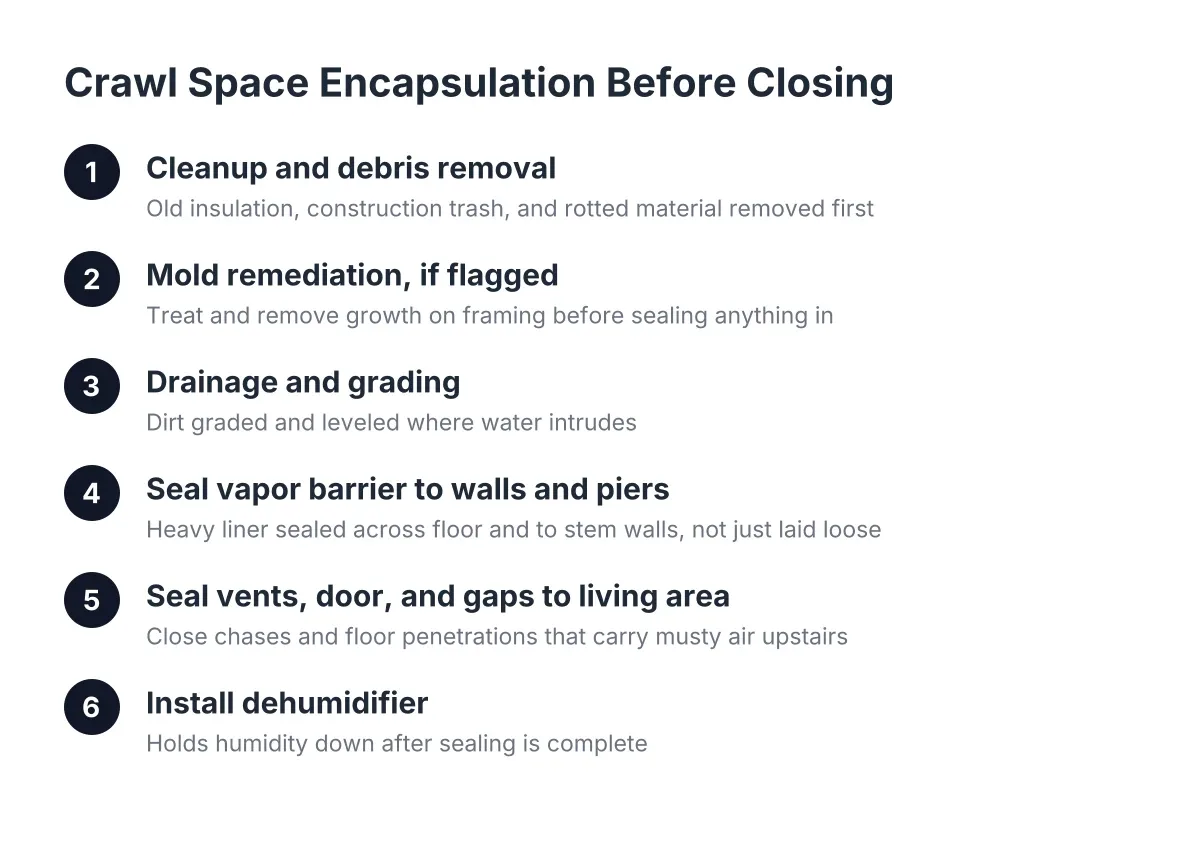
Crawl space encapsulation before a closing means sealing the crawl space into a dry, controlled zone: a heavy vapor barrier across the entire floor sealed to the walls and piers, sealed vents and door, drainage where water collects, and a dehumidifier to hold humidity down. Done correctly, it converts the inspector's worst photo into the strongest page in your disclosure packet.
The distinction between encapsulation and a cheap patch matters here. According to the U.S. Department of Energy, true encapsulation runs plastic sheeting across the entire crawl space floor and seals it to the stem walls and around support beams, rather than laying plastic loosely on the ground. A buyer's inspector can tell the difference in about thirty seconds. Loose plastic reads as a cover-up; a sealed liner with taped seams reads as a permanent fix.
A complete scope for a Charleston crawl space repair for home sale usually includes these steps, in order:
- Cleanup and debris removal. Old insulation, construction trash, and rotted material come out first. Leftover debris under a fresh liner is a red flag on re-inspection.
- Mold remediation, if flagged. Treat and remove growth on framing before anything gets sealed in. Sealing over mold is the mistake that gets deals re-opened.
- Drainage and grading. Where water intrudes, the dirt gets graded and leveled, sloped slightly toward a perimeter drain so water flows to a sump pump instead of pooling in the middle, per guidance from the Building America Solution Center. A sump pump also acts as an emergency backstop, since a sealed crawl space can otherwise trap water like a pool if a pipe bursts.
- Structural repairs. Support jacks, sistered joists, or beam repair happen before the liner goes down, not after.
- Vapor barrier installation. Heavy liner across the floor, up the walls, wrapped around piers, with sealed seams. One local code note: some jurisdictions require a termite inspection strip left uncovered near the top of the foundation wall, according to Stego Industries, so the installer should confirm Charleston-area requirements.
- Air sealing and insulation. Vents and the access door get sealed. In a conditioned crawl space, insulation moves to the stem walls and rim joists rather than between the floor joists, often as taped rigid foam sealed at the rim joist, per the Building America Solution Center.
- Dehumidifier installation. A crawl space dehumidifier holds relative humidity at a set point year-round, which matters in a climate where outdoor air is damp from May through October.
Not every pre-sale situation needs all seven steps. If the inspection flagged only a torn vapor barrier and mild surface moisture, a new sealed liner and a dehumidifier may satisfy the buyer. If it flagged standing water and joist rot, cutting the drainage or structural work to save money will likely surface again at re-inspection.
How Fast Can Encapsulation Work Be Completed Before Closing?
Most crawl space encapsulation projects take two to five working days once the crew starts, depending on square footage, how much cleanup and mold remediation is needed, and whether drainage or structural repairs are in scope. A straightforward vapor barrier and dehumidifier job on a small Charleston bungalow can finish in a day or two. Add a French drain, sump pump, and beam repair, and you are closer to a week.
The schedule risk is usually not the labor. It is the sequence. Suppose a seller in West Ashley gets an inspection report on a Friday flagging mold on the subfloor and a failed vapor barrier, with closing set 21 days out. In that scenario, a workable timeline looks like this:
- Days 1 to 3: Crawl space inspection by a specialist, written scope and quote, and the buyer's agent reviews the proposed fix.
- Days 4 to 7: Negotiation settles on who pays, whether directly or through a seller concession.
- Days 8 to 12: Mold remediation, cleanup, and any drainage or structural work.
- Days 13 to 15: Vapor barrier installation, vent sealing, dehumidifier installation.
- Days 16 to 18: Final documentation delivered; buyer's re-inspection if requested.
That leaves margin before closing. The sellers who blow their deadlines are the ones who spend the first ten days getting bids from general contractors who do not focus on crawl spaces, or debating whether a couple of box fans will pass re-inspection. They will not. This is also work worth hiring out rather than attempting yourself; encapsulation means long hours in a tight, dark space, and a rushed DIY liner with unsealed seams is one of the first things a re-inspection catches.
The Documentation Buyers' Agents Actually Ask For
Buyers' agents reviewing a crawl space repair before closing typically ask for a written scope of work, before and after photos, moisture readings, proof of any mold remediation performed, equipment specifications for the dehumidifier and sump pump, and a paid invoice. A verbal "it's handled" satisfies no one at the closing table.
Build a packet with these items:
- The original inspection finding, so the fix maps directly to what was flagged.
- A written scope of work from the crawl space contractor describing exactly what was done and why.
- Crawl space encapsulation before and after photos, timestamped, showing the same areas the inspector photographed. This side-by-side comparison is the single most persuasive document in the packet.
- Moisture readings taken after the work, showing wood moisture content back in a normal range.
- Mold remediation documentation if growth was treated or removed.
- Dehumidifier and sump pump details, including model information and where they discharge.
- The paid invoice or receipt, which the closing attorney may need if the repair was a negotiated condition of sale.
For example, if the buyer requested crawl space repair as a condition in the repair addendum, the paid receipt plus photos usually satisfies the condition without a second inspection trip. If the buyer's agent is cautious, offer the re-inspection anyway. A sealed, dry, well-lit crawl space with a running dehumidifier sells itself in person.
One honest trade-off: encapsulation completed days before closing has not yet proven itself through a full humid season. A reasonable buyer's agent may ask about the dehumidifier's warranty or service terms. Have the installer's paperwork ready rather than promising outcomes you cannot document.
Repair, Credit, or Price Cut: Choosing Under Deadline Pressure
Whether to fix the crawl space, offer a credit, or cut the price depends on your timeline, the severity of the finding, and how the buyer's lender treats repair concessions. Completed work with documentation usually protects your sale price better than a credit, because credits invite the buyer to imagine the worst-case repair cost.
Think through it this way:
- Fix it when the finding is specific and the timeline allows. A documented encapsulation with photos closes the issue. Negotiating crawl space repair credit, by contrast, often starts from the buyer's inflated estimate, not your contractor's actual quote.
- Credit it when closing is days away and no crew can complete the scope in time. Get a written quote from a crawl space specialist so the credit is anchored to a real number instead of the buyer's guess.
- Walk carefully on price cuts. A price reduction for an undisclosed-severity crawl space problem tends to be larger than the repair itself, and the problem stays in your disclosure history if the deal falls through.
Budget-wise, most pre-sale crawl space scopes in this market land somewhere in the low thousands to around eight thousand dollars as an illustrative range, depending on square footage and whether drainage, mold removal, or structural support is included. Crawl space encapsulation cost scales mostly with floor area and scope, which is why a written, itemized quote beats any per-square-foot rule of thumb you find online.
One caution for sellers tempted by shortcuts: basement waterproofing sealer, basement waterproofing paint, and liquid rubber foundation sealant are surface coatings. They can have a place on masonry, but brushing a coating on the inside of a stem wall does not stop ground moisture from rising through a dirt floor, and an inspector will note fresh paint over damp block as a concealment attempt. In a vented Charleston crawl space, the moisture source is the ground and the humid air, and only a sealed liner, drainage, and dehumidification address it.
What Encapsulation Signals to the Buyer
A properly encapsulated crawl space tells the buyer the moisture problem was solved at the source, not masked. It also carries benefits they will notice at the walkthrough: the musty smell that used to drift up through the floors is typically gone once the crawl space is sealed and dried, and homes often feel easier to heat and cool with the crawl space brought under control.
There is an air quality angle too. About 15% of American homes sit on a crawl space foundation, according to JSE Labs, and in vented crawl spaces the air under the house mixes with the air above it. Sealing the crawl space blocks soil gas along with moisture. That matters in South Carolina, where the average indoor radon level is about 1.9 pCi/L, above the national average of 1.3 pCi/L, according to Radon.org. A conditioned crawl space is treated as part of the home's interior, receiving supply air and being pressure-balanced with the living space above, per the Building America Solution Center; that is a feature a listing agent can describe plainly and a buyer's inspector can verify.
If you have lived with a musty smell for years and only confronted it because a buyer's inspector put it in writing, the fix is the same one that would have solved it years ago. The deadline just forces the decision. Sequence the work correctly, insist on real encapsulation rather than loose plastic, and hand the buyer's agent a documentation packet that answers questions before they ask them. If the inspection flagged structural movement, sagging floors, or active flooding, bring in a crawl space specialist for a proper evaluation before committing to a scope; guessing under deadline pressure is how sellers pay for the wrong repair twice.
If you need crawl space encapsulation, Low Country Crawl Space Repair can help.
Prefer to talk it through? Call +18542013678 — a quick call is usually the fastest way to get a straight answer for your situation.