Foundation Repair vs. Encapsulation: What Solves Charleston Pier-and-Beam Problems
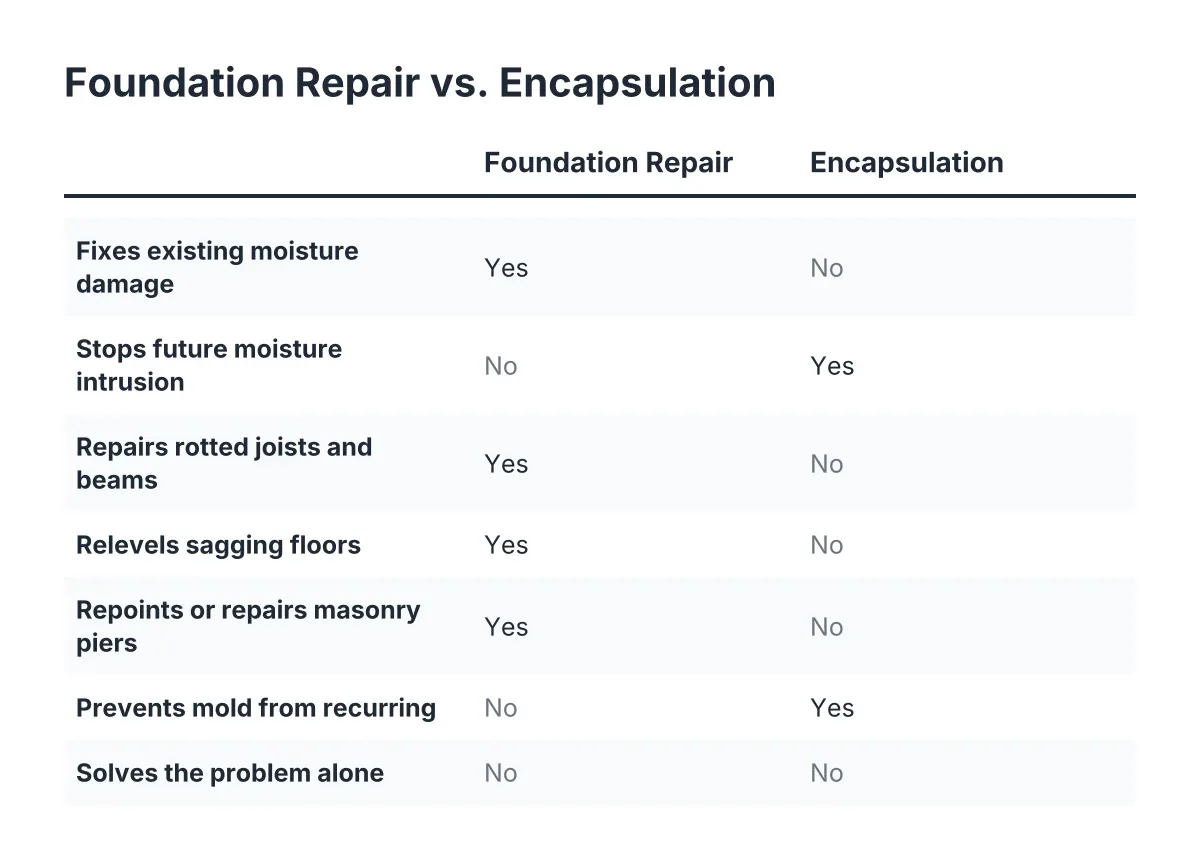
If your crawl space has damp piers, soft floor framing, or a musty smell that never leaves, you are probably weighing two fixes and wondering which one you actually need. The honest answer is that neither foundation repair nor encapsulation solves the whole problem alone in most Charleston pier-and-beam homes. When faced with the choice between foundation repair vs encapsulation, it is important to understand what each approach addresses. Foundation repair fixes the damage moisture already caused. Encapsulation stops the moisture from causing it again. This guide walks through how to tell which one your house needs, in what order, and why historic Charleston construction changes the answer.
That distinction matters most for two kinds of homeowners: the person selling a house with a spooked buyer and an inspection report that says "moisture intrusion, evidence of mold," and the owner of an older peninsula or island home watching floors slope a little more each year. Both are looking at the same underlying question. Has moisture damaged the foundation, and what does it take to fix it for good?
Why Charleston Pier-and-Beam Homes Get This Problem
Most older homes in downtown Charleston, and many on Sullivan's Island and Isle of Palms, sit on pier-and-beam foundations. Brick or masonry piers hold up wood beams, the beams hold up floor joists, and the joists hold up your floors. Between the ground and the wood is a vented crawl space that was designed for a different era, before air conditioning changed how houses handle humidity.
Here is the problem with that design in the Lowcountry. Open foundation vents were supposed to dry the crawl space out. Instead, in our climate, they pull in humid outside air for most of the year. That warm, wet air hits cooler framing and ductwork under the house and condenses. The wood stays damp, mold gets a foothold, and the musty smell starts drifting up through the floors.
Add the water table. Much of the Charleston peninsula sits a few feet above sea level, and Charleston set a record of 17 high-tide flood days during the 2023-24 meteorological year, according to NOAA Tides and Currents. On lots like these, water does not need a storm to show up under the house. It rises from below during king tides and heavy rain, then the summer humidity keeps everything wet between events.
This is not a rare situation. More than 60% of homes in the U.S. have had water or moisture problems in their basement or crawl space, according to the American Society of Home Inspectors. In Charleston, with our humidity and tidal lots, the odds run against a dry crawl space in an older home.
How Moisture Turns Into Foundation Damage
Moisture does not damage a pier-and-beam foundation overnight. It works in a sequence, and knowing where your house is in that sequence tells you what kind of repair you are facing.
First, sustained humidity above roughly 60 to 70 percent in the crawl space lets mold grow on joists and subfloor. At this stage the wood is stained and smelly but still structurally sound. This is the stage where a buyer's inspector writes "evidence of mold" and the deal starts wobbling, even though the framing may still be fine.
Next, prolonged wetness invites wood rot. Rot fungi actually eat the wood fibers, and this is where structural strength starts to go. Beams soften where they rest on piers. Joist ends crumble where they meet the sill. You may notice bouncy spots in the floor or doors that stick in humid months.
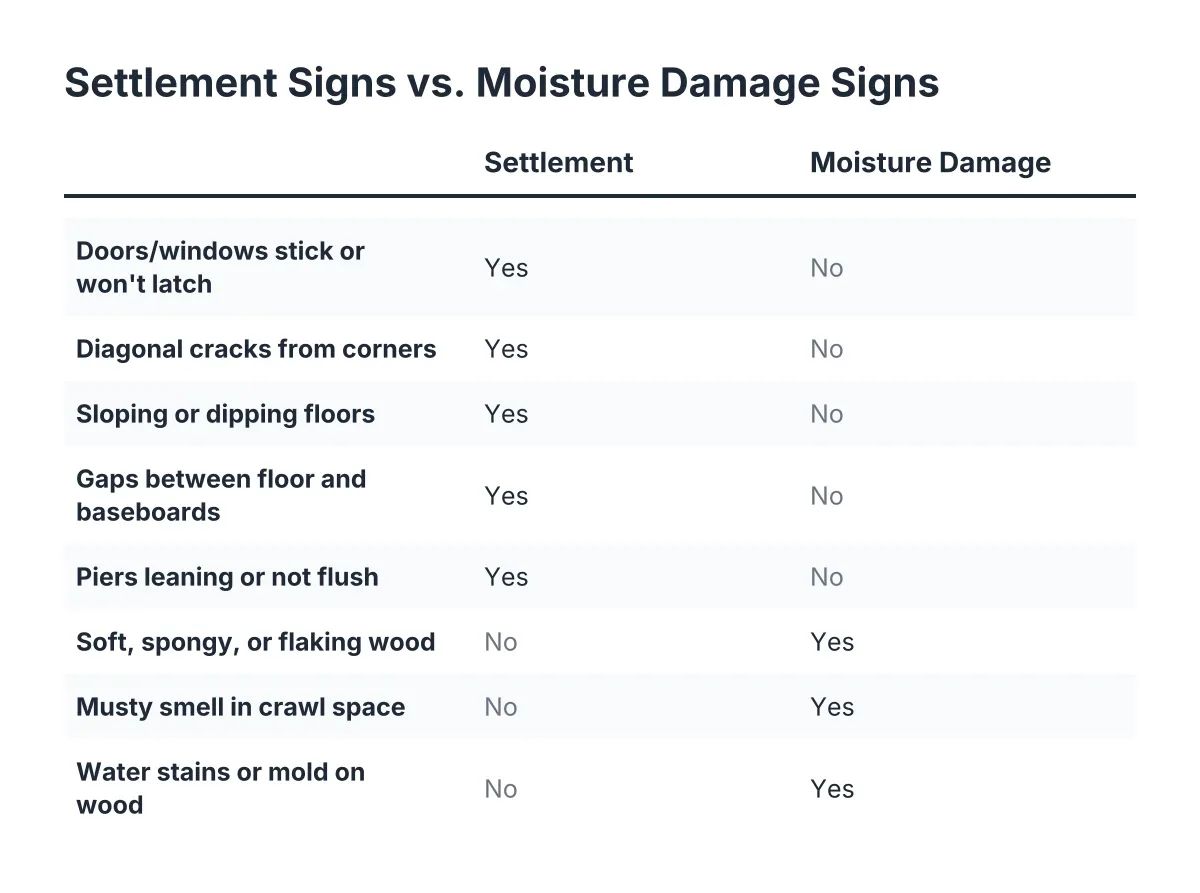
Finally, the foundation itself gets involved. Saturated soil under brick piers can shift or wash out, letting piers settle or lean. Old lime mortar in historic masonry piers wicks moisture and slowly degrades. At this point you have sagging floors, visible gaps between floors and baseboards, and cracks in interior plaster. This is genuine structural damage, and it needs foundation repair, not just moisture control.
Signs the Moisture Has Reached the Structure
Look for these markers, roughly in order of severity:
- A persistent musty smell on the first floor, strongest in summer
- Condensation or water droplets on ductwork and pipes under the house
- Dark staining or visible mold growth on joists and subfloor
- Soft or spongy wood when you press a screwdriver into a beam or joist end
- Floors that slope, bounce, or dip near the center of rooms
- Doors and windows that suddenly stick or will not latch
- Piers that lean, show missing mortar, or have gaps between the pier top and the beam
The first three signs point to a moisture problem you can still get ahead of. The last four mean moisture has likely already cost you structural capacity, and someone needs to get under the house with a level and a probe.
Foundation Repair and Encapsulation: What Each Fixes Alone
Foundation repair in a crawl space addresses the load path: the piers, beams, and joists that carry your house. In a typical Charleston pier-and-beam job, that work can include sistering or replacing rotted joists, replacing beam sections where they have gone soft, installing adjustable steel support jacks on proper footings to relevel sagging spans, and repairing or repointing masonry piers.
Done well, this work brings floors back toward level and restores the strength the wood lost. On a historic peninsula home, doing it well also means respecting the original construction. Old-growth framing, handmade brick, and soft lime mortar do not behave like modern materials. Jacking a 1920s floor system too fast can crack plaster walls upstairs. Repointing historic brick piers with hard modern mortar can make the brick itself fail later. This is where preservation-aware crawl space foundation repair separates itself from a generic jack-and-shim job.
Here is what foundation repair alone does not do: it does not change the environment that rotted the wood in the first place. Put new joists into a crawl space that still runs 75 percent humidity all summer, with open vents and bare dirt breathing ground moisture upward, and you have started the same clock over again. The new wood gets the same treatment the old wood got.
What Encapsulation Alone Fixes, and What It Misses
Crawl space encapsulation seals the crawl space off from ground moisture and outside air. According to the U.S. Department of Energy, real encapsulation means running plastic sheeting across the entire crawl space floor and sealing it to the stem walls and around support beams, not just laying plastic loosely on the dirt. A complete job also wraps each foundation pier, blocks off the foundation vents, and usually adds a dehumidifier to hold indoor-quality humidity year-round.
On flood-prone Charleston lots, drainage is part of the package. Crews typically grade the crawl space dirt to slope gently toward a perimeter drain, which intercepts water coming in under the foundation and channels it to a sump pump, according to the Building America Solution Center. The sump pump sits at the lowest point as an emergency ejector, because a sealed crawl space with no pump can trap water like a pool if a pipe bursts or floodwater gets in. In conditioned crawl spaces, insulation moves to the stem walls and rim joists rather than between the floor joists, which keeps the whole space inside the home's thermal envelope.
Encapsulation is the fix for the cause. It ends the humidity cycle, kills the conditions mold needs, protects ductwork from condensation, and usually clears the musty smell within weeks. As a long-term approach, it beats repeated temporary drying and treatment rounds, which tend to buy a dry season and then fail the next summer.
However, encapsulation does not repair anything. Sealing a crawl space over a beam that has already lost half its cross-section to rot locks in a structural problem behind a clean white liner. If a pier has settled two inches, the nicest vapor barrier in Charleston will not lift the floor back. Any mold on the framing also needs proper mold remediation before the space is sealed, or you are wrapping the problem instead of removing it.
Foundation Repair and Encapsulation Together: The Complete Solution
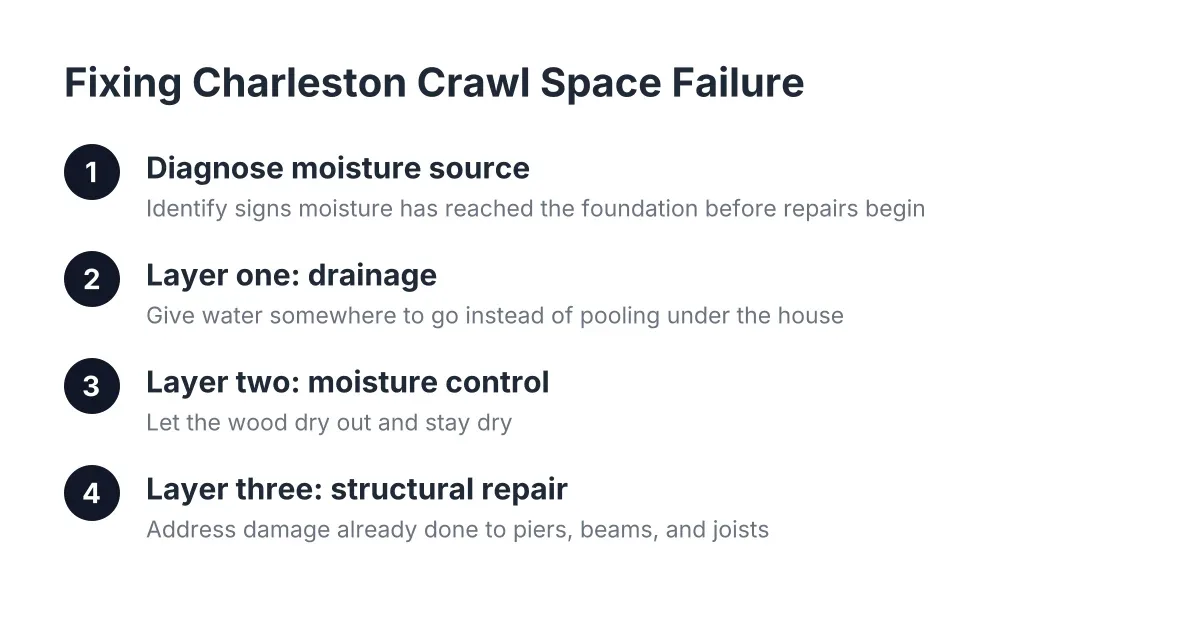
For most damp Charleston pier-and-beam homes with structural symptoms, the pairing of foundation repair and encapsulation solves both halves of the problem, and the order matters. Repair restores the structure. Encapsulation protects the repair. Skipping either half is how homeowners end up paying twice.
A sound sequence on a typical project looks like this:
- Inspection and moisture assessment. Someone crawls the full footprint, probes beams and joist ends, checks pier condition and level, and takes humidity and wood moisture readings.
- Fix the water first. Correct exterior grading, add perimeter drainage and a sump pump if the lot needs it, and dry the space. Soil piled too high against the foundation should be regraded down away from the brick line so surface water stops feeding the crawl space.
- Mold removal and cleanup. Remediate mold on framing and haul out wet debris and old insulation before anything gets sealed.
- Structural repair. Sister or replace damaged joists and beams, set support jacks on proper footings, and relevel gradually. On historic homes, this is slow, deliberate work.
- Encapsulate. Grade and level the dirt, install the sealed vapor barrier across the floor and up the stem walls, wrap the piers, block the vents, insulate the stem walls and rim joists, and set the dehumidifier.
Run in that order, foundation repair with encapsulation solves the damage, the cause, and the recurrence risk in one project instead of a cycle of callbacks. Reverse the order and you either seal in damage or repair wood into a wet environment.
One local code note: some states require a termite inspection strip near the top of the foundation wall to be left uncovered by the vapor barrier, according to Stego Industries. A crew that knows Lowcountry work will plan the liner height around that from the start rather than fail a termite inspection later.
Cost, Timeline, and Scope: What to Expect in 2026
Costs vary too widely by house to quote from an article, and any firm number without an inspection is a guess. That said, the drivers are consistent. Square footage under the house, how much framing is rotted, how many piers need work, whether the lot needs drainage and a sump pump, and how carefully historic materials must be handled all move the price. As an illustrative range only, Charleston-area owners of larger historic homes often plan for a combined structural-plus-encapsulation project in the four to five figures, with heavier structural scopes at the top of that band. An honest contractor prices from the inspection, not the phone call.
Timeline follows scope. Moisture control and encapsulation on a straightforward crawl space can move fast once scheduled. Structural work on a historic home moves slower on purpose, because releveling old framing gradually protects the plaster and trim above it.
For sellers with a closing date, here is a hypothetical worth knowing. Say a homeowner near Hampton Park gets an inspection report back flagging crawl space moisture and mold, and the buyer's agent wants it "handled" before closing. In that scenario, the useful move is a professional crawl space inspection that separates the findings into surface mold, active moisture, and structural damage. Sometimes the right scope for the sale is mold remediation plus moisture control, with documentation the buyer's agent can put in the file. Sometimes the framing is genuinely compromised and a smaller fix would just get flagged again by the buyer's own re-inspection. A specialist who explains which situation you are in, in writing, is worth more during a sale than the cheapest bid.
DIY, Pro, or Engineer: Who Handles What
Homeowners can safely handle the perimeter of this problem. Redirect downspouts away from the foundation, regrade soil that has crept up against the brick line, and keep gutters clear. You can also do your own quick check with a flashlight and a screwdriver at the crawl space entrance, probing the nearest joists for soft spots.
Everything past the vents belongs to a professional. Encapsulation is a large, physical job done in a tight, dark space; sealing details around piers, plumbing, and stem walls are where DIY liners fail, and a loose sheet of plastic on the dirt is not encapsulation. Structural work, jacking, and beam replacement carry real risk to the house and to the person under it. On a high-value historic home, bringing in a structural engineer before major releveling is money well spent, and a good contractor will welcome that rather than resist it.
Call a professional now, not later, if floors have visibly sagged, wood crumbles when probed, standing water appears under the house, or a pending sale has a crawl space finding on the inspection report.
Choosing a Crawl Space Contractor in Charleston
Three questions sort the specialists from the rest:
- Will you inspect the full crawl space and give me findings in writing? A quote from the access door is not an inspection, and porches matter too; an accessible space under a porch changes the encapsulation scope.
- What is your sequence for water, mold, structure, and sealing? The right answer puts drainage and repair before the liner, every time.
- How do you handle historic pier-and-beam construction? Listen for gradual releveling, mortar-compatible masonry repair, and vapor barrier detailing around original piers.
A fair quote itemizes the scope: drainage, remediation, structural repairs, liner specification, dehumidification, and what documentation you receive at the end. For sellers, that documentation is half the value. A written scope and completion paperwork from a legitimate specialist gives the buyer's agent something concrete, which is what actually calms a nervous buyer.
If your Charleston home is showing the signs covered here, whether it is a musty smell you have lived with for years or a line item on an inspection report with a closing date attached, the next step is a full crawl space inspection. Low Country Crawl Space Repair inspects, explains what the moisture has and has not damaged, and scopes the repair and encapsulation work your house actually needs. Reach out to schedule an inspection and get an estimate based on what is really under your floors.
If you need crawl space encapsulation, Low Country Crawl Space Repair can help.
Prefer to talk it through? Call +18542013678 — a quick call is usually the fastest way to get a straight answer for your situation.