Why Charleston Crawl Spaces Fail: Moisture, High Water Tables, and Pier-and-Beam Damage
If you just crawled under your house after a storm and found standing water, you are looking at the exact reason so many Charleston crawl spaces fail. It is not bad luck, and it is usually not one single flaw in your house. It is the combination of coastal humidity, a high water table, tidal and flood-prone lots, and older pier-and-beam construction that was never designed to stay dry through a modern hurricane season. Understanding pier-and-beam foundation failure is critical, since this guide explains how that failure happens, how to tell whether moisture has already reached your foundation, and how to compare repair options without paying for work you do not need.
The stakes are higher if you own a pre-1950s home on the peninsula, Sullivan's Island, or Isle of Palms. These houses sit on brick piers and heavy timber beams, and the original builders counted on air movement to keep things dry. That worked for a long time. However, with rising groundwater and more frequent flooding, the old approach is losing the fight, and the damage shows up first in the crawl space.
Why Charleston Crawl Spaces Fail More Than Most
Charleston crawl spaces fail more often than crawl spaces in most of the country because three conditions stack on top of each other: constant humidity, groundwater that sits close to the surface, and older vented foundations built for a drier era. Any one of these causes trouble. Together, they create a moisture problem that never fully dries out on its own.
Start with the humidity. For much of the year, outdoor air in the Lowcountry carries enough water vapor that "ventilating" a crawl space means pumping damp air under your house. That air hits cooler framing and duct surfaces, condenses, and soaks into the wood. The foundation vents that were supposed to solve the problem end up feeding it.
Next is the water table. On the peninsula and the barrier islands, groundwater can sit just a few feet below grade. After a heavy rain or a king tide, that water rises. It comes up through the crawl space floor, seeps through old brick piers, and pools in low spots. This is why so many homeowners find standing water under the house after a storm even when nothing visibly leaked.
The flooding pressure is not hypothetical. Charleston set a record of 17 high-tide flood days during the 2023 to 2024 meteorological year, according to NOAA Tides and Currents. When the tide alone can push water toward your foundation that many times in a year, a crawl space that depends on staying dry by chance is going to lose eventually.
Finally, there is the construction itself. Pier-and-beam foundations are common in older Charleston homes, and they are a small slice of American housing overall; about 15% of American homes have a crawl space foundation, according to JSE Labs. That means most national advice, and most national franchise playbooks, are written for slab or basement homes somewhere else. The failure pattern here is local, and the fix needs to be local too.
The Moisture Cascade: How Water Becomes Foundation Damage
Crawl space failure follows a predictable chain. Moisture comes first. Sustained moisture feeds mold and fungal growth on joists, beams, and subflooring. Fungal growth breaks down wood fiber, which becomes rot. Rot weakens the members that carry your floors, and weakened framing leads to sagging floors, racked door frames, and in bad cases, piers that no longer carry load evenly. Along the way, damp rotting wood also attracts pests, which accelerate the damage.
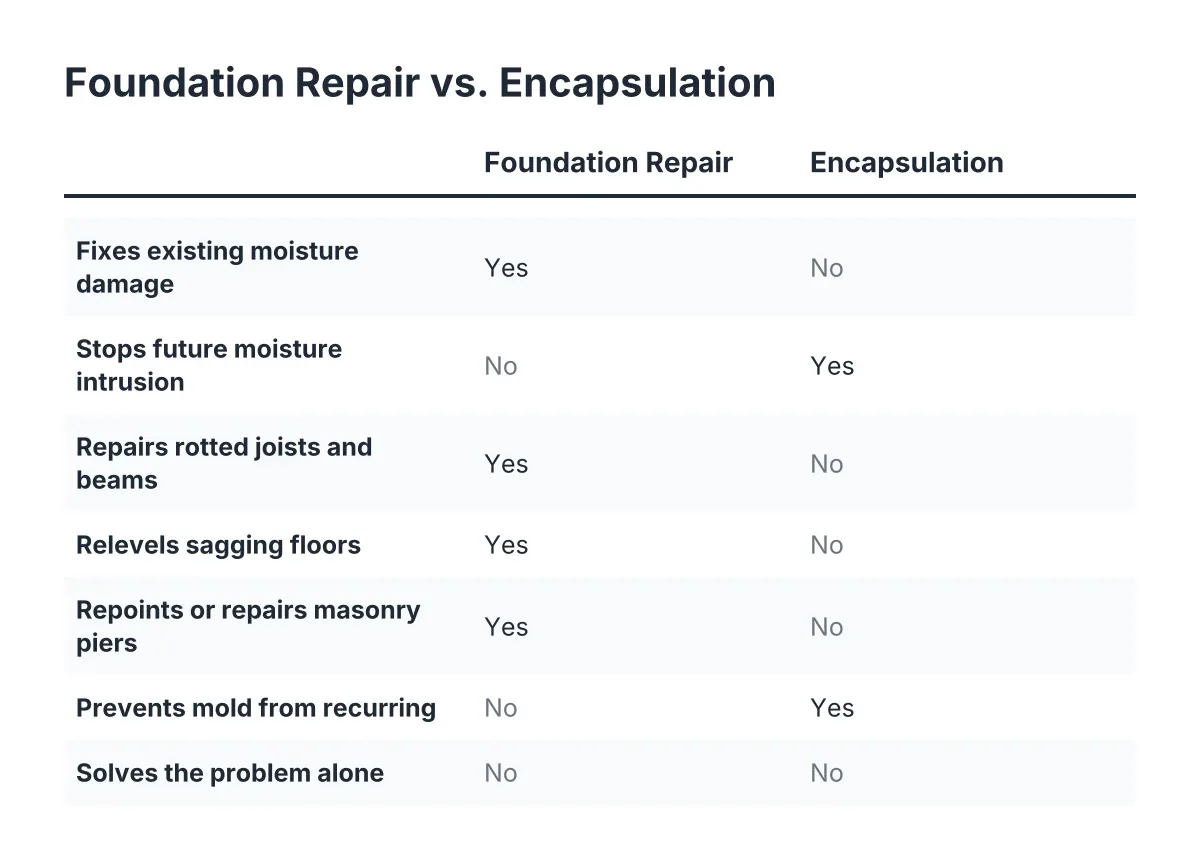
The important point for anyone comparing repair options: everything after moisture is a symptom. Mold removal without moisture control buys you a season, maybe two. Structural support jacks under a beam that is still soaking wet will need to hold up wood that keeps softening. Fix the moisture problem first, or plan to fix everything else twice.
Moisture reaches a Charleston crawl space through several doors at once:
- Ground vapor rising from bare soil, which never stops in a high water table area
- Standing water from rain, tidal flooding, or poor yard drainage
- Humid outside air entering through foundation vents and gaps
- Plumbing leaks that drip unnoticed for months
- Cracks in brick piers or foundation walls open to the outside
This is also why moisture problems get worse instead of better. The water table does not drop over time, the humidity does not go away, and rot does not reverse. Delaying repairs almost always increases the eventual cost of the fix. You are not alone in facing this; more than 60% of U.S. homes have had water or moisture problems in their basement or crawl space, according to the American Society of Home Inspectors. In Charleston, the local conditions push that problem toward the structural end faster.
Signs Moisture Has Reached Your Foundation
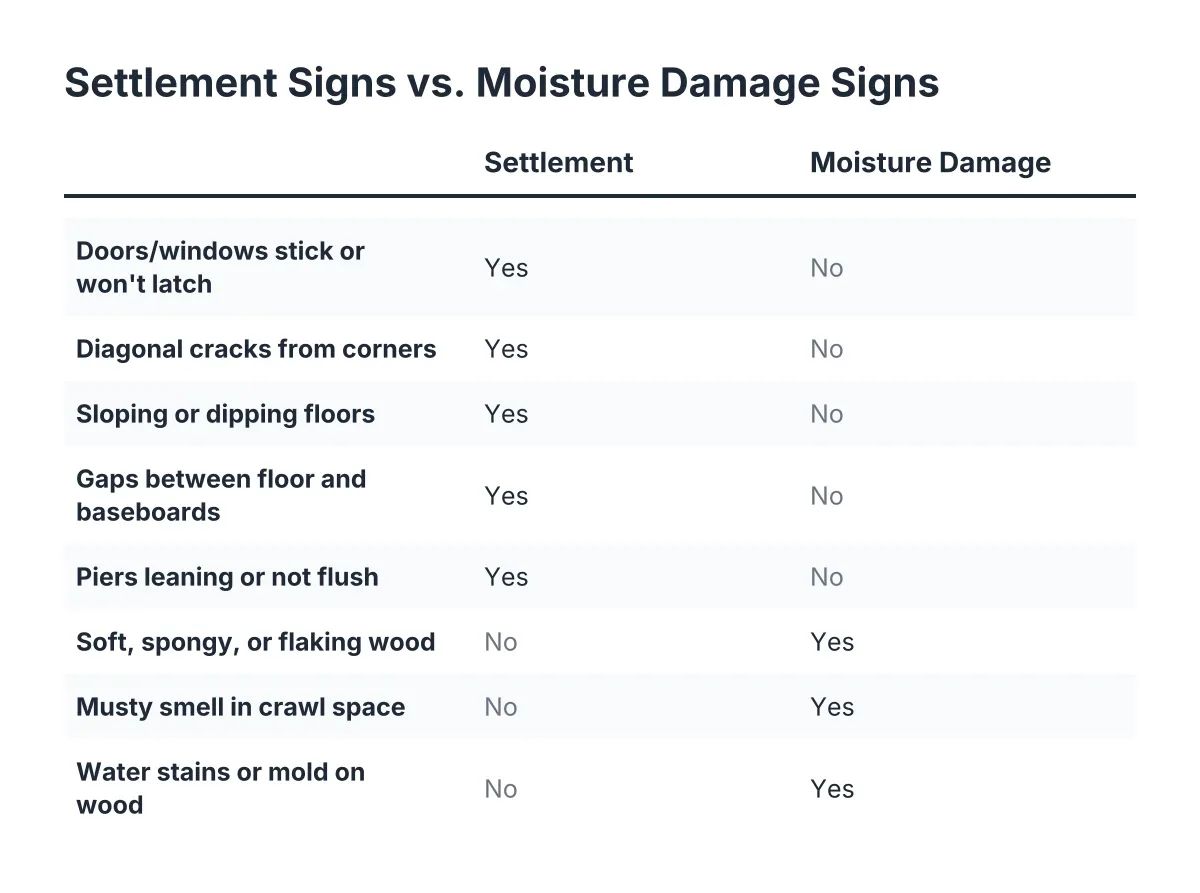
The signs of foundation damage from moisture usually show up inside the house before most owners ever look under it. You can spot the early warnings without crawling through mud, though a proper inspection under the house is the only way to confirm what is happening.
Watch for these indicators upstairs:
- Floors that slope, bounce, or feel soft in specific spots, especially near exterior walls
- Doors and windows that stick or no longer latch, a sign the frame has shifted
- Gaps opening between baseboards and floors, or cracks at door corners
- A musty smell that gets stronger after rain and never fully clears
- Cupping or buckling in hardwood floors, which points to humidity rising from below
Under the house, the picture gets clearer. Look for dark staining or white fungal growth on joists and beams, wood that gives when you press a screwdriver into it, insulation that sags or falls apart when touched, rust on ductwork and fasteners, and efflorescence, the white mineral crust, on brick piers. Persistent high humidity degrades fiberglass insulation to the point that it crumbles in your hand, and falling insulation is one of the most common tells that a crawl space has been wet for years.
One sign deserves special attention in historic homes: mortar. Old brick piers were often laid with soft lime mortar. Constant wetting and drying cycles wash that mortar out, and a pier can look intact while the joints holding it together have turned to sand. If you see crumbling mortar or a pier that has visibly shifted, bring in a structural engineer or a foundation repair specialist familiar with historic masonry before anyone touches it.
Why Pier-and-Beam Foundation Failure Happens Differently in Historic Homes
Historic pier-and-beam foundations in Charleston fail differently than modern crawl spaces because the materials, the load paths, and the repair constraints are all different. A 1920s house on the peninsula does not fail like a 1990s house in the suburbs, and it should not be repaired like one either.
First, the materials. Original heart pine beams and joists are dense and rot-resistant, which is why many have survived a century of humidity. But when they do rot, they are expensive to match, and wholesale replacement changes the character of the house. A preservation-aware repair sisters or splices new lumber alongside sound original wood rather than ripping it all out.
Second, the piers. Brick piers on shallow footings sit in soil that saturates and dries with every storm cycle. That movement causes differential settling; one pier drops a half inch while its neighbors stay put, and the beam above it goes out of level. Foundation settling in a crawl space rarely announces itself all at once. It accumulates, storm by storm, until the floor above tells the story.
Third, the vents. Crawl space foundation vent problems cut both ways in a historic home. The vents let humid air in, which is bad. However, sealing them as part of encapsulation has to respect how the masonry breathes and, in some cases, local requirements. For example, some states require a termite inspection strip near the top of the foundation wall to be left uncovered by the vapor barrier, so local codes should be checked before any full encapsulation, according to Stego Industries.
This is the gap that generic crawl space companies miss. A templated fix, jack it up, wrap it in plastic, install a dehumidifier, can work on a newer house. On a historic pier-and-beam foundation, the sequence matters, the materials matter, and lifting a sagging beam too fast can crack century-old plaster two floors up. Preservation-aware crawl space foundation repair moves in small increments and treats the original structure as something to save, not something to work around.
Comparing Your Repair Options After the Water Shows Up
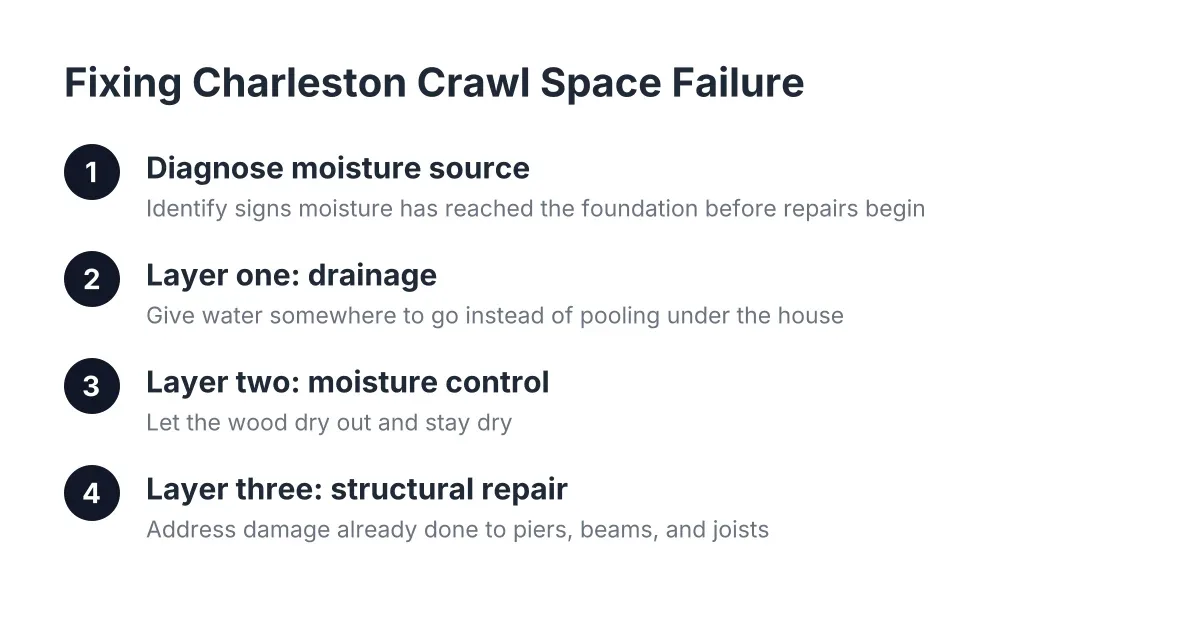
Say a homeowner on Sullivan's Island crawls under the house the morning after a tropical storm and finds two inches of standing water across half the crawl space, plus fuzzy white growth on a beam near a low corner. In that scenario, there are three questions to answer in order: how do we get water out now, how do we keep it from coming back, and has the structure already been hurt. Each question maps to a different layer of repair, and not every house needs every layer.
Layer one: drainage, so water has somewhere to go
If water pools under your house after every heavy rain, drainage comes before everything else. A perimeter drain installed around the interior of the foundation wall intercepts water entering under the foundation and channels it to a sump pump, according to the Building America Solution Center. Grading the crawl space dirt so it slopes slightly toward the drain helps water move to the pump instead of pooling in the middle, per the same source.
A sump pump alone, without a drain, handles water that happens to reach the pit. A French drain style perimeter system plus a pump handles water across the whole footprint. For a flood-zone lot near the water table, the combined system is usually the honest answer, and it is worth knowing that in a sealed crawl space a sump pump also acts as the emergency exit for water, since an encapsulated space otherwise traps water like a pool, according to the Building America Solution Center.
Layer two: moisture control, so the wood can dry and stay dry
Once liquid water is handled, the vapor problem remains. Options range from a simple vapor barrier to full crawl space encapsulation. True encapsulation runs plastic sheeting across the entire crawl space floor and seals it to the stem walls and around support piers, rather than laying plastic loosely on the ground, according to the U.S. Department of Energy. Done properly, the floor is often built up with several inches of gravel beneath the vapor barrier with drainage piping around the perimeter, per the Building America Solution Center.
A dehumidifier then holds the sealed space at a safe humidity level year-round. Some homes go further and condition the crawl space, treating it as part of the home's interior with supply air and pressure balancing, and insulating at the stem walls and rim joists instead of between the floor joists, according to the Building America Solution Center. For a historic home with ductwork under the floor, that approach also protects the ducts from condensation.
The trade-off is cost and fit. Not every Charleston crawl space needs full encapsulation. A dry, well-drained lot with minor humidity might do fine with a sealed vapor barrier and a dehumidifier. A peninsula lot that floods on king tides needs the whole system. Be wary of anyone who prescribes the maximum package before measuring moisture levels or checking the drainage picture outside the house.
Layer three: structural repair, if the damage is already done
Where rot has weakened beams or piers have settled, moisture control alone will not restore the structure. Structural repair for pier-and-beam homes typically means adjustable steel support jacks on proper footings, sistered or replaced beam sections, repointed or rebuilt masonry piers, and slow, incremental lifting to bring floors back toward level without cracking finishes above. When pier-and-beam foundation failure has progressed to structural damage, specialized foundation repair expertise becomes essential.
This is where searching for a concrete foundation repair near me result and calling the first name is risky for a historic home. Slab repair techniques like slabjacking do not apply to pier-and-beam construction. You want a foundation repair specialist who works in crawl spaces regularly and understands historic masonry, and for significant settling or pier damage, an independent structural engineer's assessment before the work starts. That report protects you, and it keeps the repair scope honest.
How Charleston Crawl Space Failures Get Fixed for Good
The lasting fix pairs the layers in the right order: drainage first, moisture control second, structural repair third, and verification always. When Charleston crawl spaces fail, it is almost never because one product was missing. It is because water kept winning year after year. The repair has to break that cycle, not just clean up after the latest storm.
There is a payoff for doing it right. Once moisture is controlled, the repaired structure stops degrading. Keeping crawl space humidity in check after framing repairs can extend the life of the new understructure by decades, which matters when you have invested in matching original materials on a high-value historic home. A sealed, dry crawl space also improves air quality upstairs, since a share of the air you breathe on the first floor rises from below, carrying whatever musty smell and spores live down there. Sealing the crawl space can also reduce soil gas entry; South Carolina's average indoor radon level is about 1.9 pCi/L, above the national average of 1.3 pCi/L, according to Radon.org, which is one more reason a sealed floor beats bare dirt.
As for budget, treat any number you hear before an inspection as a guess. Illustrative ranges for the Charleston market run from a few thousand dollars for drainage and a sump pump, to the low five figures for full encapsulation with dehumidification, to somewhere in the $6,000 to $20,000 range when structural work on a historic pier-and-beam foundation joins the scope. These are estimates for planning, not quotes; the real number depends on square footage, access, how far the rot has traveled, and what the piers reveal once someone competent looks at them.
If you found water under your house this week, here is the practical order of operations. Get the standing water pumped out so things can start drying. Get a crawl space inspection that measures wood moisture, maps the low spots, and checks every pier, not a two-minute flashlight glance. Then compare proposals layer by layer: what handles the water, what handles the vapor, and what handles the structure. A contractor who can explain which layers your house needs, and which it does not, is the one worth hiring. In a city where the water table, the tides, and the humidity never take a season off, that clear-eyed match between problem and fix is what finally ends the cycle.
If you need crawl space encapsulation, Low Country Crawl Space Repair can help.
Prefer to talk it through? Call +18542013678 — a quick call is usually the fastest way to get a straight answer for your situation.