Foundation Settlement vs. Foundation Damage: How Charleston Homeowners Can Tell the Difference
You went under the house after the storm and found standing water. Now you are looking at a leaning pier, a beam with a water stain, or a floor above that dips when you walk across it. The question that matters is whether you are dealing with settlement vs foundation damage, or both. Settlement and damage get lumped together, but they are different problems with different fixes and different price tags. In a Charleston crawl space, where coastal humidity and a high water table never let up, knowing which one you have decides whether you need a drainage system, a structural repair, or a full moisture control plan.
This guide walks through the difference in plain terms, shows you what to look for under your own house, and explains how repair decisions change for the pier-and-beam foundations common in older Charleston homes.
What Foundation Settlement Actually Is
Foundation settlement is the downward movement of a house as the soil beneath it compresses or shifts. Every home settles to some degree in its first years as the soil adjusts to the weight above it. That kind of uniform, gradual settling is normal and usually harmless. The problem starts when settlement is uneven, ongoing, or driven by water moving soil out from under the foundation.
In the Lowcountry, the soil under most homes is sandy, silty, and often saturated for weeks at a time. Charleston set a record of 17 high-tide flood days during the 2023–24 meteorological year, according to NOAA Tides and Currents. That water does not just sit in the yard. It moves through the soil under your crawl space, and moving water carries soil with it.
Over years, that erosion creates voids and depressions under foundation piers and beams. The dirt that once supported a brick pier washes out or collapses, the pier drops or tilts, and the beam above it sags. That is uneven settlement, and it is the most common way Charleston crawl spaces move from a moisture problem to a structural one.
Here is the key distinction. Settlement describes movement. Damage describes what that movement, or the moisture itself, has done to the materials holding up your house.
How Settlement vs Foundation Damage Affects Your Repair Strategy
Foundation damage means the structural components themselves have failed or degraded. In a pier-and-beam crawl space, that usually looks like one of these:
- Wood rot in beams, sills, or floor joists from long-term humidity or direct water contact
- Cracked, leaning, or crumbling brick or block piers
- Beams that have crushed, split, or pulled away from their piers
- Mold and fungal decay softening structural wood
- Rusted or failed metal connectors and supports
Notice that most of these are moisture problems first and structural problems second. A beam does not rot because the house settled. It rots because it sat over damp soil in 80 percent humidity for a decade, or because standing water reached it after every heavy rain. This is why the settlement-versus-damage question matters so much in Charleston. In drier climates, foundation trouble usually starts with soil. Here, it usually starts with water.
More than 60 percent of U.S. homes have had water or moisture problems in their basement or crawl space, according to the American Society of Home Inspectors. In flood-prone Charleston neighborhoods, that share of homes with a wet crawl space history runs higher than most homeowners realize, and the wood under those homes shows it.
Reading the Signs of Settlement and Foundation Damage Under Your House
You can learn a lot with a flashlight, a pair of boots, and 30 minutes under the house once the water has receded. Wait until it is safe to go under, then look for these markers. Each one points toward settlement, damage, or both.
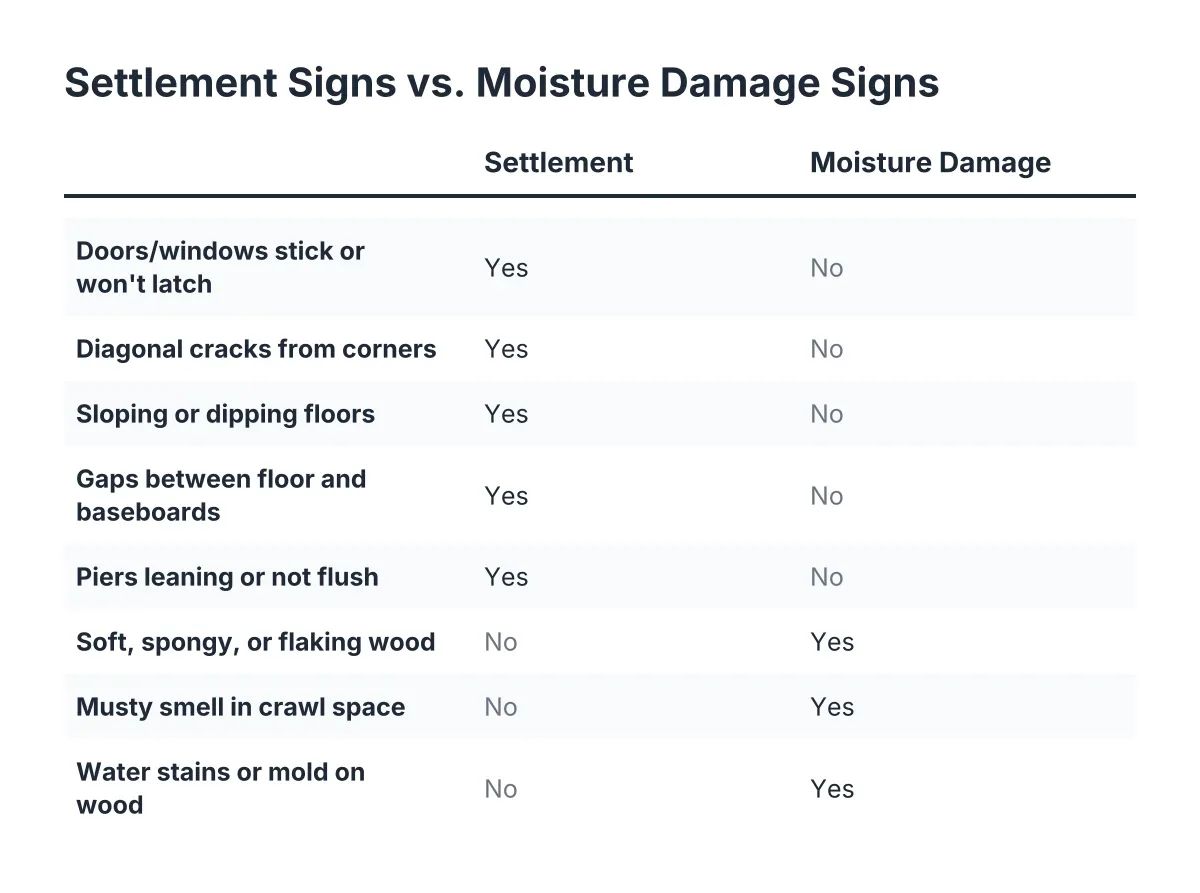
Signs that point to settlement
Settlement leaves geometric evidence. The house is moving, so look for things that are no longer level or square:
- Doors and windows that stick or will not latch, especially after wet seasons
- Diagonal cracks in drywall radiating from door and window corners
- Sloping or dipping floors concentrated in one area of the house
- Gaps opening between the floor and baseboards
- Piers that lean or no longer sit flush under their beams
A wavy, sagging floor with visible gaps at the baseboard is a sign of advanced trouble underneath. At that stage you are usually looking at both settlement and damage together, because the movement has been going on long enough for moisture to do its own work on the wood.
Signs that point to moisture damage
Damage leaves material evidence. Probe suspect wood with a screwdriver; sound wood resists, rotted wood gives:
- Soft, spongy, or flaking wood on beams, sills, or joists
- A persistent musty smell in the crawl space or rising into the house
- Visible mold growth on framing or subfloor
- Dark water stains on wood, especially a horizontal stain line
That stain line deserves special attention. A visible line on piers, soil, or beams marks the historical high-water mark; it tells you how deep water has stood in your crawl space before, even if it is dry today. If that line sits above the bottom of your beams, water has reached structural wood, and rot is likely somewhere.
One common point of confusion is worth clearing up. Light-colored, chalky mineral trails on foundation walls are usually deposits left by past groundwater intrusion, not mold. They still matter, because they confirm water has been moving through the wall, but they are a drainage clue rather than a mold remediation problem.
When it is both
Suppose a homeowner in West Ashley crawls under the house after a tropical storm and finds two inches of standing water, a brick pier tilted several degrees, and a sill beam that crumbles at the corner when probed. In that scenario, water eroded the soil under the pier over several storm seasons, causing settlement, while the same moisture rotted the beam, causing damage. Fixing only one problem leaves the other to keep working on the house.
Why Pier-and-Beam Homes Change the Diagnosis
Most foundation content online assumes a poured slab or a full basement. Charleston's older housing stock does not work that way. About 15 percent of American homes sit on a crawl space foundation, according to JSE Labs, but in Charleston's historic neighborhoods the share is far higher. Raised pier-and-beam construction with vented crawl spaces was the standard for good reason: it lifted living space above flood level and let air move under the house.
That design changes how foundation settlement and foundation damage show up, and how they get fixed.
First, pier-and-beam homes settle point by point, not as one unit. A slab cracks as a system. A pier-and-beam home can have one failing pier under the back bedroom while the rest of the house sits solid. That makes diagnosis more precise but also easier to get wrong from the surface. Figuring out how many support points a house needs, and where, takes an on-site look at exactly which sections are sinking. There is no standard layout; it varies house by house.
Second, the original vented design that once helped these homes now works against them. Foundation vents pull in humid coastal air most of the year. That air condenses on cool framing, feeds mold, and keeps the wood damp enough to rot slowly. Crawl space foundation vent problems are a quiet contributor to structural damage in older homes, which is why moisture control is part of the repair conversation, not a separate topic.
Third, historic homes deserve repairs that respect the original construction. Old-growth heart pine beams and handmade brick piers are not commodities. Where a beam is partially rotted, a sister beam or a spliced repair can preserve the original member. Where a pier has failed, adjustable steel support jacks can restore level while keeping the historic piers in place. A repair approach built for slab homes, jacking and mudjacking and concrete injection, does not translate to a 1920s pier-and-beam house on the peninsula.
Matching the Repair to the Problem
Once you know whether you are dealing with settlement, damage, or both, the repair path becomes clearer. Here is how the options line up.
If the problem is settlement from water-moved soil
The structural fix is targeted support: steel support jacks or new piers placed where the house has dropped, set on stable footing, and adjusted to bring beams back toward level. However, resupporting the house without stopping the water is a temporary fix. The soil will keep eroding, and the new supports will face the same conditions that undermined the old ones.
Therefore, a lasting repair pairs structural support with drainage. A perimeter drain installed around the interior of the crawl space foundation wall intercepts water entering under the foundation and channels it to a sump pump, according to the Building America Solution Center. Grading the crawl space soil so it slopes gently toward the drain, rather than pooling in the middle, makes the whole system work better. For homes where water enters after every hard rain, this drainage work is the difference between a repair that holds and one you repeat.
If the problem is moisture damage to wood
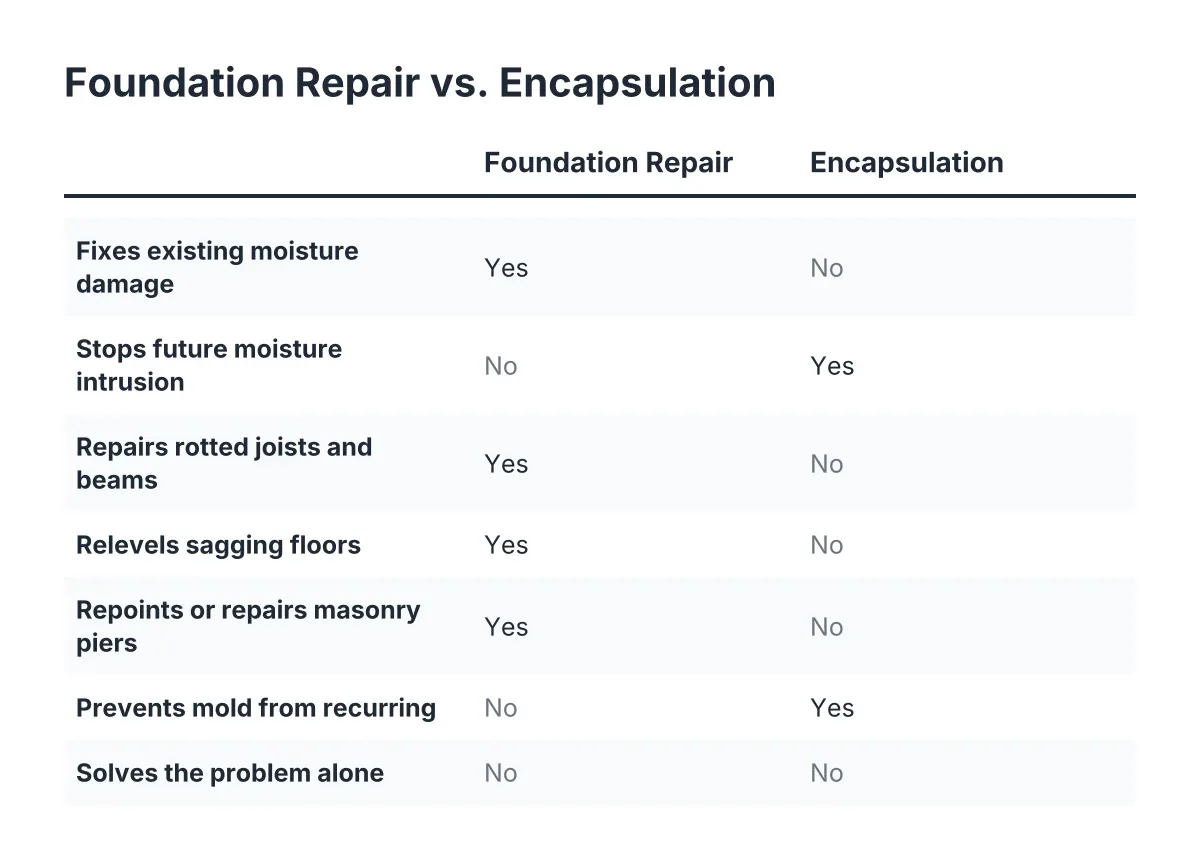
Rotted beams, sills, and joists need repair or replacement, and any mold growth needs proper mold removal before the space is sealed up. But again, the damage came from somewhere. If the crawl space stays humid, new wood will follow the same path as the old.
This is where crawl space encapsulation earns its place in a foundation conversation. Encapsulation means running heavy plastic sheeting across the entire crawl space floor and sealing it to the stem walls and around support piers, according to the U.S. Department of Energy, not just laying plastic loosely on the dirt. Done right, the floor is often built up with gravel beneath the vapor barrier with drainage piping around the perimeter. Paired with a dehumidifier, it takes the humidity that feeds rot and mold out of the equation.
One code note worth knowing: some states require a termite inspection strip near the top of the foundation wall to stay uncovered by the vapor barrier, according to Stego Industries, so local requirements should be checked before the liner goes up.
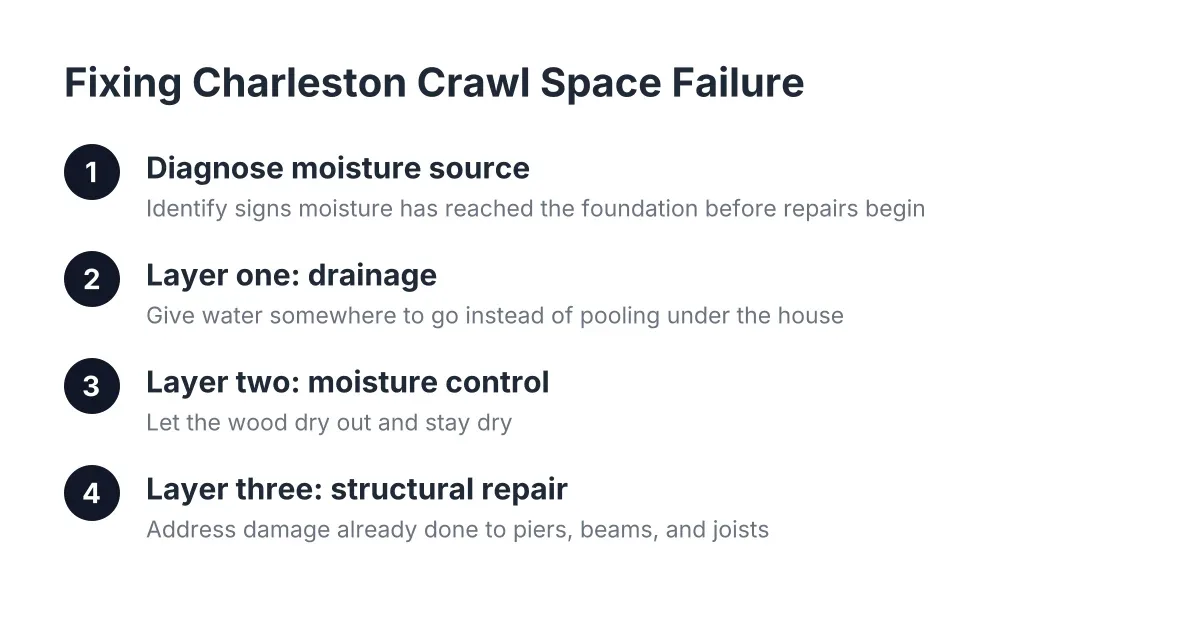
If it is both, sequence matters
For a house with standing water, settled piers, and rotted wood, a sensible repair order in 2026 looks like this:
- Get the standing water out and dry the space.
- Install drainage: perimeter drain, graded soil, and a sump pump sized for the lot.
- Repair or replace damaged beams, sills, and joists, and remediate any mold.
- Restore level with support jacks or new piers where the house has settled.
- Seal the space with a vapor barrier and add a dehumidifier to hold humidity down.
Skipping steps saves money on paper and costs more in practice. Encapsulating over wet soil traps the problem. Jacking a beam that is still rotting transfers load to failing wood.
Getting an Honest Diagnosis Before You Spend
The post-storm moment is when homeowners are most vulnerable to being sold too much or too little. If you are searching for foundation repair contractors near me with water still under the house, slow down long enough to get a real diagnosis. A skilled, unbiased inspector can generally tell the difference between soil saturation that calls for full waterproofing and isolated vapor barrier damage that only needs a patch or replacement, based on physical evidence in the crawl space itself.
A thorough crawl space inspection should include documentation of both settlement and foundation damage indicators:
- Locating and documenting the high-water stain line
- Probing beams, sills, and joists for rot, not just looking at them
- Checking each pier for lean, cracking, and voids underneath
- Measuring high and low points along the foundation walls to see which direction water travels
- Identifying entry points, including any cracked foundation joints open to the outside that let water and humidity in
That height measurement matters more than it sounds. Tracking where the crawl space floor sits high and where it sits low tells the inspector which way water moves through the space, and that shapes the drainage design. A sump pump in the wrong corner pumps out less water than a drain routed with the flow.
On pricing, a trustworthy proposal for crawl space foundation repair should be itemized. You should see the drainage work, the structural repairs, the vapor barrier, and the equipment as separate line items, so you can understand what each part costs and ask why each one is included. A single lump-sum number gives you nothing to evaluate and nothing to compare.
One honest caveat: no article can diagnose your house. Settlement and damage overlap, historic construction adds variables, and the difference between a $2,000 drainage fix and a $15,000 structural repair, to use rough illustrative ranges, comes down to what an experienced person finds under your specific home. Use this guide to ask better questions, not to skip the inspection.
Living With the Fix: What Comes After the Repair
If you already have an encapsulated crawl space with a sump pump and dehumidifier, the settlement-versus-damage question does not go away. It becomes a maintenance question. Charleston's storm seasons test these systems every year, and a system that fails quietly can let the old problem restart before you notice.
A simple annual rhythm keeps the repair working:
- Test the sump pump before hurricane season by pouring water into the basin and confirming it cycles
- Check the dehumidifier filter and drain line, and confirm the space holds steady below about 60 percent relative humidity
- Walk the vapor barrier for tears, loose seams, or sections pulled away from the stem wall
- After any major storm, look for new water stains, standing water, or shifted supports
In addition, keep an eye upstairs. New sticking doors, fresh drywall cracks, or a floor that starts to dip again are early signs that something under the house has changed. Caught early, most recurrences are small fixes. Caught late, you are back to the diagnosis stage.
The difference between settlement and damage is the difference between a house that moved and a house that is weakening. In Charleston, water usually drives both. Control the water, support the structure where it has dropped, and repair the wood the moisture claimed, in that order, and a pier-and-beam home that has stood for a century has every reason to stand for another one.
If you need crawl space encapsulation, Low Country Crawl Space Repair can help.
Prefer to talk it through? Call +18542013678 — a quick call is usually the fastest way to get a straight answer for your situation.