Pier-and-Beam Foundation Settling: Causes, Repairs, and When to Worry
If your floors feel soft, bouncy, or tilted, you are probably wondering how bad it is and what it will cost to fix. In Charleston, most of these problems trace back to pier-and-beam foundation settling causes that start with moisture under the house, not with the house itself failing. That distinction matters. Some sagging floors need a few hundred dollars of moisture control. Others need support jacks and beam repair. A few are genuine emergencies. This guide walks through what makes a pier-and-beam foundation settle, how to tell a minor fix from a structural problem, and what the repair options actually involve, so you can evaluate what you are dealing with before anyone tries to sell you anything.
How a Pier-and-Beam Foundation Works, and Why Charleston Homes Have Them
A pier-and-beam foundation holds your house up on a series of masonry or concrete piers. Wood beams run across the tops of those piers, and floor joists sit on the beams. Your floor sits on the joists. The whole system leaves a crawl space underneath, usually 18 inches to a few feet tall.
Older Charleston homes were built this way for good reason. The Lowcountry has a high water table, tidal lots, and flood-prone soil. Raising the house off the ground kept the living space above standing water and let air move underneath. According to JSE Labs, about 15 percent of American homes sit on a crawl space foundation, and in older Charleston neighborhoods that share runs much higher.
The design has one built-in weakness, though. Every structural part of it, the piers, the beams, and the joists, lives in the dampest part of the property. When moisture gets out of control down there, the wood and the soil both start giving way. That is where settling begins.
What Causes Foundation Settling in Pier-and-Beam Homes
Pier-and-beam foundation settling in Charleston usually comes from one of five causes: soil movement under the piers, moisture-rotted beams and joists, failed or undersized piers, erosion and washout under the foundation, and long-term humidity damage to the wood framing. Most houses with sagging floors have more than one of these happening at once, and moisture is almost always the common thread.
Soil Movement and Washout Under the Piers—Common Foundation Settling Causes
Piers are only as stable as the dirt they sit on. Charleston soil stays wet for much of the year, and it moves. During the 2023 to 2024 meteorological year, Charleston set a record of 17 high-tide flood days, according to NOAA Tides and Currents. Every one of those flood cycles pushes water through the soil under raised homes near the water.
Over years, that water erodes soil and creates voids and depressions under piers and footings. A pier sitting over a washed-out pocket sinks. When one pier drops even half an inch, the beam above it dips, and the floor above that beam sags or slopes.
Rotted beams and floor joists
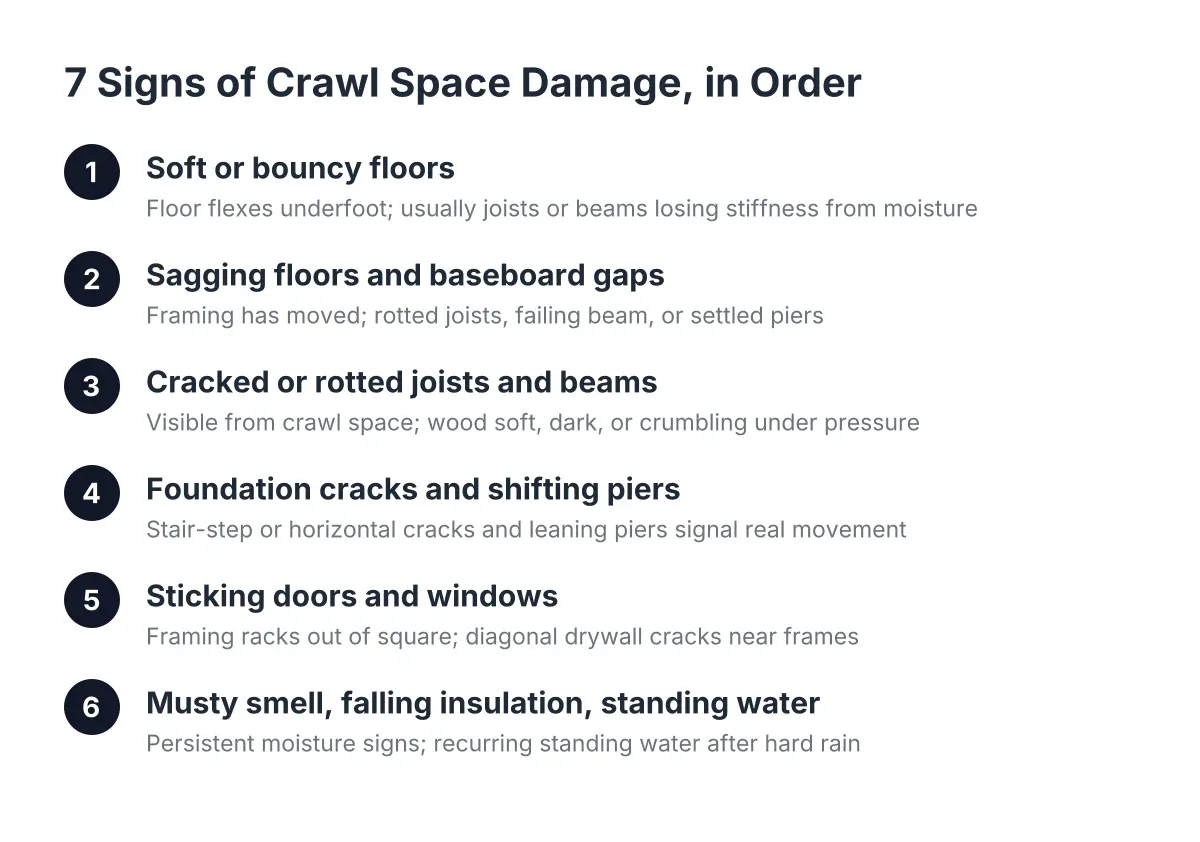
Wood in a damp, vented crawl space absorbs moisture year after year. Coastal humidity, hurricane-season rain, and ground moisture rising from bare dirt all feed the problem. Eventually the wood fibers weaken and rot. A rotted joist flexes when you walk over it, which is why the floor feels bouncy in one spot. A rotted beam sags across a wider area, which is why a whole room can feel tilted.
There is a useful diagnostic point here. A visibly bowed beam paired with a high moisture reading at that same spot tells you moisture is driving the structural sag, not just age. That means fixing the wood without fixing the moisture only buys you a few years before the new wood rots too.
Failing or poorly spaced piers
Some older homes simply have too few piers, or piers spaced too far apart for the span they carry. Brick piers can also crack, lean, or lose mortar over decades. Proper pier spacing depends on the beam size, the wall height, and whether a real footing exists underneath, which is why one house needs piers every six feet and another needs them every eight.
Drainage and grading problems around the house
Sometimes the settling cause sits outside the crawl space entirely. Soil piled too high against the foundation, above the brick line, funnels rainwater straight toward the crawl space instead of away from it. Downspouts dumping next to the foundation do the same thing. The fix in those cases starts with regrading and drainage, not with jacks.
How to Tell a Moisture Problem From a Structural Emergency
Most sagging floors in Charleston are not emergencies. A floor that has developed a slight bounce or a musty smell over several years usually signals a moisture problem that has started to affect the wood. A floor that has dropped noticeably in months, or one where doors suddenly stop closing, deserves a professional inspection quickly.
Here is a practical way to sort what you are seeing:
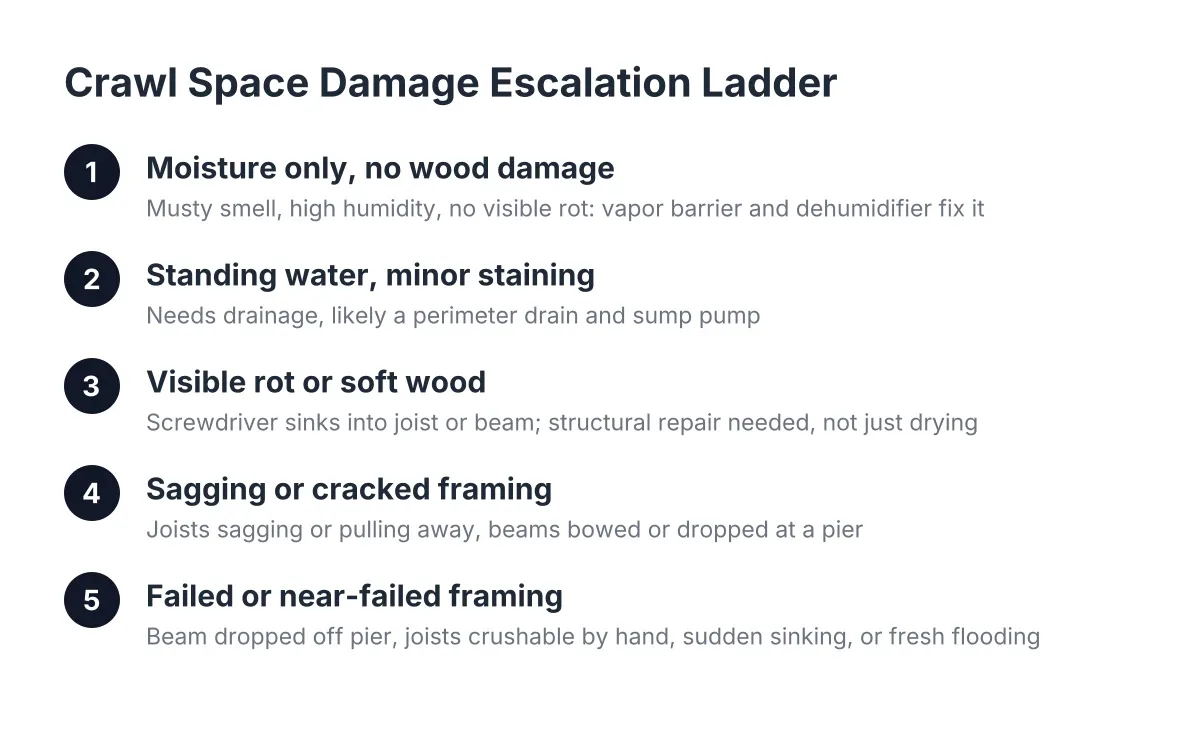
- Likely a moisture fix first: musty smell in the house, dampness on the crawl space dirt, condensation on ducts or pipes, mild floor bounce in one room, mold spotting on joists without soft wood.
- Structural repair territory: floors visibly sloping, gaps opening between floor and baseboard, doors and windows sticking or swinging on their own, wood that crumbles or feels spongy when probed with a screwdriver.
- Treat it as urgent: a beam visibly cracked or separated from its pier, a pier leaning or collapsed, a floor that has dropped suddenly, or new sagging directly under a heavy load like a bathtub or piano.
One reassurance worth stating plainly: some dampness around the perimeter of a crawl space after a rainy stretch is normal for pier-and-beam homes here and is not alarming by itself. The same standing dampness in a dry August week is a different story, because it points to a drainage or water-table problem rather than recent weather.
Is a sagging floor an emergency?
A sagging floor is rarely an immediate emergency, but it never improves on its own. The urgent cases are sudden drops, cracked or shifted beams, and floors sagging under heavy fixtures. Slow, gradual sag that developed over years gives you time to get an inspection and compare repair options without panic.
The reason to act within months rather than years is cost escalation. A joist that needs sistering today may need full replacement in two years, and the beam it sits on may follow. Moisture damage compounds; the repair bill compounds with it.
What Structural Repair Under the House Actually Involves
Crawl space structural repair for a settling pier-and-beam home comes down to three kinds of work: adding or restoring support under the beams, repairing or reinforcing the wood framing, and fixing the moisture problem that caused the damage. A repair that skips the third step tends to repeat itself.
Support jacks and new piers
Steel support jacks, sometimes called crawl space jacks or screw jacks, sit on a stable footing and support a sagging beam from below. A crew installs them where the beam has dropped, then raises the beam slowly, often over days or weeks, to avoid cracking drywall and plaster upstairs. Jacks work well when the existing piers are sound but too far apart, or when a beam needs help mid-span.
Where an existing pier has failed or sunk, the repair may mean rebuilding the pier or adding new ones. Placement is not guesswork. It requires someone under the house identifying exactly where the structure is dropping, because the right pier layout depends on which sections of the home are affected.
Beam repair and joist sistering
When floor damage is limited, the standard approach is sistering: fastening a new joist alongside the rotted one so the new wood carries the load. Beams with localized rot get reinforced or replaced in sections. Full floor-system replacement is the last resort, reserved for widespread rot, and most Charleston homes caught at the sagging-floor stage never need it.
This is licensed-contractor work, not a weekend project. Jacking a beam wrong can crack masonry, break plumbing, or shift loads onto framing that cannot carry them. Get the structural work done by a licensed contractor, and get more than one opinion if the first quote feels padded.
Fixing the moisture source
Depending on the specific pier-and-beam foundation settling factors at your house, the moisture side of the repair may include regrading soil away from the brick line, a crawl space drainage system with a perimeter drain and sump pump, a sealed vapor barrier, or a full encapsulation with a dehumidifier. A perimeter drain installed along the interior of the foundation wall intercepts water coming in under the foundation and channels it to a sump pump, according to the Building America Solution Center. Grading the crawl space dirt to slope slightly toward that drain helps water move to the pump instead of pooling in the middle.
Full encapsulation means running heavy plastic sheeting across the entire crawl space floor and sealing it to the stem walls and around the support structure, not just laying plastic loosely on the dirt, according to the U.S. Department of Energy. In a complete job, the piers themselves get wrapped individually. One code note: some states require an uncovered termite inspection strip near the top of the foundation wall, so the vapor barrier layout should follow local requirements, according to Stego Industries.
What Does Pier-and-Beam Structural Repair Cost?
Structural repair costs for a settling pier-and-beam home vary widely because the work scales with damage. As rough 2026 illustrative estimates, individual support jacks often run a few hundred to around a thousand dollars each installed, sistering a handful of joists commonly lands in the low thousands, and beam replacement with new supports can reach five figures when damage is widespread. These are ballpark ranges, not quotes; your foundation repair cost depends on access, span, and how much wood has rotted.
Moisture control adds its own line items. A vapor barrier alone costs far less than full encapsulation with drainage and a dehumidifier, and the right scope depends on how wet your crawl space actually runs. Wet crawl spaces are common here; the American Society of Home Inspectors reports that more than 60 percent of U.S. homes have had water or moisture problems in their basement or crawl space. Common does not mean ignorable, but it does mean the industry has standard, well-understood fixes at every price level.
For example, suppose a homeowner in West Ashley is selling a 1960s ranch and the buyer's inspector flags two rotted joists, a bowed section of beam, and a saturated crawl space with no vapor barrier. In that scenario, a typical repair might be sistering the joists, setting two or three support jacks under the beam, and installing a vapor barrier with a dehumidifier, plausibly in the $4,000 to $8,000 range all in. That fits inside common seller-concession budgets and closes the inspection item without rebuilding the floor. The same house left alone for five more years could need beam replacement at double the price.
Skepticism about big quotes is healthy. If a company inspects a house with mild floor bounce and one damp corner, then quotes a five-figure package on the first visit, ask them to separate the structural repairs from the moisture upgrades and justify each. A legitimate residential foundation repair scope will map each line item to specific damage you can see or that they can show you in photos.
Repair Options Compared: From a Dehumidifier to Full Structural Work
The honest answer to "do I need the full job" is that it depends on where your house sits on the damage curve. Here is how the options stack up:
- Dehumidifier and ventilation adjustments. Lowest cost. Helps a crawl space that smells musty but has sound wood and no standing water. Trade-off: in a vented Charleston crawl space with bare dirt, a dehumidifier fights the ocean of humidity coming through the vents and up from the ground, so it often falls behind in summer.
- Vapor barrier and drainage. Mid-range. Stops ground moisture and channels water to a sump pump. The right call when dampness is chronic but the framing is still solid. Trade-off: does not fix wood that has already rotted.
- Encapsulation with dehumidification. Higher cost. Seals the crawl space, controls humidity year-round, and protects new structural wood so the repair lasts. Trade-off: it is the most expensive moisture option, and it is overkill for a dry crawl space with a one-time leak.
- Structural repair, with jacks, beam work, or joist sistering. Priced by scope. Required once wood is soft or the floor has measurably dropped. Trade-off: doing it without addressing moisture invites a repeat repair.
Notice the pattern. Moisture control protects the structure; structural work restores it. A house foundation problem caught early may need only the first or second option. A house that has smelled musty for years while the floors slowly softened probably needs both categories, and pretending otherwise just delays the structural bill.
Why the Musty Smell and the Sagging Floor Are Usually the Same Problem
That persistent musty smell upstairs and the soft spot in the hallway floor typically share one source: excess moisture in the crawl space. The smell is mold and damp wood off-gassing into the house through gaps in the floor. The sag is the same damp wood losing strength. Candles and air fresheners mask the first symptom and do nothing for the second.
This is why the smell keeps coming back after rain and humid stretches. The crawl space gets wetter, mold activity picks up, and more of that air drifts up into your living space. If guests have mentioned the smell for years and the floors have gradually gotten bouncier, that timeline itself is evidence the two problems are connected.
The fix order matters. Address the moisture, remediate any mold on the framing, and repair the weakened wood. Skip the first step and the smell returns; skip the last and the floor keeps dropping.
What a Straight Inspection Should Tell You
A worthwhile crawl space inspection ends with specifics, not a scare pitch. Whoever crawls under your house should come back with photos and be able to answer these questions:
- Where is the moisture coming from: ground, drainage, plumbing leak, or humid outside air through the vents?
- Which joists and beams are actually soft, measured by probing, not just discolored?
- Are the piers sound, and is the sag from failed piers, washed-out soil, or rotted wood above them?
- What is the minimum repair that solves the problem, and what would a longer-term fix add?
Pay attention to whether the inspector separates causes from symptoms. Mold on a joist is a symptom. Standing water after a dry week is a cause. Any recommendation should trace back to the specific foundation settling causes under your house, because pier placement, beam repair scope, and drainage layout all depend on where the damage actually is.
One limitation worth naming: no article can tell you whether your particular floor is a moisture fix or a structural repair. Wood that looks fine can be soft inside, and a sag that seems minor can sit over a failed pier. If your floors are sloping, doors are sticking, or the crawl space stays wet in dry weather, get a professional under the house before deciding anything. The inspection is the cheap part. What it tells you determines whether you are budgeting for a dehumidifier or for beam work, and knowing that answer is worth far more than another year of covering up the smell.
If you need crawl space encapsulation, Low Country Crawl Space Repair can help.
Prefer to talk it through? Call +18542013678 — a quick call is usually the fastest way to get a straight answer for your situation.