7 Signs of Structural Damage in Charleston Crawl Spaces (And Which Ones Are Emergencies)
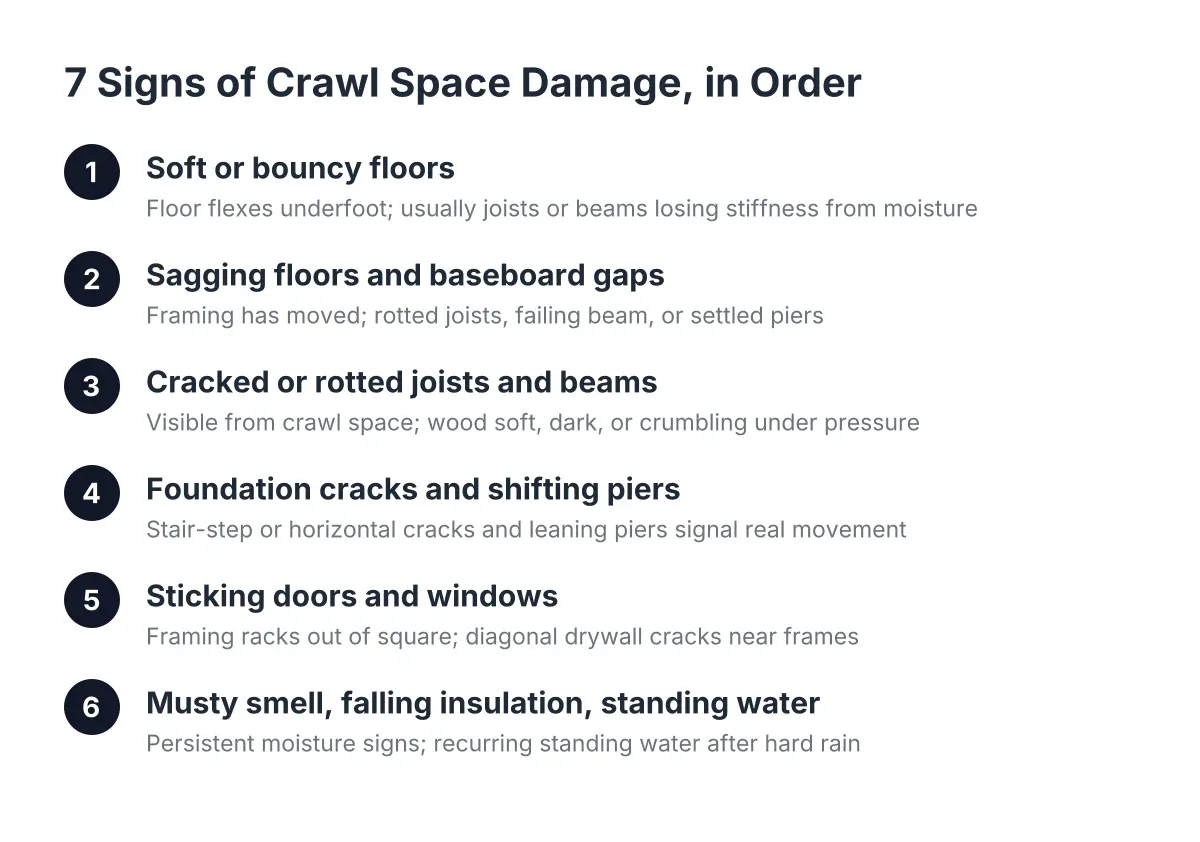
You crawled under the house after the last storm, found standing water, and now you are wondering how bad it really is. That is the right question to ask. The signs of structural damage Charleston homeowners find in their crawl spaces range from minor moisture symptoms that a vapor barrier and dehumidifier can fix, to rotted beams that need support jacks before the floor above gets worse. Understanding crawl space damage signs helps you recognize which problems require immediate professional attention and which can wait. This list walks through seven signs, roughly in order of severity, and tells you plainly which ones can wait a month, which need repair this season, and which mean you should keep foot traffic off part of the floor until a professional looks at it.
One number worth knowing up front: more than 60% of U.S. homes have had water or moisture problems in their basement or crawl space, according to the American Society of Home Inspectors. Water under a Charleston house is common. Structural damage is what happens when that water sits unaddressed for years. The whole point of this article is to help you tell one from the other, so you fix the actual problem and do not pay for repairs you do not need.
1. Soft or Bouncy Floors That Flex When You Walk
A floor that dips or bounces underfoot usually means the joists or beams below have lost stiffness. In a damp Charleston crawl space, that loss almost always comes from moisture. Wood that stays above roughly 20 percent moisture content for long stretches starts to soften, and once fungus takes hold, the wood loses strength faster than it looks like it should.
Here is the escalation guide. A single bouncy spot near a bathroom or kitchen often traces to one damaged joist and a plumbing leak; that is a contained repair, not a whole-house project. Bounce across an entire room, or floors that feel spongy in several rooms, points to a beam or multiple joists and needs an inspection within weeks, not months. Either way, bounce alone is rarely an emergency; it is a warning that the wood is asking for help.
2. Sagging Floors and Gaps at the Baseboard
Sagging is one step past bouncy. When the floor visibly slopes toward the middle of a room, or you notice a gap opening between the floor and the baseboard, the framing underneath has actually moved. A wavy, sagging floor with baseboard gaps is a visible symptom of advanced moisture damage below, not an early one.
Sagging floors above a crawl space typically mean one of three things: rotted floor joists, a failing beam, or support piers that have settled into wet soil. Charleston's high water table and clay-heavy soils make pier settling more common here than in drier regions. This is the point where crawl space structural repair enters the conversation, usually meaning support jacks, sistered joists, or beam replacement. Sagging that is worsening month over month, or paired with doors that no longer latch, should be inspected within days.
3. Cracked or Rotted Floor Joists and Beams
This is the sign you can only see from inside the crawl space, and it is the most direct one. Rotted floor joists in a crawl space look dark, feel soft when you press a screwdriver into them, and sometimes crumble at the edges. Cracks that run along the length of a joist, or joists that have visibly split near a pier, mean the member is carrying less load than it was built to carry.
For example, suppose a homeowner in West Ashley goes under the house after a tropical storm to check on standing water and finds two joists near the ductwork that a screwdriver sinks into like a sponge. In that scenario, the water is the trigger, but the rot has been building for years. The illustrative fix is usually sistering new lumber alongside the damaged joists and adding a support jack under the weakened span, often in the low thousands rather than the tens of thousands, though only an on-site inspection can put a real number on it. Joist repair belongs to a licensed contractor; this is not a weekend project, because a misplaced jack can crack the floor or shift the load onto another weak member.
4. Foundation Cracks and Shifting Piers
Cracks in the stem wall, brick piers, or foundation footing show up when the ground under the house moves. In the Lowcountry, that movement usually comes from soil that swells when saturated and shrinks when it dries, a cycle that repeats every hurricane season. Charleston set a record of 17 high-tide flood days during the 2023-24 meteorological year, according to NOAA Tides and Currents, so lots near marshes and creeks see that wet-dry cycle more than most.
Not every crack is structural. Hairline vertical cracks in a poured stem wall are often shrinkage and can be sealed; foundation crack repair epoxy handles many of these, and sealing matters because an open crack lets outside humidity pour into the crawl space. However, stair-step cracks in brick piers, horizontal cracks in the stem wall, or piers that lean or have separated from the beam above them are genuine structural signals. Those need an inspection before the next heavy rain, because saturated soil is exactly when a compromised pier moves further.
5. Doors and Windows That Stick, and Cracks Above Frames
When the framing under a house shifts, the walls above it rack slightly out of square. The first place you notice is doors that suddenly stick or will not latch, windows that bind, and diagonal cracks in drywall radiating from the corners of door and window frames. One sticking door after a humid August is normal in Charleston; wood swells. Several doors sticking at once, on the same side of the house, alongside new drywall cracks, is a pattern worth taking seriously.
This sign matters because it is often how the signs of structural damage Charleston houses hide below finally show up in the living space. Most people never go under their own house, so damage in the crawl space goes undetected for years until the rooms above start telling on it. If sticking doors show up within weeks of finding standing water under the house, treat the two as connected and get the crawl space inspected rather than just planing the doors.
6. Recognizing Crawl Space Damage Signs: Persistent Musty Smell and Falling Insulation
A musty smell in the living space is the earliest warning in this whole list, and the cheapest one to act on. That odor is crawl space air moving up into the house, carrying moisture and mold spores with it. Look under the house and you will often find a second clue: fiberglass batt insulation sagging or falling from between the joists. Wet insulation gets heavy, pulls loose, and tells you humidity is winning down there.
The good news is that at this stage you are usually still in moisture-control territory, not structural repair. The typical fix is a sequence, and it stops the cascade before wood starts rotting:
- A full crawl space inspection to find where the water and humidity are coming in
- Standing water removed, plus drainage such as a perimeter French drain and sump pump if water recurs after rain
- A sealed vapor barrier across the floor and up the stem walls; real encapsulation seals the sheeting to the walls and around support piers, not just plastic laid loosely on the dirt, per U.S. Department of Energy guidance
- A crawl space dehumidifier to hold humidity down year-round
- Mold remediation on any framing that already shows growth
Grading the crawl space floor to slope slightly toward the drain helps water reach the sump pump instead of pooling in the middle, a detail the Building America Solution Center notes and one that matters on Charleston's flat, low lots. Catch the problem here and you may never need a support jack at all.
7. Standing Water That Returns After Every Hard Rain
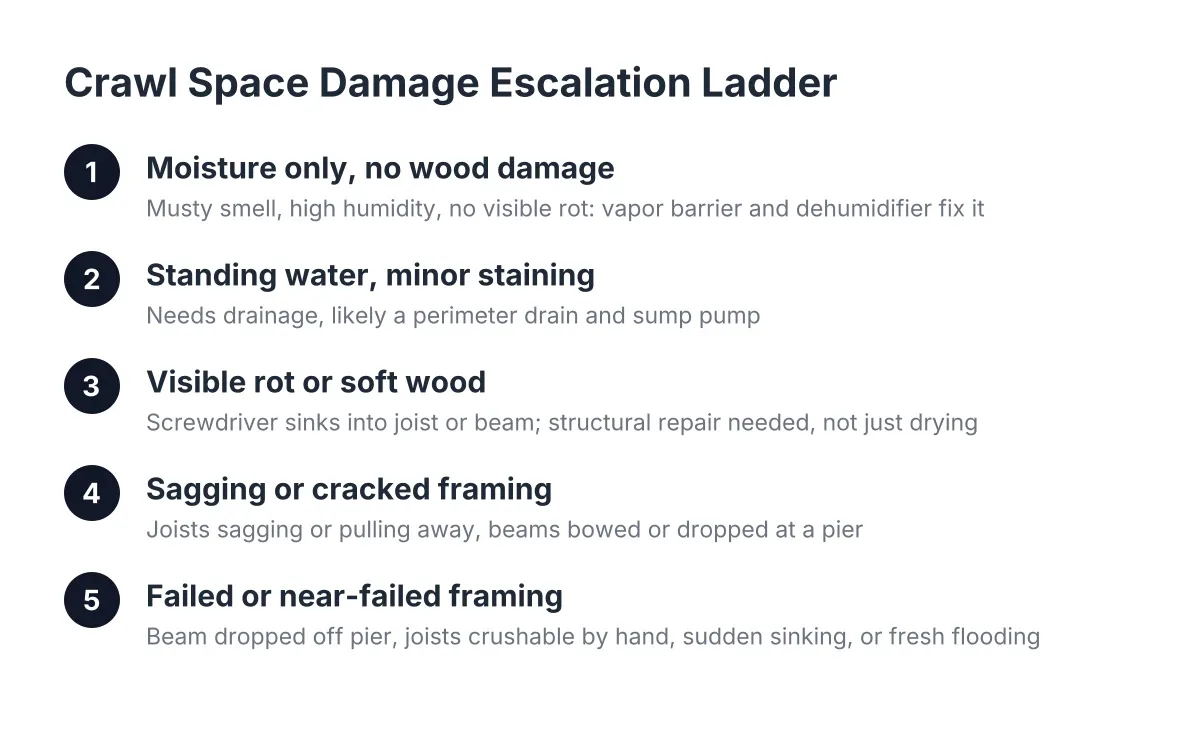
If you just found water under the house after a storm, this is your sign, and the honest answer is that water itself is not structural damage. Water is the cause; the damage is what one through five above describe. The escalation question is simple: has the water been happening for one season, or for ten?
Recent, recurring water with framing that still probes solid is a drainage problem. An interior perimeter drain intercepts water coming in under the foundation and channels it to a sump pump, as the Building America Solution Center describes, and paired with encapsulation and a dehumidifier it breaks the cycle. Recurring water plus soft joists, leaning piers, or sagging floors means you need both drainage and structural work, and the drainage should come first so new lumber does not sit in the same swamp that ruined the old lumber. Moisture problems under a house get worse on their own, never better, so the cheapest version of this repair is always the one done this year, not in 2028.
How to Tell Crawl Space Damage Signs From a Structural Emergency in Charleston
Sort what you found into three buckets. Musty smell, damp ground, falling insulation, or first-time standing water: schedule an inspection this month, and expect moisture control rather than framing work. Bouncy floors, hairline cracks, or one sticking door: inspect within a few weeks, and expect targeted repairs, possibly a jack or a sistered joist. Visible sag, leaning piers, horizontal stem wall cracks, or a floor that has dropped: call now, keep heavy furniture and foot traffic off the affected area, and expect structural support work.
A fair worry after a storm is that a contractor will say yes to everything and run up the bill. A skilled, unbiased inspector can usually distinguish saturated soil that needs full waterproofing from an isolated vapor barrier tear that needs only a patch, based on physical evidence in the crawl space. Ask the inspector to show you the evidence for each recommendation: the wet wood, the crack, the settled pier. Any specialist worth hiring in 2026 will walk you through photos and explain why each item is on the list, and which signs of structural damage in a Charleston crawl space genuinely need fixing now versus watching. One honest caveat: no article can grade your framing from a distance, so treat this list as a triage guide, not a diagnosis, and get eyes under the house before deciding anything.
If you need crawl space encapsulation, Low Country Crawl Space Repair can help.
Prefer to talk it through? Call +18542013678 — a quick call is usually the fastest way to get a straight answer for your situation.