Crawl Space Maintenance vs. Encapsulation: Do Charleston Homes Need Both?
If you own a home around Charleston, you have probably heard both terms and wondered how they fit together. Here is the short answer on crawl space maintenance and encapsulation: encapsulation is the one-time project that seals your crawl space against moisture, and maintenance is the ongoing work that keeps that seal doing its job. They are not competing options. One without the other leaves money on the table, and in the Lowcountry, it often leaves water under your floor too. Proper maintenance after encapsulation is essential to protect your investment and keep the system working effectively.
This guide walks through what each one does, why an encapsulated crawl space still needs regular attention, and what a realistic service schedule looks like for a home sitting on Charleston's high water table. If you already had your crawl space encapsulated, the second half of this article is your playbook for protecting that investment, your equipment, and your warranty.
What Encapsulation Does and What It Cannot Do
Crawl space encapsulation is a sealing project, not a maintenance plan. According to the U.S. Department of Energy, encapsulation means running plastic sheeting across the entire crawl space floor and sealing it to the stem walls and around support beams, rather than laying plastic loosely on the dirt. A full job in the Charleston area usually also includes sealing the foundation vents, wrapping the piers, installing a dehumidifier, and sealing the crawl space door.
Done right, it changes the environment under your house. The vapor barrier blocks ground moisture. The dehumidifier controls the humidity that still works its way in. A drainage system and sump pump handle liquid water during storms and king tides. Floor joists dry out, the musty smell fades, and mold loses the damp conditions it needs.
However, encapsulation is a system of parts, and parts wear. The dehumidifier has a filter, a condensate line, and a compressor. The sump pump has a float switch that can stick. Additionally, the vapor barrier has seams and seals that can pull loose if someone crawls through to run cable or fix a pipe. None of those things maintain themselves.
That is where the confusion starts. Homeowners sometimes hear "encapsulation" and picture a one-and-done fix, like a new roof. A better comparison is an HVAC system. The installation solves the problem, but filters, checkups, and the occasional repair keep it solved.
Why Crawl Space Maintenance Still Matters After Encapsulation
An encapsulated crawl space still needs maintenance because the equipment inside it runs year-round in one of the most demanding climates in the country. Charleston's coastal humidity, tidal lots, and hurricane-season rain put constant load on dehumidifiers, sump pumps, and barrier seals. Maintenance after encapsulation is necessary to catch failures before they escalate, and most warranties require documented upkeep.
Consider what your system is up against. Moisture problems are common everywhere; more than 60 percent of U.S. homes have had water or moisture trouble in their basement or crawl space, according to the American Society of Home Inspectors. Charleston adds tidal flooding on top of that. NOAA Tides and Currents recorded 17 high-tide flood days here during the 2023-24 meteorological year, a local record. Each of those events pushes groundwater higher under homes on low-lying lots.
There is also a quirk of sealed crawl spaces that surprises people. The Building America Solution Center notes that a sealed crawl space can trap water like a pool if a pipe bursts or floodwater gets in, which is exactly why a sump pump sits at the lowest point as the emergency exit for water. If that pump fails and nobody notices, the barrier that normally protects your home holds the water against it instead.
Finally, there is the quiet failure problem. An unsealed crawl space announces trouble with a musty smell in the hallway. An encapsulated one hides it. A dehumidifier that quit in June might not make itself known until floor joists show surface mold in October. Scheduled inspections exist to catch that gap.
Maintenance vs. Encapsulation: Which One Does Your Home Need?
Which one your home needs depends on where you are starting from. A damp, vented, never-sealed crawl space needs encapsulation first; maintenance alone cannot fix a dirt floor breathing moisture into your framing. An already-encapsulated crawl space needs maintenance, not a second encapsulation. Most Charleston homes with moisture problems eventually need both, in that order.
Here is a plain decision rule you can apply from your own hallway:
- Vented crawl space, musty smell, damp insulation, or mold on joists: you need moisture control first, which usually means encapsulation with a vapor barrier, a dehumidifier, and drainage if water pools.
- Encapsulated crawl space with working equipment: you need a maintenance schedule, typically one or two professional visits a year plus storm-season checks.
- Encapsulated crawl space with a torn barrier, a dead dehumidifier, or standing water: you need repair, then a maintenance plan so it does not happen again.
- Sagging or bouncy floors in either case: you need a structural inspection before anything else, because support jacks or beam repair may come first.
One honest caveat: full encapsulation is not always required. Once a specialist diagnoses the actual moisture and mold conditions, a lower-budget fix such as a dehumidifier alone sometimes handles a mild humidity problem. The point of an inspection is to match the fix to the problem, not to sell the biggest package.
Where Sagging Floors Fit Into This Decision
A soft or bouncy floor changes the order of operations. Sagging floors usually mean moisture has already damaged floor joists or beams, or that support spacing was never adequate. In that case, structural support comes before or alongside moisture work; sealing a crawl space does not straighten a rotted joist.
Say a homeowner in West Ashley notices the hallway floor flexing and a bedroom door that suddenly sticks. In that scenario, an inspection might find two joists softened by years of condensation and a beam that needs sistering, plus humidity readings in the 70s. The right sequence is structural repair with support jacks and beam work first, then encapsulation to stop the rot from continuing, then a maintenance plan to keep the dehumidifier and sump pump honest. Fixing the structure without fixing the moisture invites the same repair again in ten years.
The fear with sagging floors is always the bill. The honest answer is that the range is wide, which is exactly why a specific inspection matters. As a rough illustration, adding a couple of support jacks under a sound beam is a modest job, while replacing rotted beams and multiple joists across a large footprint is a major one. You cannot know which house you are standing in until someone crawls under it with a flashlight and a moisture meter.
A Crawl Space Maintenance and Encapsulation Service Schedule
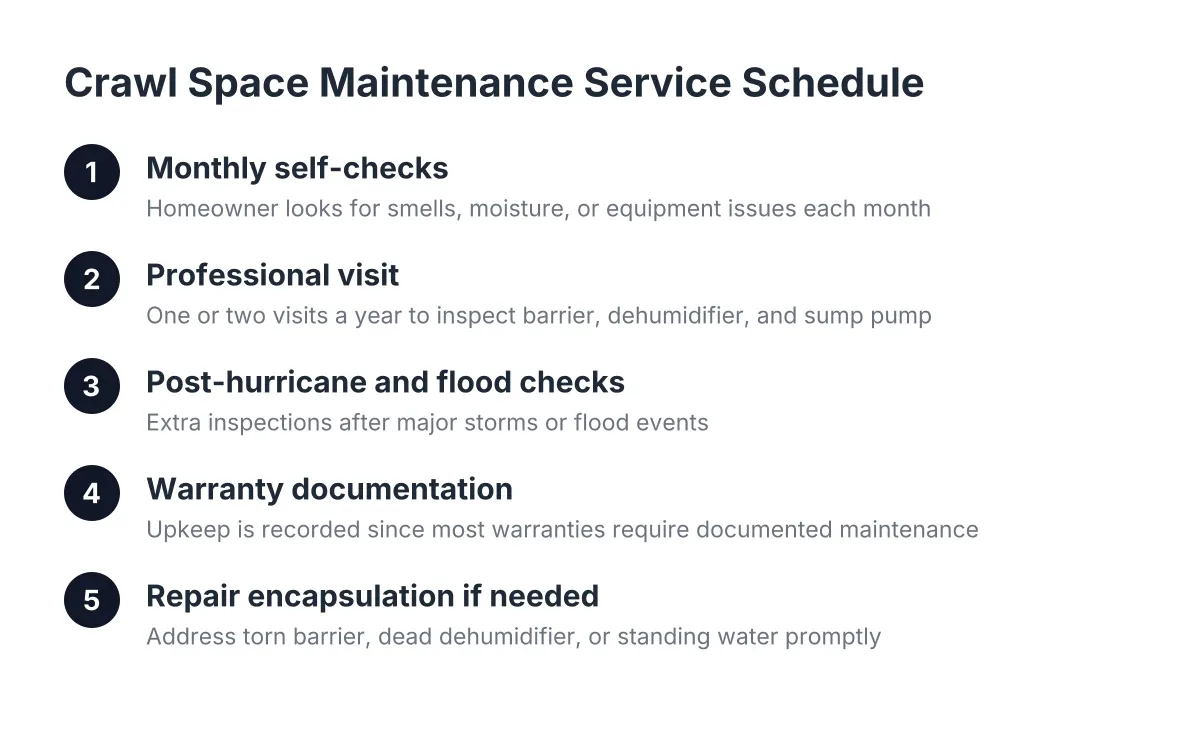
A realistic service schedule for an encapsulated Charleston crawl space runs on three clocks: monthly glances you do yourself, one or two professional visits per year, and event-driven checks after major storms or flooding. Together they catch equipment failures early, keep humidity in range, and create the service records most encapsulation warranties expect.
What you can check yourself each month
First, you do not need to crawl anywhere for the basics. Spend five minutes a month on these:
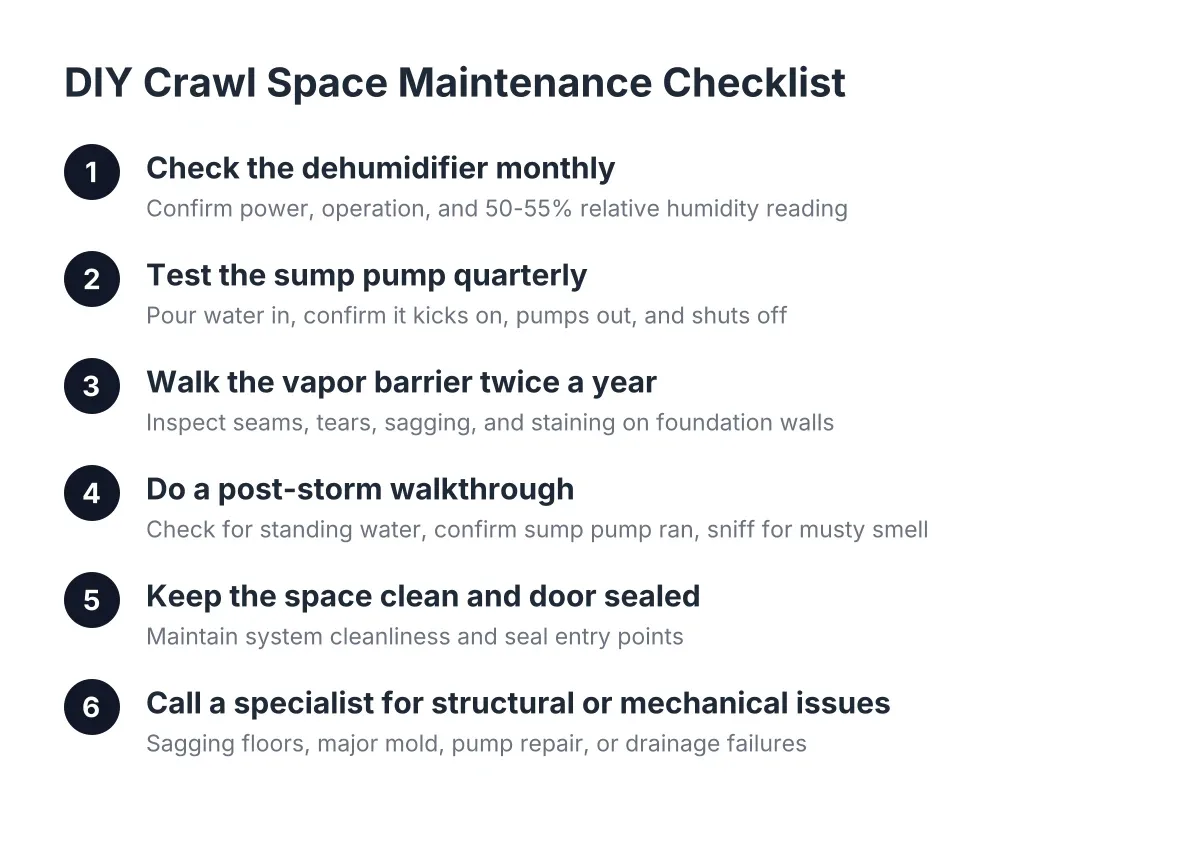
- Check the dehumidifier readout or your remote humidity sensor. Under about 55 percent relative humidity is the target; readings creeping into the 60s mean something changed.
- Listen at the crawl space access for the dehumidifier cycling. Dead silence for days in a Charleston summer is a red flag.
- Pour a bucket of water into the sump basin if it is accessible, and confirm the pump kicks on and the water leaves.
- Walk your floors. New soft spots, new squeaks, or doors that start sticking deserve attention, not a wait-and-see.
- Sniff at the access door. A returning musty smell inside an encapsulated space means moisture is getting past something.
What a professional visit covers
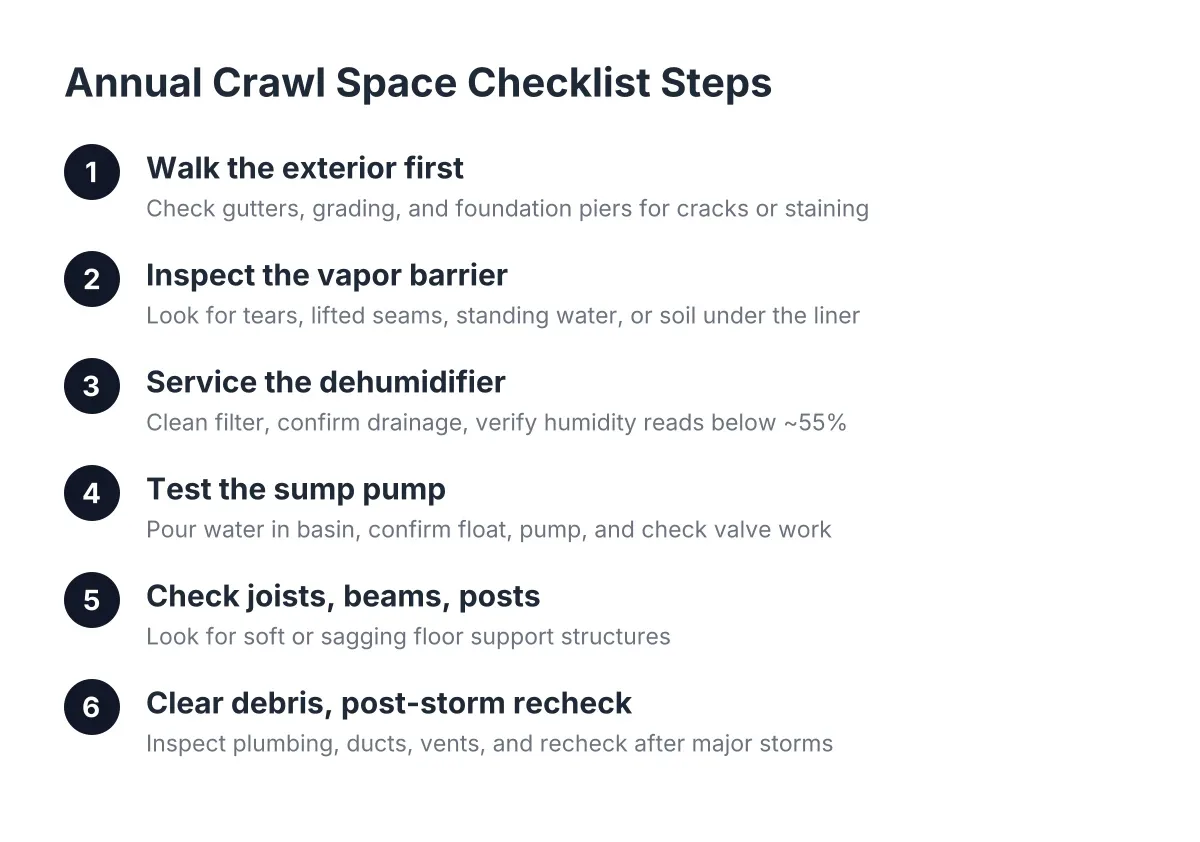
Next, the annual or twice-yearly professional visit goes deeper than a homeowner reasonably can. A typical crew on a maintenance visit will clean or replace the dehumidifier filter, flush the condensate line, verify the unit holds its humidity setpoint, and test the sump pump, float switch, check valve, and discharge line. They inspect the vapor barrier seam by seam, re-taping pulled sections and re-sealing around piers and the stem wall.
In addition, a good visit looks past the equipment. The technician takes moisture readings on joists and beams, checks for new mold growth, inspects insulation at the rim joists, and confirms the crawl space door still seals. If your home has perimeter drainage, they confirm water still reaches the sump instead of pooling mid-floor. The Building America Solution Center notes that encapsulated floors are graded to slope toward the drain for exactly this reason; settling soil can undo that slope over time.
How often should you service a crawl space dehumidifier? Twice a year is the sensible rhythm in the Lowcountry; once before the summer humidity peak and once after hurricane season. Homes on dry, elevated lots can sometimes stretch to annual service, while flood-zone lots near tidal creeks should not.
Post-hurricane and flood-event checks
Event-driven checks are the third clock, and around here they matter as much as the calendar. After any named storm, days of heavy rain, or a king-tide flooding event, the crawl space deserves a look within the following week. You are checking for standing water on the vapor barrier, a sump pump that ran continuously and tripped a breaker, and barrier sections lifted or shifted by water pressure.
Suppose a storm drops eight inches of rain on a James Island lot and the power blinks out for six hours. In that scenario, the sump pump sat dead during the heaviest inflow. Water may have risen onto the barrier and drained slowly once power returned, leaving sediment on the plastic and moisture trapped at low seams. The crawl space looks fine from the access door, but a post-storm inspection finds and dries what a calendar visit three months later would have found as mold.
Warranty Terms and the Cost of Skipping Service
Most crawl space encapsulation warranties tie coverage to upkeep, and that is the part homeowners miss. Materials warranties on the vapor barrier, equipment warranties on the dehumidifier and sump pump, and workmanship warranties on the installation each carry their own terms. Equipment warranties in particular commonly expect documented service, such as filter changes, at stated intervals.
Read your paperwork and note three things: what each warranty covers, how long it runs, and what maintenance it requires. If your installer offers a service plan, the paper trail it creates is often as valuable as the visits themselves. A warranty claim on a failed dehumidifier goes differently when you can show two years of documented filter changes than when the unit sat untouched since installation.
There is a trade-off worth stating plainly. Ongoing crawl space maintenance is a recurring cost, and for a budget-minded household it can feel optional in a year when nothing goes wrong. As an illustrative estimate, an annual service plan for an encapsulated crawl space often lands in the few-hundred-dollars-a-year range, while replacing a dehumidifier that died unnoticed, remediating the mold that followed, and repairing a softened joist can each cost several times that. The math favors the boring visit.
One more Charleston-specific reason to keep eyes under your house: South Carolina's average indoor radon level is about 1.9 pCi/L, above the national average of 1.3, according to Radon.org. An encapsulated, conditioned crawl space changes how air moves under your home, which is one more reason periodic professional attention beats set-and-forget.
Signs Your Encapsulation Itself Needs Repair
An encapsulation system needs repair, not just routine service, when the barrier or equipment is no longer doing its job. The clearest signs are a returning musty smell, humidity readings that stay above 60 percent despite a running dehumidifier, visible water on top of the vapor barrier, torn or displaced plastic, and condensation on ductwork or the dehumidifier housing.
Watch for these specifics:
- Seams pulling loose from the stem wall. Tape adhesives fail over years, especially where tidal groundwater keeps the wall cool and damp.
- Punctures and drag tears. Plumbers, electricians, and cable installers crawl on the barrier; a single unsealed tear lets ground moisture back into a sealed space with nowhere to go.
- A dehumidifier that runs constantly. Either the unit is failing, the space has a new moisture source, or the barrier has been breached.
- Sump pump short-cycling or humming without pumping. Stuck floats and clogged discharge lines are the usual suspects, and both are cheap fixes caught early.
- New floor movement upstairs. Fresh bounce or sag over an encapsulated crawl space means moisture or structural trouble got past the system and needs an inspection now.
One scope note belongs here. If you suspect active structural damage, hidden plumbing leaks, or widespread mold, bring in a crawl space specialist rather than patching symptoms yourself; misreading a structural problem as a moisture problem, or the reverse, is the most expensive mistake a homeowner can make under the house. Also check local code details before modifying any barrier: Stego Industries notes that some states require a termite inspection strip near the top of the foundation wall to stay uncovered by the vapor barrier.
The Bottom Line for Charleston Homeowners
Crawl space maintenance and encapsulation are two halves of one answer to the same Lowcountry problem. Encapsulation stops the moisture; maintenance keeps it stopped. About 15 percent of American homes sit on a crawl space foundation, according to JSE Labs, but few of them sit on ground this wet, this low, or this humid for this much of the year.
If your crawl space is still vented and damp, start with an inspection and get the moisture problem diagnosed before anyone sells you a fix. If your crawl space is already encapsulated, put the maintenance schedule on your calendar now, in 2026, before the summer humidity and hurricane season test it again. The homeowners who get the most from their encapsulation are not the ones who bought the most equipment. They are the ones whose equipment gets checked.
If you need crawl space encapsulation, Low Country Crawl Space Repair can help.
Prefer to talk it through? Call +18542013678 — a quick call is usually the fastest way to get a straight answer for your situation.