Why Crawl Space Dehumidifiers Fail in Charleston, and How to Fix Yours
If you bought a dehumidifier to kill that musty smell and it keeps coming back, you are not alone. In Charleston's coastal humidity, crawl space dehumidifiers fail for predictable reasons: open vents feeding them endless damp air, standing water underneath the plastic, and the wrong unit for the job. Sometimes the dehumidifier is enough. Often it is a band-aid on a water problem. This guide walks you through, step by step, how to figure out why a dehumidifier runs constantly in coastal humidity and which solution fits your situation.
Here is the honest version up front. A dehumidifier is a moisture absorber machine for the air. It cannot stop water coming up from a high water table, through a vented foundation, or off bare dirt. More than 60% of U.S. homes have had water or moisture problems in a basement or crawl space, according to the American Society of Home Inspectors. In Charleston, with tidal lots and a water table a few feet down, the odds run worse. Follow the steps below before you buy another unit or sign an encapsulation contract.
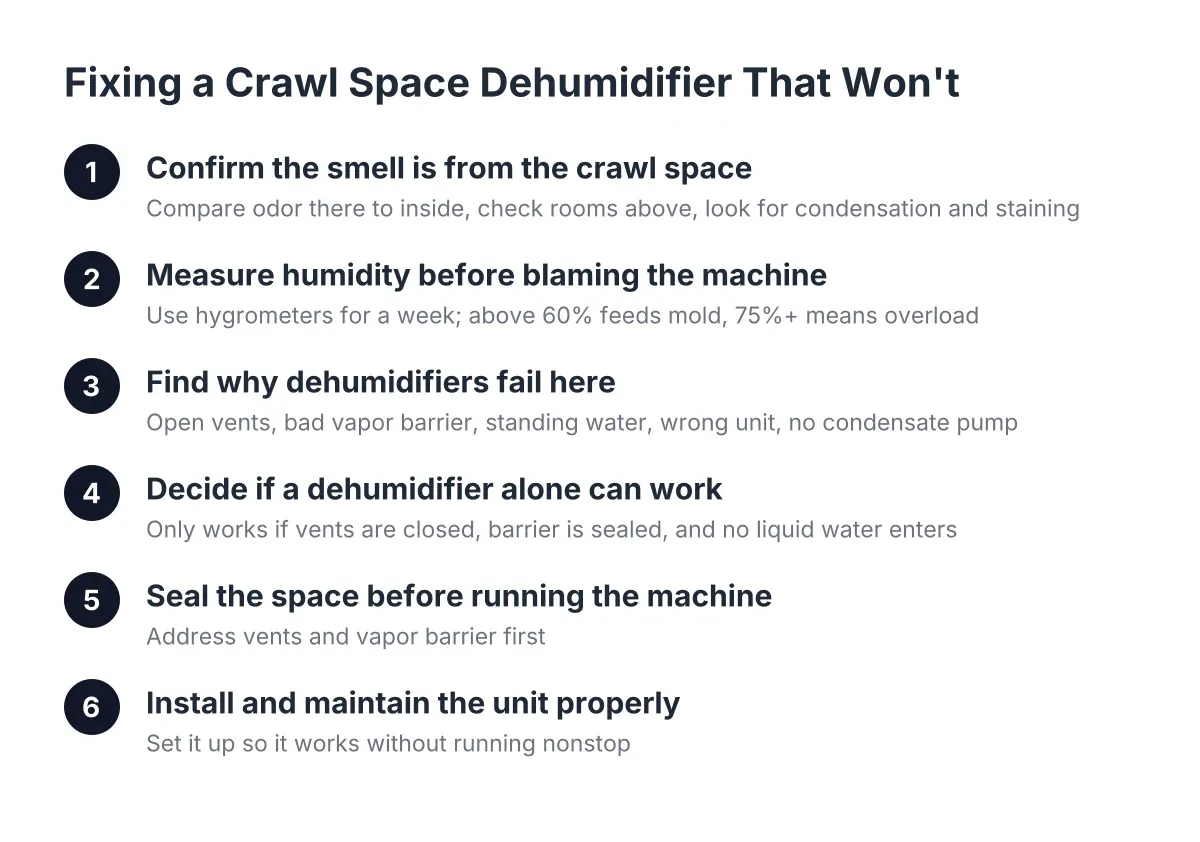
Step 1: Confirm the Musty Smell Is Actually Coming From the Crawl Space
Before you spend a dollar, prove the source. Pick a humid afternoon after rain, when the smell is strongest. Open the crawl space access door and compare what you smell there to what you smell inside the house. A damp, earthy, old-gym-bag odor in both places points to the crawl space.
Next, check the floors above it. Air in a pier-and-beam home moves upward; the crawl space pushes air into your living space through gaps around pipes, ducts, and floorboards. If the smell is strongest in rooms directly over the crawl space, and weaker upstairs, you have your answer.
In addition, look for the physical signs while you are down there:
- Condensation or water droplets on ductwork, pipes, or the underside of the subfloor
- White fuzzy growth or dark staining on floor joists and beams
- Damp or mud-slick dirt, or plastic sheeting with water pooled on top
- Rusted nails, ductwork straps, or HVAC equipment
- Insulation sagging or falling out from between the joists
Two or more of these means the crawl space is your source, not the carpet, the HVAC, or the dog.
Step 2: Measure the Humidity Before You Blame the Machine
Buy two inexpensive hygrometers, about $10 to $20 each as a rough estimate, and place one in the crawl space and one in the living space. Check them for a week. Crawl space readings above 60% relative humidity feed mold growth and that musty smell. Readings pinned at 75% or higher, day after day, tell you the moisture load is bigger than air drying alone can handle.
Also note the pattern. If humidity spikes after every rain or every king tide, water is entering the space, not just humid air. Charleston set a record of 17 high-tide flood days during the 2023 to 2024 meteorological year, according to NOAA Tides and Currents. On a downtown peninsula lot or on Sullivan's Island, that tidal push shows up under your house before it shows up in the street.
Step 3: Find the Reasons Crawl Space Dehumidifiers Fail Here
Why Does a Dehumidifier Run Constantly in Coastal Humidity?
Crawl space dehumidifiers fail in Charleston mainly because they fight an open system. Vented crawl spaces pull in humid outdoor air year-round, bare or poorly sealed dirt wicks ground moisture upward, and high water tables push liquid water in during tides and storms. The unit dries air that is replaced faster than it can be processed, so it runs constantly and still loses.
Walk your crawl space and check each failure point:
- Open foundation vents. Old Charleston homes were built with vented crawl spaces on purpose. In our climate, those vents pull in outdoor air that often carries more moisture than the air inside. Your dehumidifier is drying the whole Lowcountry, one vent at a time.
- No vapor barrier, or a bad one. Loose plastic thrown over the dirt is not a vapor barrier. Ground moisture rises around every gap and seam. A dehumidifier running over bare dirt never catches up.
- Standing or entering water. No moisture absorber machine removes liquid water. If water seeps in through the foundation or rises from below, you need drainage, a sump pump, or waterproofing first.
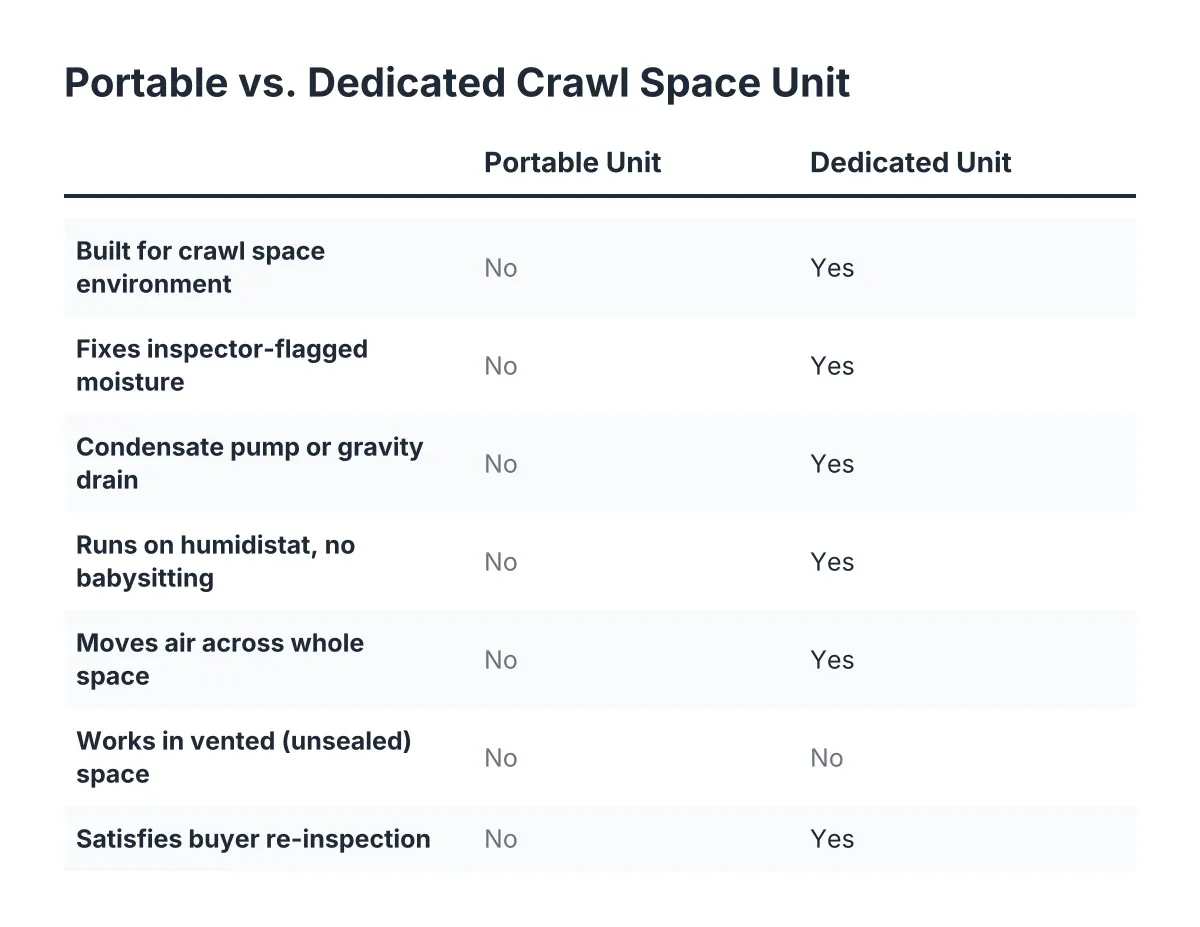
- The wrong unit. A residential dehumidifier from a big-box store is built for a bedroom, not a dirty, humid, 60-inch-tall space. Crawl space conditions chew these units up. A commercial-grade unit built for crawl spaces lasts longer, though reliability still varies by model.
- No condensate pump. The crawl space is usually the lowest point of the house, so gravity drainage rarely works. Without a condensate pump, the collection bucket fills, the unit shuts off, and nobody notices for months.
If you checked boxes 1 through 3, the dehumidifier was never going to win. That is a moisture control problem, not an equipment problem.
Step 4: Decide Whether a Dehumidifier Alone Can Do the Job
Here is the decision rule, stated plainly. A dehumidifier alone can work when the crawl space is reasonably sealed and dry underfoot: vents closed, a sealed ground vapor barrier in place, and no liquid water entering. In that setup, the unit handles residual water vapor and holds humidity where you set it. That is what it was designed for.
However, a dehumidifier alone will fail, and keep failing, when any of these is true:
- Foundation vents are open to outdoor air
- The ground is bare dirt or covered with loose, unsealed plastic
- Water enters after rain, tides, or irrigation
- Humidity stays above 70% even with the unit running nonstop
Suppose a homeowner in a 1920s pier-and-beam house near Hampton Park has been running a portable unit under the house for a year, and the dehumidifier runs constantly with the bucket filling every two days. The unit has already been replaced once, and the musty smell still drifts up through the heart-pine floors every August. In that scenario, the homeowner is not buying the wrong dehumidifiers; the homeowner is asking a fan-and-coil appliance to solve a drainage and air-sealing problem. The honest answer is that the money spent replacing units would have gone further on sealing the space first.
To be fair, the reverse is also true. If your crawl space is already tight and dry, and humidity hovers at 62% in summer, you do not need a $10,000 encapsulation job. A properly sized, commercial-grade dehumidifier with a condensate pump may be all it takes. Anyone who quotes you full encapsulation without measuring humidity or checking for water entry has skipped the diagnosis.
Step 5: Seal the Space Before You Run the Machine
If Step 4 showed an open or wet crawl space, fix the system before trusting the equipment. The order matters:
- Handle liquid water first. Grade the crawl space dirt to slope toward a drain, and intercept entering water with a perimeter drain that channels it to a sump pump, an approach described by the Building America Solution Center (PNNL/DOE). In flood-prone Charleston lots, a sump pump also acts as an emergency backstop, since a sealed crawl space can otherwise trap water like a pool.
- Install a real vapor barrier. Crawl space encapsulation runs heavy plastic sheeting across the entire floor and seals it to the stem walls and around support piers, according to the U.S. Department of Energy. Sealed seams are the difference between a vapor barrier and a tarp. Check local code first; some states require an uncovered termite inspection strip near the top of the foundation wall, per Stego Industries.
- Seal the vents and air leaks. Closing off outdoor air is what finally lets a dehumidifier get ahead of the moisture load.
- Then add the dehumidifier. In a sealed crawl space, the unit controls residual water vapor and holds a precise humidity level, instead of gambling on passive airflow through vents.
One trade-off worth knowing: in a historic home with original heart pine, it is possible to over-dry the space. Set the unit around 50 to 55% relative humidity rather than running it as low as it will go. If your home is pre-1950s with signs of wood rot or sagging floors, bring in a crawl space specialist or structural engineer before sealing anything; moisture may have already compromised beams that need structural support or repair first.
Step 6: Install and Maintain the Unit So It Works Without Constantly Running
Even in a sealed space, crawl space dehumidifiers fail early when they are installed carelessly and then forgotten. Set yours up to survive:
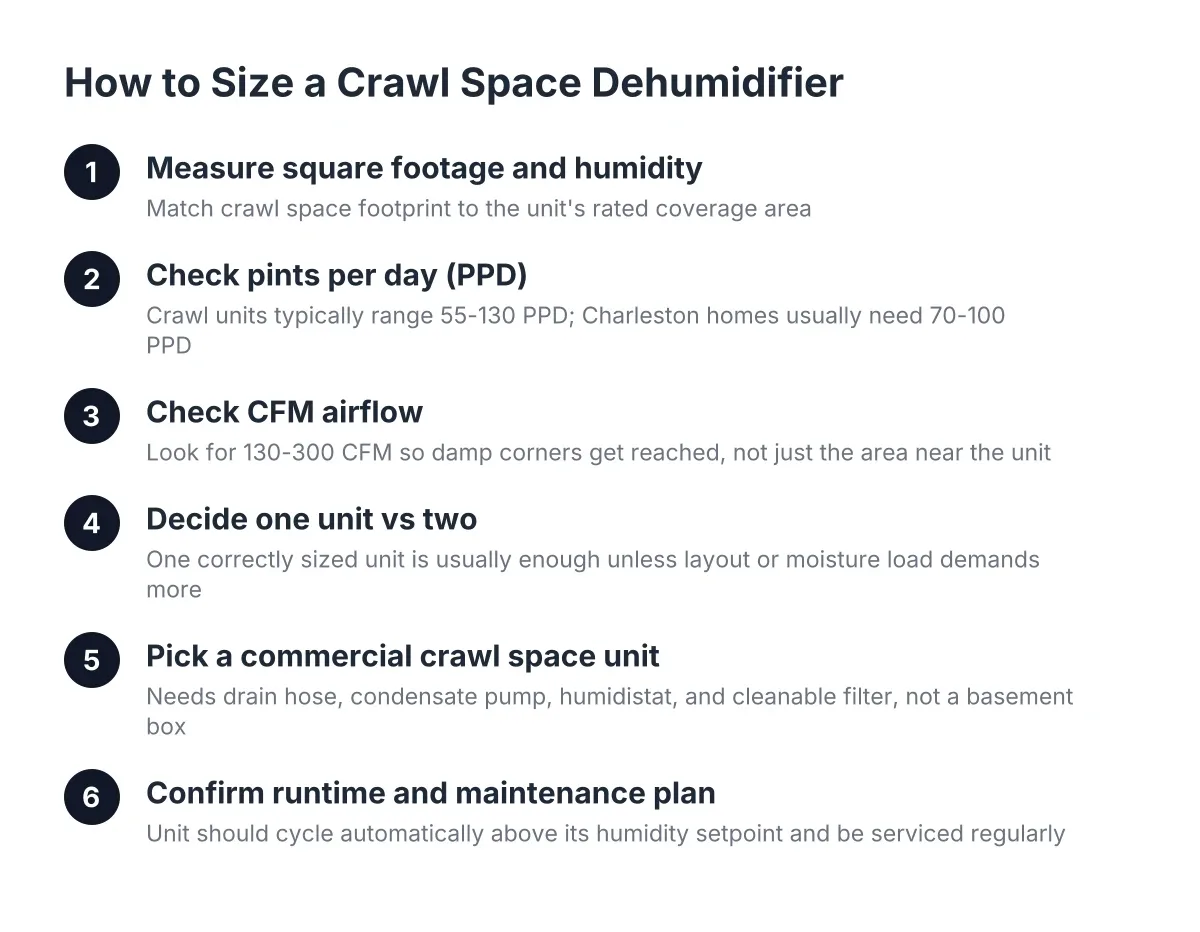
- Choose a commercial-grade unit rated for crawl space conditions, not a residential model
- Pair it with a condensate pump that lifts water out of the space, since the crawl space sits below everything that could drain it
- Elevate the unit off the ground on blocks or hang it from the joists
- Register the manufacturer warranty the day it is installed; these units break down more than homeowners expect
- Clean or replace the filter on schedule, and check the drain line for clogs twice a year
- Recheck your hygrometer monthly; rising humidity with a running unit means something changed
When a unit runs constantly without lowering humidity, it is your early warning. Either water is getting in again, a seal has failed, or the unit itself is dying. Investigate within the week, not the season.
The Straight Answer for the Skeptic
You were right to be suspicious of a one-size-fits-all pitch. A dehumidifier is not a scam, and encapsulation is not always necessary. The question is whether your crawl space is an open system or a closed one. Open systems defeat the machine; closed systems let it do its job. Measure the humidity, find the water, and seal before you dry. Do that in order, and the musty smell your guests keep noticing finally goes away, because you fixed the moisture problem instead of masking it.
If you need crawl space encapsulation, Low Country Crawl Space Repair can help.
Prefer to talk it through? Call +18542013678 — a quick call is usually the fastest way to get a straight answer for your situation.