6 Mil vs 10 Mil Vapor Barrier: What Actually Holds Up in a Charleston Crawl Space
Walk down the plastic sheeting aisle at any big box store and you will see rolls of 6 mil vapor barrier priced to move. It looks like the obvious fix for a damp crawl space. However, in Charleston's coastal humidity, that thin plastic is where most failed crawl space jobs start. This guide walks you through how to evaluate vapor barrier thickness step by step, so you can tell whether a 6 mil sheet, a 10 mil liner, or something heavier is the right call under your home, and whether the barrier already down there is doing anything at all.
If your floors feel bouncy or a hallway has developed a soft spot, the vapor barrier question matters more than you might think. Moisture rising off bare soil is what rots floor joists and beams in the first place. The right barrier, sealed the right way, is the first line of defense for the wood structure holding up your floors.
Step 1: Understand What Mil Rating Actually Means
A mil is one thousandth of an inch. A 6 mil vapor barrier is 0.006 inches thick, about the thickness of a heavy trash bag. A 10 mil liner is 0.010 inches. A 12 or 20 mil reinforced liner is thicker still, and usually built with a woven or scrim layer inside.
Here is the catch: mil rating alone does not tell you quality. Two things matter more than the number on the roll.
- What the mil rating measures. A true rating reflects the actual liner material. Some products count a reinforcement scrim layer in the measurement, which inflates the number without adding real plastic.
- How the sheet is built. A higher mil rating does not automatically mean a stronger product. Some high-mil barriers are several thin layers glued together rather than one solid sheet, and glued layers can separate over time.
Therefore, when you compare products or contractor quotes, ask what the mil rating measures and whether the liner is a single extruded sheet, a laminated stack, or a woven material. Woven barriers without a scrim layer resist wear well in high-traffic spots, like the path a technician crawls to reach your HVAC unit or dehumidifier filter.
Step 2: Know Why 6 Mil Vapor Barrier Fails in Charleston Crawl Spaces
Why does 6 mil plastic fail under Charleston homes? Standard 6 mil vapor barrier fails because it punctures easily on the shell, brick rubble, and debris common under pre-1950s pier-and-beam homes, and because it tears when anyone crawls on it. Once holed, it stops blocking soil moisture, and Charleston's ground stays wet nearly year round.
Puncture resistance matters more than stretch or tensile strength for a crawl space liner. Nobody is pulling on the plastic; people are kneeling on it over sharp debris. A plumber crawling to a leak, an HVAC tech servicing ductwork, or an inspector checking your joists will all put knees and boots on that sheet.
Charleston adds its own pressure. The peninsula and the barrier islands sit on a high water table, and NOAA Tides and Currents recorded 17 high-tide flood days in Charleston during the 2023-24 meteorological year. Wet soil pushes moisture upward constantly. A thin sheet with a few punctures lets that vapor straight into your floor framing, which is exactly how joists soften and floors start to sag.
You are not alone in dealing with this. More than 60% of U.S. homes have had water or moisture problems in their basement or crawl space, according to the American Society of Home Inspectors.
Step 3: Inspect the Barrier You Have Now
Before you buy anything, get eyes on what is already down there, or have someone do it for you. Look for these signs that your current barrier is torn, damaged, or inadequate:
- Bare soil visible between sheets, or sheets covering less than the full floor
- Rips, punctures, or worn-through paths where trades have crawled
- Water pooled on top of the plastic, which points to a drainage problem the barrier cannot fix
- Condensation on the underside of the subfloor or on ductwork above the plastic
- A musty smell in the crawl space or drifting up into the living space
- White fuzz or dark staining on joists and beams, which suggests mold and active moisture
Note the seams too. Loose sheets laid edge to edge with no vapor barrier tape do little in a vented crawl space, because humid outside air moves freely over and under them. In addition, check whether the plastic runs up the foundation piers and stem walls or just lies flat on the dirt. Flat and loose is a ground cover; sealed to the walls is the start of real moisture control.
One caution for older homes: if you see sagging joists, a cracked sill beam, or floors that bounce when you walk, do not treat this as a plastic problem. That calls for a professional inspection, and possibly structural support like crawl space jacks or beam repair, before any liner goes down.
Step 4: Compare 6 Mil and 10 Mil Vapor Barrier Options Honestly
Is 10 mil worth the extra cost over 6 mil? For a Charleston crawl space, yes in almost every case, because the added puncture resistance is what keeps the barrier working past its first year. The material cost difference between 6 mil and 10 mil is small compared to the labor of installing either one, so paying a crew to install thin plastic is poor economics.
Here is how the options break down:
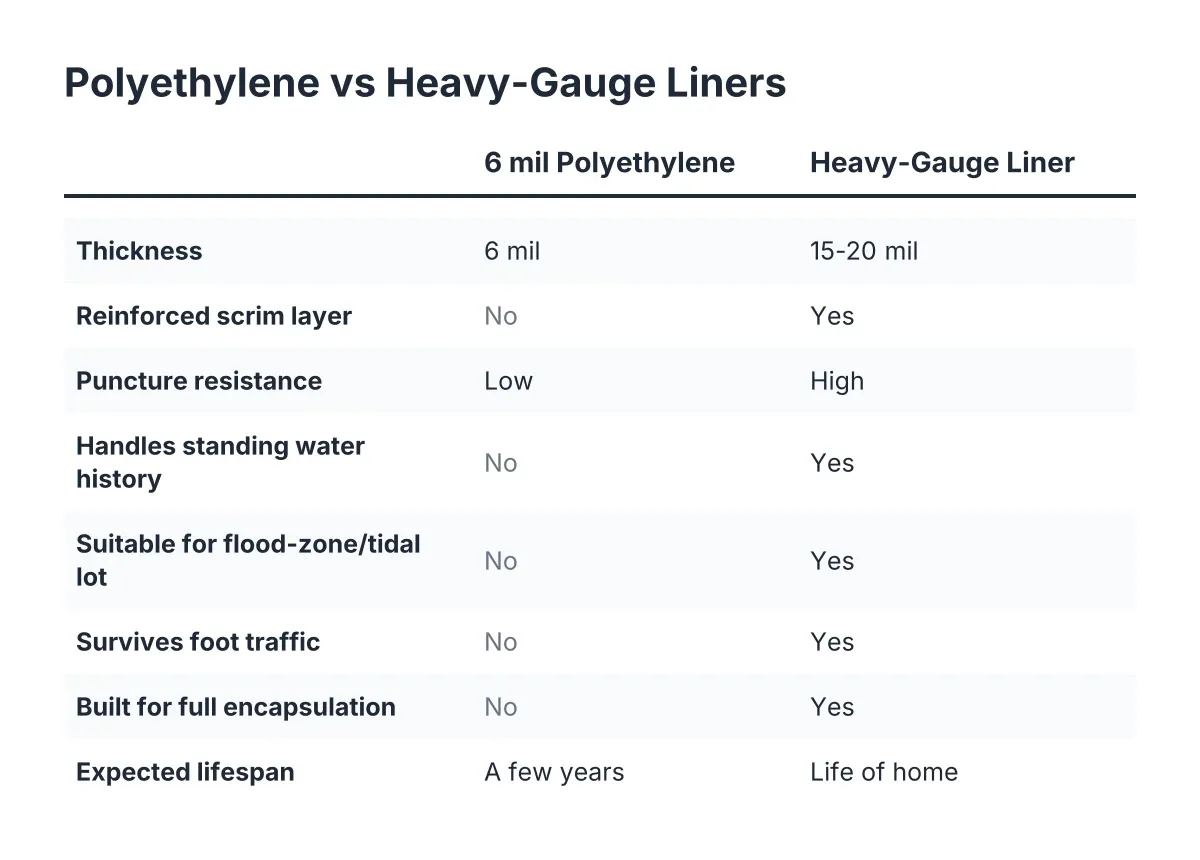
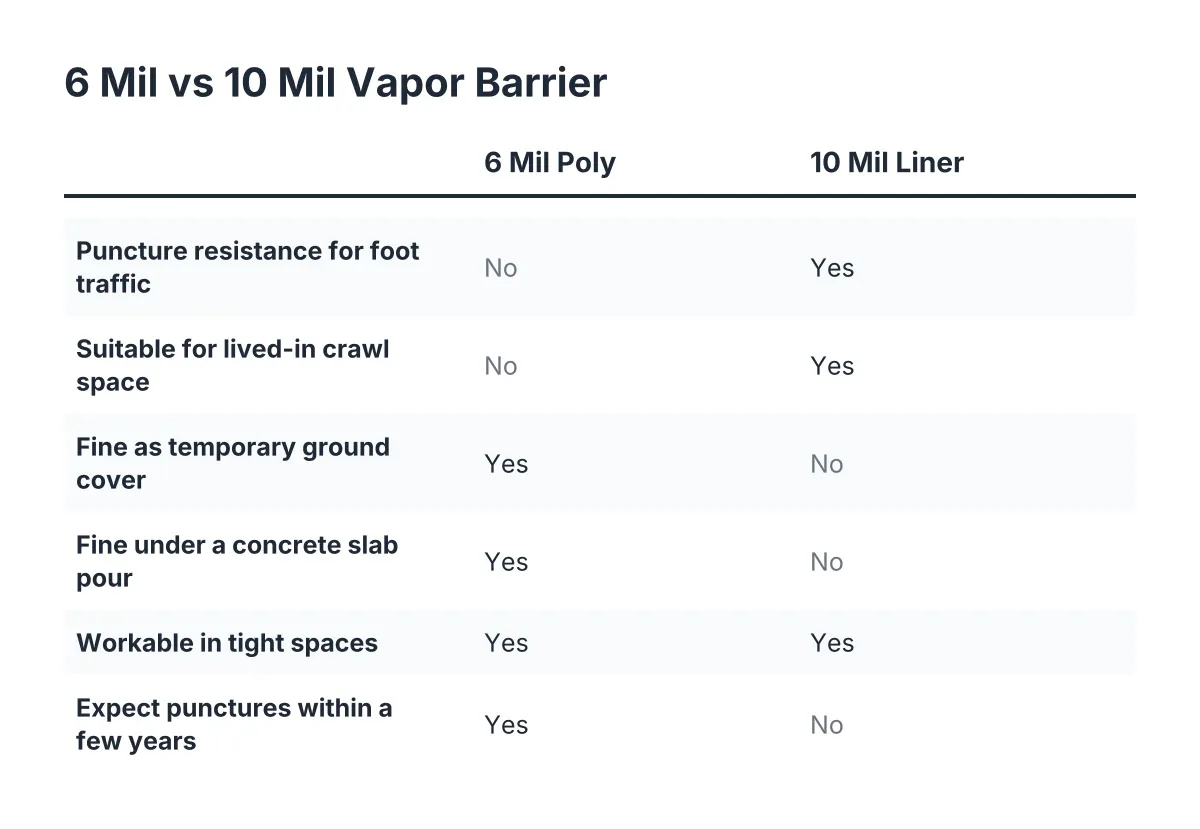
- 6 mil poly sheeting. Fine as a temporary ground cover, a dust layer during other repairs, or a moisture barrier under a concrete slab pour where it will never be walked on again. Under a lived-in Charleston home with trades crawling through, expect punctures within a few years.
- 10 mil liner. The realistic minimum for a crawl space that will see foot traffic. Better puncture resistance, still workable in tight spaces.
- 12 to 20 mil reinforced liner. The standard for full crawl space encapsulation. These handle repeated crawling near furnaces, sump pumps, and dehumidifiers without wearing through.
Placement matters as much as thickness. Wall liners are typically thinner and more pliable than floor liners, because you need a workable material to fit around piers and seal to masonry. In addition, a proper job often layers new material over an old barrier rather than tearing everything out, so the combined thickness under foot ends up far greater than any single sheet.
One more distinction worth knowing: a vapor barrier is not vapor barrier insulation. In a conditioned crawl space, insulation goes at the exterior stem walls and rim joists rather than between the floor joists, according to the Building America Solution Center. Foam board on foundation walls can even act as its own vapor barrier in some assemblies, so a good contractor will look at the whole system, not just the plastic.
Step 5: Decide Between a Vapor Barrier and Full Encapsulation
A standalone crawl space vapor barrier blocks moisture rising from the soil. Full encapsulation goes further: the liner covers the entire floor and seals to the stem walls and around support piers, according to the U.S. Department of Energy, and the space is closed off from outside air and dried with a dehumidifier.
For a vented crawl space, the trade-off is real. A ground barrier alone blocks soil moisture, which helps. However, Charleston's humid air still flows through the vents and condenses on cool wood and ductwork all summer. That is why many homeowners with a decent ground cover still smell mustiness and still find damp joists.
Suppose you own a 1920s pier-and-beam single on the peninsula with original heart pine floors and a soft spot near the back hall. In that scenario, a typical scope might include mold remediation on the affected joists, sistering or jacking the weakened framing, then a sealed 12 mil liner, sealed vents, and a dehumidifier. For historic Charleston homes with structural work involved, that kind of comprehensive project commonly lands in the five-figure range as a rough illustrative estimate, while a straightforward liner replacement in a sound crawl space costs a fraction of that. An honest inspection tells you which situation you have before anyone quotes a number.
Sites with standing water need drainage first. Encapsulated floors are often built up with gravel beneath the liner and perimeter drainage piping, according to the Building America Solution Center, and low-lying Charleston lots frequently need a sump pump as well. No thickness of plastic fixes water that pools on top of it.
Step 6: Get the Installation Details Right, or Hire Someone Who Will
Material choice fails without proper installation. Whether you go DIY with a ground cover or hire a pro for encapsulation, these details separate a real vapor barrier from a plastic sheet fix:
- Clean the floor first. Remove construction debris, sharp shell, and old lumber that would puncture the liner.
- Pre-cut sections outside. Measure and cut panels in the yard or driveway. Wrestling a full roll in a 24-inch crawl space is how liners get torn on day one.
- Overlap and tape every seam. Floor liner should overlap wall liner by at least 6 inches for a secure seal, according to Stego Industries, and seams need vapor barrier tape rated for the material, not duct tape.
- Seal to piers and stem walls. Loose edges let soil moisture escape around the barrier.
- Leave a termite inspection strip. Some codes require a gap near the top of the foundation wall so inspectors can spot termite tubes, according to Stego Industries. Check local requirements before sealing to the top of the wall.
A homeowner can lay a ground-cover barrier in an accessible, dry crawl space. Call a professional when you see mold on framing, standing water, sagging or bouncy floors, rotted joists, or a crawl space too tight to work in safely. Those conditions point to moisture control, waterproofing, or foundation repair problems that plastic alone will not solve.
Step 7: Vet the Quote Before You Sign
When you gather estimates in 2026, three questions cut through the sales talk fast:
- What mil rating and construction is the liner, and does the rating include the scrim? You want the true thickness of the actual material.
- How will seams, piers, and walls be sealed? Taped overlapped seams and mechanical attachment to the stem walls are the marks of a job built to last.
- What happens with drainage and humidity? A fair quote for a damp Charleston crawl space addresses water and air, not just plastic. If your crawl space floods or stays humid, expect line items for drainage, a sump pump, or a dehumidifier, with reasoning behind each.
A fair quote also starts with an inspection that shows you photos of your own crawl space, names the moisture source, and separates the must-fix structural issues from the nice-to-have upgrades. If your floors already move underfoot, that separation is the answer you are paying for; it tells you whether you are facing a liner replacement or beam repair.
If you are in Charleston or the surrounding communities and want a straight answer about the barrier under your home, Low Country Crawl Space Repair inspects crawl spaces, explains what the moisture is doing to your structure in plain language, and quotes the fix that matches the problem. Reach out to schedule an inspection and get an estimate before a soft floor becomes a structural one.
If you need crawl space encapsulation, Low Country Crawl Space Repair can help.
Prefer to talk it through? Call +18542013678 — a quick call is usually the fastest way to get a straight answer for your situation.