How Tidal Flooding and High Water Tables Quietly Break Crawl Spaces in Charleston
If you own an older home on the Charleston peninsula, Sullivan's Island, or Isle of Palms, you already live with tidal flooding and high water. You plan errands around king tides. You know which streets go under after a hard rain. What most homeowners do not realize is that the same water sitting in the street is also working on the wood under their house. It does not need to touch the floor joists to hurt them. It just needs to keep the crawl space damp, month after month, until soft floors, wood rot, and that musty smell you cannot get rid of show up upstairs. Understanding how tidal flooding affects your crawl space is the first step toward protecting your home's structure. Tidal flooding in a crawl space poses one of the most overlooked threats to homes in our region.
This guide explains how tidal flooding and a high water table damage the structure under a Charleston home, how to tell a minor moisture problem from a genuine structural emergency, and what repair actually involves. The goal is simple: help you figure out where you stand before anyone tries to sell you anything.
Why Charleston Crawl Spaces Take the Hit From Tidal Flooding and High Water
Charleston sits low, and the water table sits high. NOAA Tides and Currents recorded 17 high-tide flood days in Charleston during the 2023 to 24 meteorological year, a record for the city. Those are days when water rises into streets and yards without a drop of rain falling. On a low peninsula lot, that water does not stay in the street. It pushes up through the soil, and the soil under your house is the floor of your crawl space.
Older Charleston homes were built for this in one sense. Pier-and-beam foundations raise the living space above grade, and vented crawl spaces were the standard approach for generations. The trouble is that the vents designed to dry the space out now do the opposite. In our coastal humidity, vented crawl spaces pull in warm, wet air most of the year. That air condenses on cool framing and ductwork. Add a water table that rises with the tides, and the ground under the house stays damp even in a dry week.
You are not imagining a widespread problem, either. More than 60 percent of U.S. homes have had water or moisture problems in their basement or crawl space, according to the American Society of Home Inspectors. In a city where tidal flooding and high water tables are part of daily life, the odds run higher still. About 15 percent of American homes sit on a crawl space foundation, according to JSE Labs, but on the peninsula and the barrier islands, the raised crawl space is the norm rather than the exception.
The Cascade: How Moisture Under the House Becomes a Structural Problem
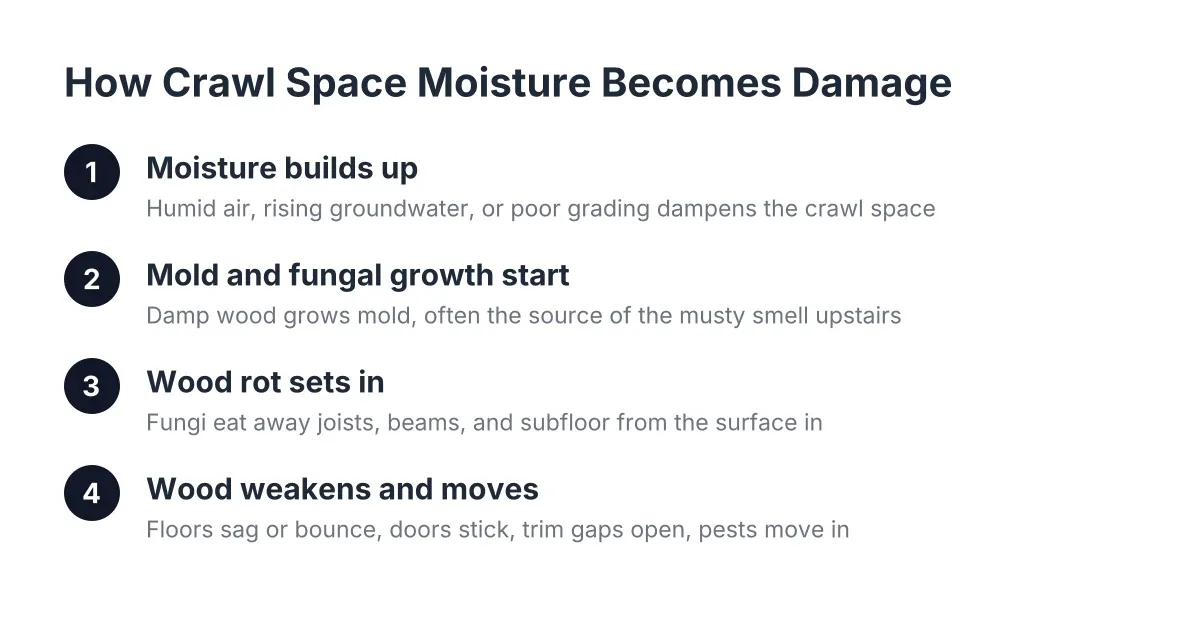
Crawl space damage follows a predictable order. It rarely starts with a beam failing. It starts with humidity.
First, moisture builds up. That can be humid air coming through vents, groundwater rising with the tide, or rain running toward the foundation from failed gutters and bad grading. Next, mold and fungal growth start on damp wood. This is where the musty smell begins, and it is often the first sign a homeowner notices upstairs. Then comes wood rot. Fungi that feed on wet wood slowly eat the joists, beams, and subfloor from the surface in. Finally, the weakened wood starts to move. Floors sag, bounce, or slope. Doors stick. Trim gaps open up. At that point, moisture has become a structural problem, and damp, decayed wood also attracts pests that make things worse.
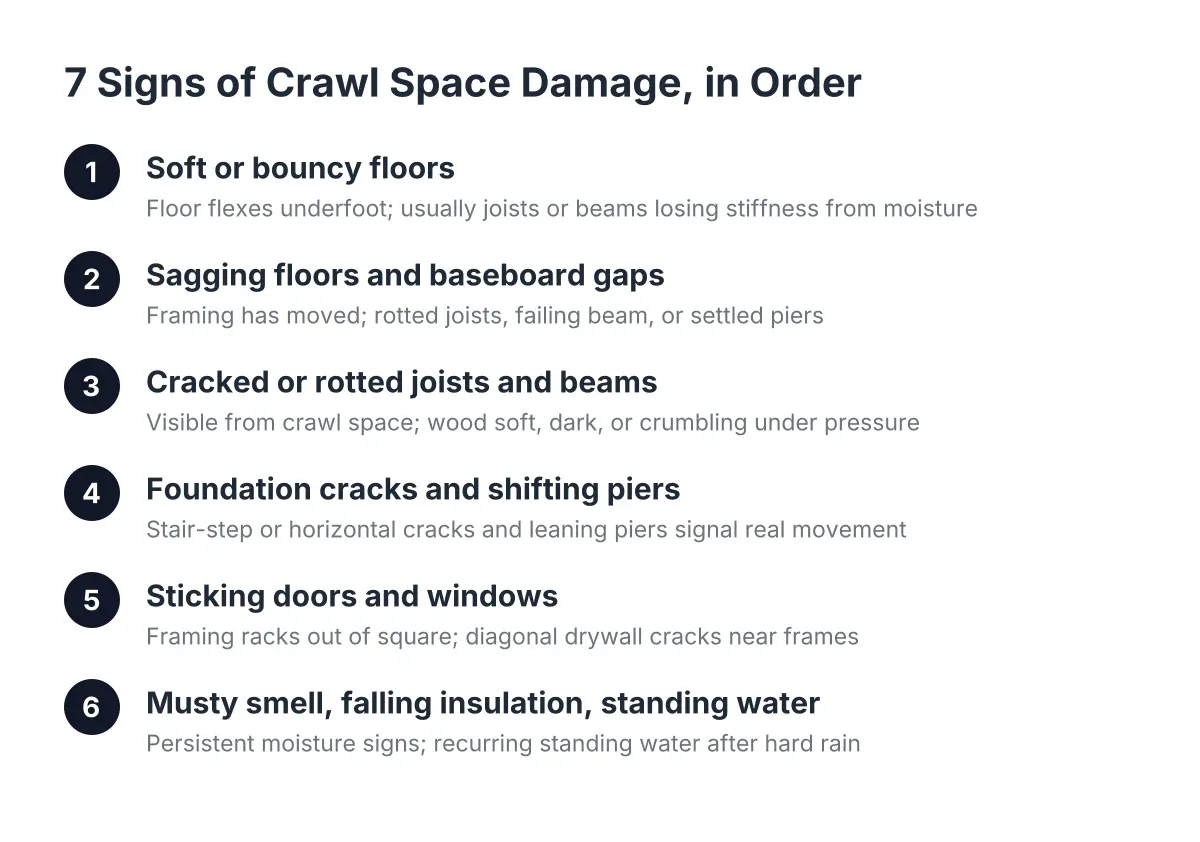
The important point for a skeptical homeowner is this: the smell and the sag are the same problem at different stages. If your house has smelled musty for years and now a floor feels soft near an exterior wall, you are probably not dealing with two separate issues. You are watching one issue mature.
Why the Musty Smell Upstairs Points Below
A persistent musty smell that worsens after rain or in humid weather is a strong clue the source is under the house. In most raised homes, a large share of the air you breathe upstairs rises from the crawl space through gaps in the subfloor, plumbing penetrations, and ductwork. If mold is growing on damp joists below, the smell rides that air into your living room. Candles and air fresheners mask it for an evening. They cannot fix it, because the source keeps producing.
Suppose a homeowner downtown has burned candles and sprayed the house for a year, and guests still mention the smell. In that scenario, the honest next step is not another air freshener. It is a flashlight, or an inspection, under the house. If the framing down there is damp, stained, or fuzzy with growth, the mystery is solved.
How Tidal Flooding and Water Damage Leave Evidence in Your Crawl Space
Water writes its history on a crawl space. You can learn a lot in twenty minutes with a flashlight, or by asking pointed questions of anyone who inspects it for you.
Look for these signs:
- A waterline or stain line on piers, soil, or vapor barrier. A visible stain line marks the historical high-water point, showing how high water has actually risen under the house.
- Standing water or saturated soil, especially near the perimeter or in low spots in the middle of the crawl space.
- Efflorescence, the white, chalky mineral residue on brick piers or masonry walls, left behind when water wicks up and evaporates.
- Dark staining, soft spots, or fungal growth on joists and beams. Probe suspect wood with a screwdriver; sound wood resists, rotted wood gives.
- Rusted ductwork, fasteners, or support hardware, which signals long-term high humidity even without standing water.
- Sagging insulation hanging from the subfloor, usually because it soaked up moisture and pulled loose.
However, read the evidence carefully. A high, uniform waterline well above the soil does not automatically mean the crawl space floods every season; that pattern is uncommon in true recurring flooding and can reflect a single past event. The stronger indicator of a chronic problem is a combination: a waterline plus failed gutters, bad downspouts, and soil around the home that stays saturated. When those show up together, you are dealing with a genuine ongoing water problem, not a one-time incident. Recognizing how tidal flooding persistently affects your crawl space over time helps you distinguish between isolated incidents and serious structural threats.
Direction matters too. Measuring where water sits highest and lowest along the foundation walls shows which way water travels under the house, and that shapes any drainage fix. A good inspection maps this rather than guessing.
Minor Moisture Fix or Structural Emergency? A Straight Escalation Guide
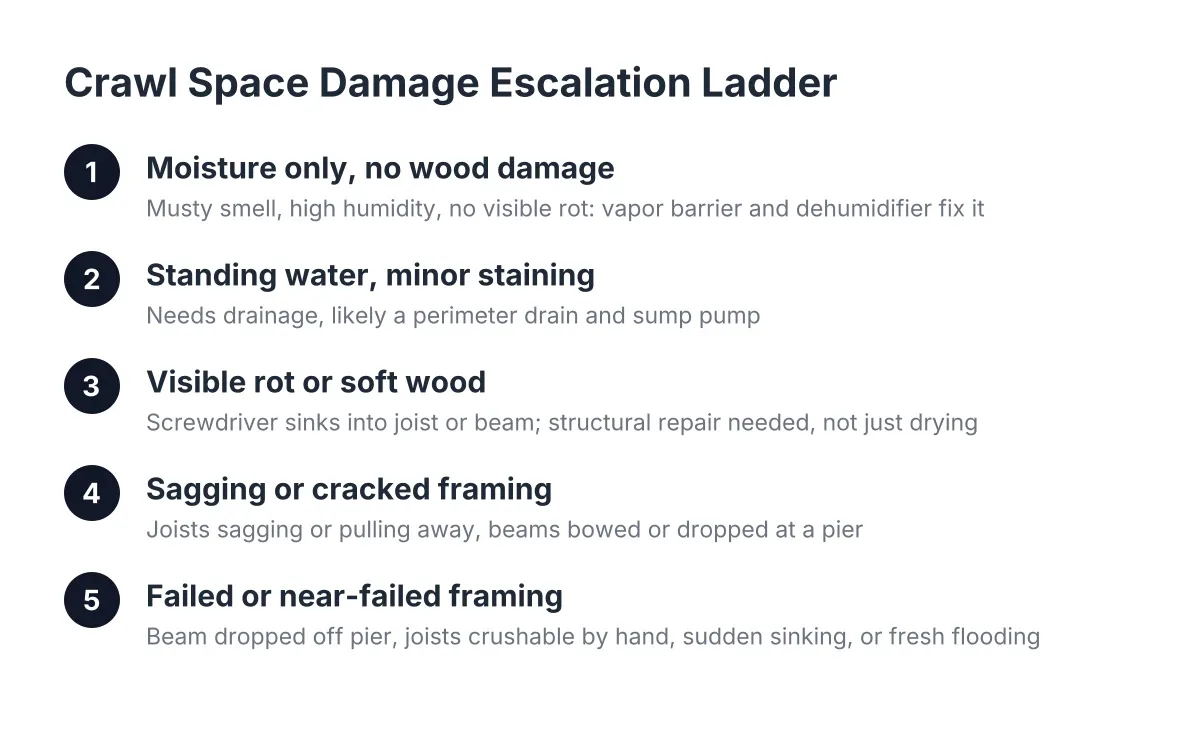
Here is the question behind the fear of a runaway bill: how do you know whether you need a dehumidifier or a crew with support jacks? The honest answer is that most crawl space problems in Charleston fall into a middle tier, and the extremes are easier to identify than people think.
Use this three-tier guide.
Tier 1: Moisture Control, Not Structural Work
If the wood under your house is damp or lightly stained but still firm when probed, and floors upstairs feel normal, you are at the moisture stage. The fix is moisture control: a proper vapor barrier sealed across the ground, a crawl space dehumidifier sized for the space, and correcting obvious water sources like downspouts dumping at the foundation. Mold removal may be needed on affected framing, but the structure itself does not need repair.
This is the stage where a skeptic's instinct is partly right. A dehumidifier alone in a vented, unsealed crawl space fights a losing battle against unlimited outdoor humidity. But moisture control done as a system, with sealing and dehumidification together, is the correct scope here. Nobody at this stage needs beams replaced.
Tier 2: Localized Structural Repair
If a screwdriver sinks into a joist, or one section of floor has gone soft or bouncy near a bathroom or exterior wall, you have crossed into repair territory, but a contained version of it. Typical work includes sistering new lumber alongside weakened joists, replacing short runs of rotted beam, and adding steel support jacks on proper footings to carry load while damaged wood is corrected.
This is the most common form of crawl space structural repair in older Charleston homes, and it is far less dramatic than the phrase suggests. A localized repair addresses the damaged members and the moisture source that caused them. It does not mean rebuilding the foundation. The critical rule: structural repair without moisture control is temporary. New wood in a wet crawl space rots on the same schedule the old wood did. Keeping moisture controlled after repair can extend the life of the new framing by decades.
Tier 3: Genuine Emergency
True emergencies are rare, and they announce themselves. Warning signs include a floor that has visibly dropped or slopes sharply, a beam that has cracked or pulled off a pier, piers that are leaning or crumbling, or new cracks opening in interior walls above the crawl space. If you see these, keep weight off the affected area and get a structural assessment quickly. For historic peninsula homes, it is often worth involving a structural engineer alongside a crawl space specialist, since original framing and masonry may need preservation-minded handling.
The reassurance in this tiering is real. Sagging floors caused by moisture almost always develop over years, not days. If your floor feels slightly bouncy but nothing has moved suddenly, you have time to inspect, plan, and get more than one opinion. You do not have time to keep ignoring it, because Tier 2 problems only travel in one direction.
What Repair and Water Management Actually Involve on a Tidal Lot
On a lot where tidal flooding and high water push groundwater up from below, fixing the wood is only half the job. The other half is managing the water that will keep coming. A high water table cannot be handled by a vapor barrier alone; it needs drainage, typically a perimeter drain feeding a sump pump.
A complete approach on a flood-prone Charleston lot generally works in this order:
- Structural repair first. Rotted joists are sistered or replaced, damaged beam sections are repaired, and support jacks on proper footings restore level, stable floors.
- Grading and drainage. The crawl space floor is graded to slope slightly toward the drain, which, according to Building America Solution Center (PNNL/DOE), helps water flow into a perimeter drain and sump pump instead of pooling in the middle. The perimeter drain intercepts water entering under the foundation and channels it to the pump.
- Encapsulation. Heavy plastic sheeting runs across the entire floor and seals to the stem walls and around support piers, per the U.S. Department of Energy's description of proper encapsulation. This is different from plastic laid loosely on the dirt. One practical note: some codes require leaving a termite inspection strip uncovered near the top of the foundation wall, according to Stego Industries, so local requirements should be checked.
- Dehumidification. With outside air sealed out and groundwater managed, a dehumidifier can actually hold the space dry year-round, including through hurricane-season humidity swings.
In an encapsulated crawl space, the sump pump serves as the safety valve. Building America Solution Center (PNNL/DOE) notes that a sealed crawl space can trap water like a pool if a pipe bursts or floodwater enters, so a pump at the low point ejects it automatically. On a tidal lot, that is not optional equipment; it is the piece that makes the rest of the system survivable during a king tide or tropical storm.
One honest caveat: sealed systems need occasional attention. Persistent water pressure at a wall seam can gradually loosen even strong seam tape on a vapor barrier, so a periodic inspection of a system on a flood-prone lot is reasonable maintenance, not a sign the work failed.
What This Costs, and Why the Range Is Wide
For 2026 planning purposes, think in tiers that match the escalation guide above. These are illustrative estimates, not quotes, and every house differs.
Moisture control alone, meaning vapor barrier, sealing, and a dehumidifier, commonly runs in the low-to-mid four figures for a typical crawl space. Localized structural work, such as a few support jacks and sistered joists, often lands in the mid four figures to low five figures. A full package on a historic peninsula home, combining beam repair, drainage, sump pump, encapsulation, and dehumidification, can reach the $10,000 to $20,000 range, given older framing, masonry piers, and preservation constraints.
Two things keep that range honest. First, masonry matters separately from wood. If piers or stem walls show cracking, foundation crack repair cost gets scoped on its own, since a hairline crack in a brick pier and a failing pier are different problems with different price tags. Second, scope should match the tier. A Tier 1 house does not need Tier 3 work, and a legitimate inspection will say so plainly.
Watch for these signs an assessment is trustworthy:
- The inspector shows you photos or brings you under the house to see the evidence yourself.
- Findings map to specific locations, not vague claims about the whole crawl space.
- The proposal separates moisture control from structural work, so you can see what each part costs and why.
- Nobody pressures you to sign the same day for a problem that took years to develop.
Where to Start if Your House Smells Musty and a Floor Feels Soft
Start with the source, not the symptom. If the smell worsens after rain or humid spells, and any floor feels bouncy or soft, get eyes on the crawl space. Look for a waterline, probe the wood, and check where your downspouts discharge. Then match what you find to the three tiers above.
For most Charleston homeowners, the answer will be moisture control, possibly with some localized wood repair. That is a solvable, budgetable project, not a runaway bill. For a smaller number, the water table and tidal exposure demand real drainage: perimeter drain, sump pump, and full encapsulation built to handle water that will keep coming. And for the rare true emergency, the signs are visible and unmistakable, and a structural engineer should be part of the conversation.
Either way, the musty smell is information. It is the earliest, cheapest warning the cascade offers. On a tidal lot in the Lowcountry, taking it seriously now is how you avoid meeting the later, more expensive stages of the same problem.
If you need crawl space encapsulation, Low Country Crawl Space Repair can help.
Prefer to talk it through? Call +18542013678 — a quick call is usually the fastest way to get a straight answer for your situation.